

APEX EKG Test UPDATED ACTUAL Questions and CORRECT
Answers
v
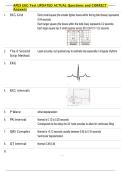
1. EKG Grid Each small square (the smaller lighter boxes within the big bold boxes) represents
0.04 seconds
Each larger square (the boxes within the bold lines) represents 0.2 seconds.
Each large square has 5 small squares across SO 0.04 X 5 = 0.2 seconds
2. The 6 Second Least accurate, but quickest way to estimate rate especially in irregular rhythms
Strip Method
3. EKG
4. EKG intervals
5. P Wave Atrial depolarization
6. PR Interval Normal is 0.12 to 0.20 seconds
Corresponds to the delay the AV node provides to allow for ventricular filling
7. QRS Complex Normal is <0.12 seconds usually between 0.06 to 0.10 seconds
Ventricular depolarization
8. QT Interval Normal 0.36-0.46
9.
, APEX EKG Test UPDATED ACTUAL Questions and CORRECT
Answers
v
6 Steps for Determine Regularity
Rhythm Interpre- Calculate the Rate
tation Evaluate the P wave
Measure the PRI
Evaluate the QRS Width
Evaluate the T wave and Calculate the QTI
10. Normal Sinus Regularity: atrial and ventricular rate are regular
Rhythm Rate: 60 to 100 beats per minute
P wave: upright, smooth, round and uniform shape, one for every QRS complex
PRI : 0.12 to 0.20 seconds
QRS: 0.06 to 0.10 seconds
QTI: 0.36 to 0.46 seconds
T wave: upright, smooth and round uniform shape
11. Sinus Bradycar- Regularity: atrial and ventricular rate are regular
dia Rate: < 60 beats per minute
P wave: upright, smooth, round and uniform shape, one for every QRS complex
PRI : 0.12 to 0.20 seconds
QRS: 0.06 to 0.10 seconds
QTI: 0.36 to 0.46 seconds
T wave: upright, smooth and round uniform shape
12. Sinus Tachycar- Regularity: atrial and ventricular rate are regular
dia Rate: >100 beats per minute
P wave: upright, smooth, round and uniform shape, one for every QRS complex
PRI : 0.12 to 0.20 seconds
QRS: 0.06 to 0.10 seconds
QTI: 0.36 to 0.46 seconds
T wave: upright, smooth and round uniform shape
Answers
v
1. EKG Grid Each small square (the smaller lighter boxes within the big bold boxes) represents
0.04 seconds
Each larger square (the boxes within the bold lines) represents 0.2 seconds.
Each large square has 5 small squares across SO 0.04 X 5 = 0.2 seconds
2. The 6 Second Least accurate, but quickest way to estimate rate especially in irregular rhythms
Strip Method
3. EKG
4. EKG intervals
5. P Wave Atrial depolarization
6. PR Interval Normal is 0.12 to 0.20 seconds
Corresponds to the delay the AV node provides to allow for ventricular filling
7. QRS Complex Normal is <0.12 seconds usually between 0.06 to 0.10 seconds
Ventricular depolarization
8. QT Interval Normal 0.36-0.46
9.
, APEX EKG Test UPDATED ACTUAL Questions and CORRECT
Answers
v
6 Steps for Determine Regularity
Rhythm Interpre- Calculate the Rate
tation Evaluate the P wave
Measure the PRI
Evaluate the QRS Width
Evaluate the T wave and Calculate the QTI
10. Normal Sinus Regularity: atrial and ventricular rate are regular
Rhythm Rate: 60 to 100 beats per minute
P wave: upright, smooth, round and uniform shape, one for every QRS complex
PRI : 0.12 to 0.20 seconds
QRS: 0.06 to 0.10 seconds
QTI: 0.36 to 0.46 seconds
T wave: upright, smooth and round uniform shape
11. Sinus Bradycar- Regularity: atrial and ventricular rate are regular
dia Rate: < 60 beats per minute
P wave: upright, smooth, round and uniform shape, one for every QRS complex
PRI : 0.12 to 0.20 seconds
QRS: 0.06 to 0.10 seconds
QTI: 0.36 to 0.46 seconds
T wave: upright, smooth and round uniform shape
12. Sinus Tachycar- Regularity: atrial and ventricular rate are regular
dia Rate: >100 beats per minute
P wave: upright, smooth, round and uniform shape, one for every QRS complex
PRI : 0.12 to 0.20 seconds
QRS: 0.06 to 0.10 seconds
QTI: 0.36 to 0.46 seconds
T wave: upright, smooth and round uniform shape


