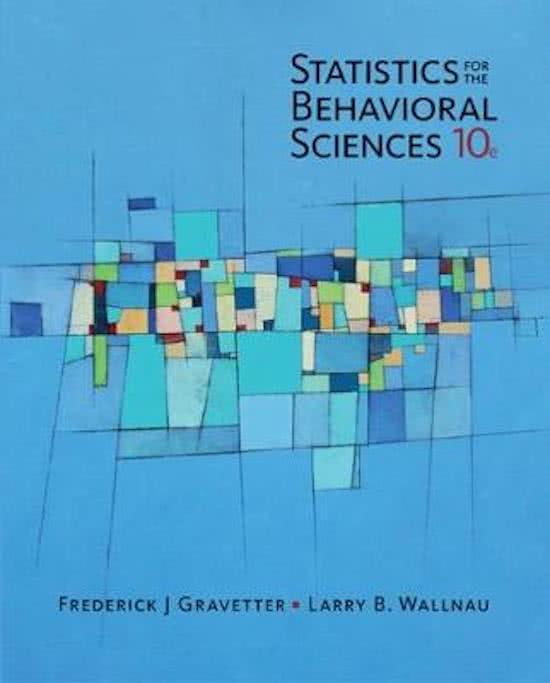
Test Bank For
Statistics for The Behavioral
Sciences, 10th Edition By
Frederick Gravetter, Larry
Wallnau
(All Chapters 1-18, 100%
Original Verified, A+ Grade)
All Chapters Arranged
Reverse: 18-1
This is The Original Test Bank
For 10th Edition, All other Files
in The Market are
Fake/Old/Wrong Edition.
,Name Clas Dat
: s: e:
chapter 18
Indicate whether the statement is true or false.
1. For a binomial test, if pn = 10 and qn = 90, then n = 100.
a. True
b. Fals
e
2. For a binomial test with p = 1/2 and n = 36, the z-score for X = 21 is z = +1.00.
a. True
b. Fals
e
3. In a binomial hypothesis test, the value for X must always be a whole number (not a fraction or decimal value).
a. True
b. Fals
e
4. Binomial data exist whenever a measurement procedure classifies individuals into exactly two distinct categories.
a. True
b. Fals
e
5. If other factors are held constant, both the mean and standard deviation for the binomial distribution will both increase
as the sample size increases.
a. True
b. Fals
e
6. For a binomial distribution with p = 1/4 and a mean of m = 12, the standard deviation is s = 9.
a. True
b. Fals
e
7. Assume there are two categories, A and B, and the symbol X stands for the number of individuals classified as
belonging to category A in a sample of size n. X can have any value from 0 to n and each value of X has a specific
probability. The distribution of probabilities for each value of X is called the binomial distribution.
a. True
b. Fals
e
8. In a sign test, dividing the zero differences evenly between the two groups will increase the likelihood of rejecting the
null hypothesis.
a. True
b. Fals
e
Copyright Cengage Learning. Powered by Cognero. Page 1
,Name Clas Dat
: s: e:
chapter 18
9. If p = 1/5, the binomial distribution for samples of n = 100 will have a standard deviation of σ = 4.
a. True
b. Fals
e
10. For a two-tailed binomial test with n = 100, a = .05, and a null hypothesis stating that p = 0.10, a score of X = 13
would be sufficient to reject the null hypothesis.
a. True
b. Fals
e
11. For a binomial test, if pn = 12 and qn = 36, then p = 0.25.
a. True
b. Fals
e
12. For binomial data that satisfy the criterion for using the normal approximation, you can either compute a z-score or a
2
value for chi-square. The relationship between the two statistics is z = χ .
a. True
b. Fals
e
13. The binomial test can be used as an alternative to the chi-square test for goodness of fit provided the observed
frequencies fit in exactly two categories.
a. True
b. Fals
e
14. The binomial distribution with p = .10 has a mean of m = 10. For this distribution, there are n = 100 scores in the
sample.
a. True
b. Fals
e
15. For a binomial distribution with p = 1/2 and n = 30, the value of X ranges from 1 to 30.
a. True
b. Fals
e
16. For a binomial distribution based on n = 100, the standard deviation would be larger for p = 0.90 than for p = 0.80.
a. True
b. Fals
e
17. The binomial test is only used when the data consist of classifying each individual into one of two categories.
a. True
Copyright Cengage Learning. Powered by Cognero. Page 2
, Name Clas Dat
: s: e:
chapter 18
b. Fals
e
18. In a binomial hypothesis test, the value for μ must always be a whole number (not a fraction or decimal value).
a. True
b. Fals
e
19. For the binomial test, p = q.
a. True
b. Fals
e
20. The null hypothesis for the sign test always states that p = q.
a. True
b. Fals
e
21. For a binomial test with p = 0.20 and n = 100, the z-score for X = 24 is z = 0.25.
a. True
b. Fals
e
22. If either pn or qn is greater than 10, the test statistic for the binomial test is a z-score and the critical values are
obtained from the unit normal table.
a. True
b. Fals
e
23. The normal approximation is appropriate for binomial data with n = 36 and p = 0.80.
a. True
b. Fals
e
24. Discarding the zero differences for a sign test increase the likelihood of rejecting the null hypothesis.
a. True
b. Fals
e
25. The sign test can be used as an alternative to the independent-measures t test.
a. True
b. Fals
e
26. For any binomial distribution, p + q = 1.00.
a. True
Copyright Cengage Learning. Powered by Cognero. Page 3
Statistics for The Behavioral
Sciences, 10th Edition By
Frederick Gravetter, Larry
Wallnau
(All Chapters 1-18, 100%
Original Verified, A+ Grade)
All Chapters Arranged
Reverse: 18-1
This is The Original Test Bank
For 10th Edition, All other Files
in The Market are
Fake/Old/Wrong Edition.
,Name Clas Dat
: s: e:
chapter 18
Indicate whether the statement is true or false.
1. For a binomial test, if pn = 10 and qn = 90, then n = 100.
a. True
b. Fals
e
2. For a binomial test with p = 1/2 and n = 36, the z-score for X = 21 is z = +1.00.
a. True
b. Fals
e
3. In a binomial hypothesis test, the value for X must always be a whole number (not a fraction or decimal value).
a. True
b. Fals
e
4. Binomial data exist whenever a measurement procedure classifies individuals into exactly two distinct categories.
a. True
b. Fals
e
5. If other factors are held constant, both the mean and standard deviation for the binomial distribution will both increase
as the sample size increases.
a. True
b. Fals
e
6. For a binomial distribution with p = 1/4 and a mean of m = 12, the standard deviation is s = 9.
a. True
b. Fals
e
7. Assume there are two categories, A and B, and the symbol X stands for the number of individuals classified as
belonging to category A in a sample of size n. X can have any value from 0 to n and each value of X has a specific
probability. The distribution of probabilities for each value of X is called the binomial distribution.
a. True
b. Fals
e
8. In a sign test, dividing the zero differences evenly between the two groups will increase the likelihood of rejecting the
null hypothesis.
a. True
b. Fals
e
Copyright Cengage Learning. Powered by Cognero. Page 1
,Name Clas Dat
: s: e:
chapter 18
9. If p = 1/5, the binomial distribution for samples of n = 100 will have a standard deviation of σ = 4.
a. True
b. Fals
e
10. For a two-tailed binomial test with n = 100, a = .05, and a null hypothesis stating that p = 0.10, a score of X = 13
would be sufficient to reject the null hypothesis.
a. True
b. Fals
e
11. For a binomial test, if pn = 12 and qn = 36, then p = 0.25.
a. True
b. Fals
e
12. For binomial data that satisfy the criterion for using the normal approximation, you can either compute a z-score or a
2
value for chi-square. The relationship between the two statistics is z = χ .
a. True
b. Fals
e
13. The binomial test can be used as an alternative to the chi-square test for goodness of fit provided the observed
frequencies fit in exactly two categories.
a. True
b. Fals
e
14. The binomial distribution with p = .10 has a mean of m = 10. For this distribution, there are n = 100 scores in the
sample.
a. True
b. Fals
e
15. For a binomial distribution with p = 1/2 and n = 30, the value of X ranges from 1 to 30.
a. True
b. Fals
e
16. For a binomial distribution based on n = 100, the standard deviation would be larger for p = 0.90 than for p = 0.80.
a. True
b. Fals
e
17. The binomial test is only used when the data consist of classifying each individual into one of two categories.
a. True
Copyright Cengage Learning. Powered by Cognero. Page 2
, Name Clas Dat
: s: e:
chapter 18
b. Fals
e
18. In a binomial hypothesis test, the value for μ must always be a whole number (not a fraction or decimal value).
a. True
b. Fals
e
19. For the binomial test, p = q.
a. True
b. Fals
e
20. The null hypothesis for the sign test always states that p = q.
a. True
b. Fals
e
21. For a binomial test with p = 0.20 and n = 100, the z-score for X = 24 is z = 0.25.
a. True
b. Fals
e
22. If either pn or qn is greater than 10, the test statistic for the binomial test is a z-score and the critical values are
obtained from the unit normal table.
a. True
b. Fals
e
23. The normal approximation is appropriate for binomial data with n = 36 and p = 0.80.
a. True
b. Fals
e
24. Discarding the zero differences for a sign test increase the likelihood of rejecting the null hypothesis.
a. True
b. Fals
e
25. The sign test can be used as an alternative to the independent-measures t test.
a. True
b. Fals
e
26. For any binomial distribution, p + q = 1.00.
a. True
Copyright Cengage Learning. Powered by Cognero. Page 3