

BE1-HEM1 Electromagnetics 1
Notes 1:Electric Field
1. Introduction and Coulomb’s Law
This course introduces the ubiquitous phenomenon of electomagnetic (EM) force. To say that it is impor-
tant would be a significant understatement - the EM force is one of the four fundamental forces known
to physics (the other three being gravitation and the weak and strong nuclear forces). All other forces
that we know can be reduced to some combination of these four forces, and most of them to the EM
force. The EM force of attraction between an electron and a proton is one of the forces that holds atoms
together.
Not only is the very fabric of reality dependent on EM therefore, but it is also fundamental to many
other aspects of life. Electric current is the motion of charge due to EM force. Waves of EM energy are
used for applications including (depending on their frequency) television, radio, xray, mobile phones, wifi,
microwaves, and of course a certain rather important frequency range of EM wave is known as light!
What is electric charge?
Atomic particles - electrons and protons - possess a property called electric charge that determines the
magnitude and direction of the force between them. The electron charge is given the label ’negative’,
proton charge is given the label ’positive’. Similarly charged particles repel, dissimilar charges attract.
In SI units, charge is measured in Coulombs (C). The charge on an electron is −1.602 × 10⁻¹⁹ C and
the charge on a proton is +1.602 × 10⁻¹⁹ C . Electric charge is therefore in multiples of 1.602 × 10⁻¹⁹ C
(Quarks have a charge of a third of this amount, but we don’t cover quarks on this course!). We will be
considering point charges in units of Coulombs and will not be concerned with how these point charges
are formed, but you should bear in mind that one Coulomb is a very big unit of charge!
What is electric force?
Point charges exert an equal and opposite force on each other which is proportional to the product of
their respective electric charges, inversely proportional to the square of the distance between them, and
in the direction of the straight line between them. This was determined experimentally as Coulomb’s
Law:-
q1 q2
F= 4πǫr ǫ0 r 2 r̂
r^21 r^12
F12 F21
q q
1 2
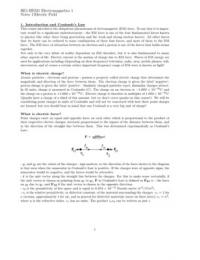
- q1 and q2 are the values of the charges - sign matters, so the direction of the force shown in the diagram
is that seen when the numerator in Coulomb’s Law is positive. If the charges were of opposite signs, the
numerator would be negative, and the forces would be attractive.
- r̂ is the unit vector along the straight line between the charges. For this to make sense vectorially, if
the unit vector is chosen as pointing from q1 to q2 , F in Coulomb’s Law is defined as F21 ie - the force
on q2 due to q1 , and F12 if the unit vector is chosen in the opposite direction.
- ǫ0 is the permittivity of free space and is equal to 8.854 × 10⁻¹² Farads/metre (C 2 /N m2 ).
- ǫr is the relative permittivity, or dielectric constant, of the material surrounding the charges. ǫr = 1 for
a vacuum, approximately 1 for air, and in general for dielectric materials (more on these later), ǫr = n2 ,
where n is the refractive index. ǫr has no units. The product ǫr ǫ0 can be written as just ǫ.
1
, BE1-HEM1 Electromagnetics 1:Notes 1:Electric Field
2. Electric field and electric field strength
The electric force is an example of ’action at a distance’. To help with the mathematical analysis of
systems of charges and the respective forces experienced, the concept of electric field is introduced. The
Coulomb’s Law interaction between two charges can then be broken down into two stages.
The first stage is to define, for just one charge (say q1 ), the region of its influence in space and to define
at each point in that space a vector quantity called its electric field strength E.
We will define the electric field strength due to q1 as E1 . E1 is a function of position in space - this
could, for example, be defined with reference to cartesian co-ordinates E1 (x, y, z), or function of position
vector r (relative to the position of q1 ) E1 (r).
The direction and magnitude of E1 at any position r is the direction and magnitude of the force a test
charge (say qt ) would feel if placed there, divided by the value of qt . In other words, the force per unit
charge.
Defining the force on the test charge due to q1 as Ft1 , E1 is defined for every position r at which qt
could be placed:-
Ft1
E1 =
qt
q1 qt 1
E1 = r̂
4πǫr 2 qt
q1
E1 = r̂
4πǫr 2
q1
The diagram above shows sample vectors of E1 . Each vector shown gives the magnitude and direction of
the electric field strength found at the position in space at the base of the vector arrow. The magnitude
is inversely proportional to r 2 and the direction points away from the charge. Remember that the vector
arrows do NOT represent a physical displacement.
However, qt , as it is not zero Coulombs, will produce its own electric field which will superimpose with
the q1 ’s electric field. Therefore, to be more rigourous in the definition of the electric field strength solely
due to charge q1 :-
Ft1
E1 = lim
qt →0 qt
The second stage, to find the force on a charge (say q2 ) placed within the electric field E1 is to multiply
the value of the charge q2 by the electric field of q1 ie F21 = q2 E1 . The units of E are Newtons/Coulomb
or Volts/metre.
In certain circumstances, E may also be a function of time t. If it is not changing with respect to time,
E is said to be electrostatic.
2
Notes 1:Electric Field
1. Introduction and Coulomb’s Law
This course introduces the ubiquitous phenomenon of electomagnetic (EM) force. To say that it is impor-
tant would be a significant understatement - the EM force is one of the four fundamental forces known
to physics (the other three being gravitation and the weak and strong nuclear forces). All other forces
that we know can be reduced to some combination of these four forces, and most of them to the EM
force. The EM force of attraction between an electron and a proton is one of the forces that holds atoms
together.
Not only is the very fabric of reality dependent on EM therefore, but it is also fundamental to many
other aspects of life. Electric current is the motion of charge due to EM force. Waves of EM energy are
used for applications including (depending on their frequency) television, radio, xray, mobile phones, wifi,
microwaves, and of course a certain rather important frequency range of EM wave is known as light!
What is electric charge?
Atomic particles - electrons and protons - possess a property called electric charge that determines the
magnitude and direction of the force between them. The electron charge is given the label ’negative’,
proton charge is given the label ’positive’. Similarly charged particles repel, dissimilar charges attract.
In SI units, charge is measured in Coulombs (C). The charge on an electron is −1.602 × 10⁻¹⁹ C and
the charge on a proton is +1.602 × 10⁻¹⁹ C . Electric charge is therefore in multiples of 1.602 × 10⁻¹⁹ C
(Quarks have a charge of a third of this amount, but we don’t cover quarks on this course!). We will be
considering point charges in units of Coulombs and will not be concerned with how these point charges
are formed, but you should bear in mind that one Coulomb is a very big unit of charge!
What is electric force?
Point charges exert an equal and opposite force on each other which is proportional to the product of
their respective electric charges, inversely proportional to the square of the distance between them, and
in the direction of the straight line between them. This was determined experimentally as Coulomb’s
Law:-
q1 q2
F= 4πǫr ǫ0 r 2 r̂
r^21 r^12
F12 F21
q q
1 2
- q1 and q2 are the values of the charges - sign matters, so the direction of the force shown in the diagram
is that seen when the numerator in Coulomb’s Law is positive. If the charges were of opposite signs, the
numerator would be negative, and the forces would be attractive.
- r̂ is the unit vector along the straight line between the charges. For this to make sense vectorially, if
the unit vector is chosen as pointing from q1 to q2 , F in Coulomb’s Law is defined as F21 ie - the force
on q2 due to q1 , and F12 if the unit vector is chosen in the opposite direction.
- ǫ0 is the permittivity of free space and is equal to 8.854 × 10⁻¹² Farads/metre (C 2 /N m2 ).
- ǫr is the relative permittivity, or dielectric constant, of the material surrounding the charges. ǫr = 1 for
a vacuum, approximately 1 for air, and in general for dielectric materials (more on these later), ǫr = n2 ,
where n is the refractive index. ǫr has no units. The product ǫr ǫ0 can be written as just ǫ.
1
, BE1-HEM1 Electromagnetics 1:Notes 1:Electric Field
2. Electric field and electric field strength
The electric force is an example of ’action at a distance’. To help with the mathematical analysis of
systems of charges and the respective forces experienced, the concept of electric field is introduced. The
Coulomb’s Law interaction between two charges can then be broken down into two stages.
The first stage is to define, for just one charge (say q1 ), the region of its influence in space and to define
at each point in that space a vector quantity called its electric field strength E.
We will define the electric field strength due to q1 as E1 . E1 is a function of position in space - this
could, for example, be defined with reference to cartesian co-ordinates E1 (x, y, z), or function of position
vector r (relative to the position of q1 ) E1 (r).
The direction and magnitude of E1 at any position r is the direction and magnitude of the force a test
charge (say qt ) would feel if placed there, divided by the value of qt . In other words, the force per unit
charge.
Defining the force on the test charge due to q1 as Ft1 , E1 is defined for every position r at which qt
could be placed:-
Ft1
E1 =
qt
q1 qt 1
E1 = r̂
4πǫr 2 qt
q1
E1 = r̂
4πǫr 2
q1
The diagram above shows sample vectors of E1 . Each vector shown gives the magnitude and direction of
the electric field strength found at the position in space at the base of the vector arrow. The magnitude
is inversely proportional to r 2 and the direction points away from the charge. Remember that the vector
arrows do NOT represent a physical displacement.
However, qt , as it is not zero Coulombs, will produce its own electric field which will superimpose with
the q1 ’s electric field. Therefore, to be more rigourous in the definition of the electric field strength solely
due to charge q1 :-
Ft1
E1 = lim
qt →0 qt
The second stage, to find the force on a charge (say q2 ) placed within the electric field E1 is to multiply
the value of the charge q2 by the electric field of q1 ie F21 = q2 E1 . The units of E are Newtons/Coulomb
or Volts/metre.
In certain circumstances, E may also be a function of time t. If it is not changing with respect to time,
E is said to be electrostatic.
2


