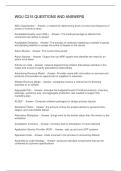
WGU C215 QUESTIONS AND ANSWERS
ABC Classification - Answer -a method for determining level of control and frequency of
review of inventory items
Acceptable Quality Level (AQL) - Answer -The small percentage of defects that
consumers are willing to accept.
Acceptable Sampling - Answer -The process of randomly inspecting a sample of goods
and deciding whether to accept the entire lot based on the results
Action Bucket - Answer -The current time period
Action Notices - Answer -Output from an MRP system that identifies the need for an
action to be taken.
Activity-on-node - Answer -network diagramming notation that places activities in the
nodes and arrows to signify precedence relationships
Advertising Revenue Model - Answer -Provides users with information on services and
products and provides an opportunity for suppliers to advertise.
Affiliate Revenue Model - Answer -companies receive a referral fee for directing
business to an affiliate
Aggregate Plan - Answer -Includes the budgeted levels of finished products, inventory,
backlogs, workforce size, and aggregate production rate needed to support the
marketing plan.
ALDEP - Answer -Computer software packages for design process layouts
Allowance Factor - Answer -the amount of time the analyst allows for personal time,
fatigue, and unavoidable delays
Alternative Workplace - Answer -brings work to the worker rather than the worker to the
workplace
Anticipation Inventory - Answer -inventory built in anticipation of future demand
Application Service Provider (ASP) - Answer -sets up and runs ERP systems
Appraisal Costs - Answer -Costs incurred in the process of uncovering defects
Assemble-to-order Strategy - Answer -produces standard components that can be
combined to customer specifications
,Assignable causes of variation - Answer -Causes that can be identified and eliminated.
Attributes - Answer -A product characteristic that has discrete value and can be
counted
Automated order entry system - Answer -A method using telephone models to send
digital orders to suppliers
Automation - Answer -Using machinery to perform work without human operators
Average number of jobs in the system - Answer -measures work-in-process inventory
Average outgoing quality (AOQ) - Answer -The expected proportion of defective items
that will be passed to the customer under the sampling plan.
Back orders - Answer -unfilled customer orders
Back-order - Answer -Delaying delivery to the customer until the item becomes
available.
Backward integration - Answer -Owning or controlling sources of raw materials and
components.
backward scheduling - Answer -scheduling method that determines when the job must
be started to be done on the due date
Balance Delay - Answer -The amount by which the line efficiency falls short of 100
percent.
Batch processes - Answer -A type of process used to produce a small quantity of
products in groups or batches based on customer orders or specifications.
Behavioral Feasibility - Answer -degree to which the job is intrinsically satisfying to the
employee
Beliefs that help define JIT Philosophy - Answer -Broad view operations, simplicity,
continuous improvements, visibility, and flexibility
Benchmarking - Answer -The process of studying the practices of companies
considered 'best-in-class' and comparing your company's performance against theirs.
Best operating level - Answer -The volume of output that results in the lowest average
unit cost.
beta probability distribution - Answer -typically represents project activities
, Bill of Material (BOM) - Answer -lists all the subassemblies, component parts, and raw
materials that go into an end item and shows the usage quantity of each required
Block Plan - Answer -schematic showing the placement of resources in a facility
Bottleneck - Answer -Longest Task in the process
Bottom-round management - Answer -Consensus management by committees or
teams
break-even analysis - Answer -technique used to compute the amount of goods that
must be sold just to cover costs
Broad view of JIT - Answer -a philosophy that encompasses the entire organization
Broad view of the organization - Answer -Tasks and procedures are important only if
they meet the company's overall goals.
bullwhip effect - Answer -inaccurate or distorted demand information created in the
supply chain
Business-to-business e-commerce - Answer -businesses selling to and buying from
other businesses
Business-to-consumer e-commerce - Answer -on-line businesses sell to individual
consumers
C-charts - Answer -A control chart used to monitor the number of defects per unit
Capacity - Answer -The maximum output rate that can be achieved by a facility
capacity cushion - Answer -Additional capacity added to regular capacity requirements
to provide greater flexibility.
Capacity Planning - Answer -the process of establishing the output rate that can be
achieved by a facility
Capacity Requirements Planning (CRP) - Answer -determines the labor and machine
resources needed to fill the open and planned orders generated by the MRP
Capacity Utilization - Answer -Percentage measure of how well available capacity is
being used.
Capacity-based Options - Answer -A group of options that allow the firm to change its
current operating capacity.
ABC Classification - Answer -a method for determining level of control and frequency of
review of inventory items
Acceptable Quality Level (AQL) - Answer -The small percentage of defects that
consumers are willing to accept.
Acceptable Sampling - Answer -The process of randomly inspecting a sample of goods
and deciding whether to accept the entire lot based on the results
Action Bucket - Answer -The current time period
Action Notices - Answer -Output from an MRP system that identifies the need for an
action to be taken.
Activity-on-node - Answer -network diagramming notation that places activities in the
nodes and arrows to signify precedence relationships
Advertising Revenue Model - Answer -Provides users with information on services and
products and provides an opportunity for suppliers to advertise.
Affiliate Revenue Model - Answer -companies receive a referral fee for directing
business to an affiliate
Aggregate Plan - Answer -Includes the budgeted levels of finished products, inventory,
backlogs, workforce size, and aggregate production rate needed to support the
marketing plan.
ALDEP - Answer -Computer software packages for design process layouts
Allowance Factor - Answer -the amount of time the analyst allows for personal time,
fatigue, and unavoidable delays
Alternative Workplace - Answer -brings work to the worker rather than the worker to the
workplace
Anticipation Inventory - Answer -inventory built in anticipation of future demand
Application Service Provider (ASP) - Answer -sets up and runs ERP systems
Appraisal Costs - Answer -Costs incurred in the process of uncovering defects
Assemble-to-order Strategy - Answer -produces standard components that can be
combined to customer specifications
,Assignable causes of variation - Answer -Causes that can be identified and eliminated.
Attributes - Answer -A product characteristic that has discrete value and can be
counted
Automated order entry system - Answer -A method using telephone models to send
digital orders to suppliers
Automation - Answer -Using machinery to perform work without human operators
Average number of jobs in the system - Answer -measures work-in-process inventory
Average outgoing quality (AOQ) - Answer -The expected proportion of defective items
that will be passed to the customer under the sampling plan.
Back orders - Answer -unfilled customer orders
Back-order - Answer -Delaying delivery to the customer until the item becomes
available.
Backward integration - Answer -Owning or controlling sources of raw materials and
components.
backward scheduling - Answer -scheduling method that determines when the job must
be started to be done on the due date
Balance Delay - Answer -The amount by which the line efficiency falls short of 100
percent.
Batch processes - Answer -A type of process used to produce a small quantity of
products in groups or batches based on customer orders or specifications.
Behavioral Feasibility - Answer -degree to which the job is intrinsically satisfying to the
employee
Beliefs that help define JIT Philosophy - Answer -Broad view operations, simplicity,
continuous improvements, visibility, and flexibility
Benchmarking - Answer -The process of studying the practices of companies
considered 'best-in-class' and comparing your company's performance against theirs.
Best operating level - Answer -The volume of output that results in the lowest average
unit cost.
beta probability distribution - Answer -typically represents project activities
, Bill of Material (BOM) - Answer -lists all the subassemblies, component parts, and raw
materials that go into an end item and shows the usage quantity of each required
Block Plan - Answer -schematic showing the placement of resources in a facility
Bottleneck - Answer -Longest Task in the process
Bottom-round management - Answer -Consensus management by committees or
teams
break-even analysis - Answer -technique used to compute the amount of goods that
must be sold just to cover costs
Broad view of JIT - Answer -a philosophy that encompasses the entire organization
Broad view of the organization - Answer -Tasks and procedures are important only if
they meet the company's overall goals.
bullwhip effect - Answer -inaccurate or distorted demand information created in the
supply chain
Business-to-business e-commerce - Answer -businesses selling to and buying from
other businesses
Business-to-consumer e-commerce - Answer -on-line businesses sell to individual
consumers
C-charts - Answer -A control chart used to monitor the number of defects per unit
Capacity - Answer -The maximum output rate that can be achieved by a facility
capacity cushion - Answer -Additional capacity added to regular capacity requirements
to provide greater flexibility.
Capacity Planning - Answer -the process of establishing the output rate that can be
achieved by a facility
Capacity Requirements Planning (CRP) - Answer -determines the labor and machine
resources needed to fill the open and planned orders generated by the MRP
Capacity Utilization - Answer -Percentage measure of how well available capacity is
being used.
Capacity-based Options - Answer -A group of options that allow the firm to change its
current operating capacity.