BUSINESS MANAGEMENT UNIT
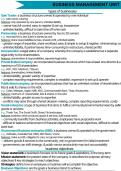
types of businesses
Sole Trader: a business structure owned & operated by one individual
e.g., cafe owner, tutoring
features: only operated by one person, unlimited liability
+ owner has full-control, easy to register & set-up, inexpensive
- unlimited liability, difficult to take time off when sick
Partnership: a business structure owned by two to 20 owners
e.g., most law firms, ben & jerry’s started as one
features: share responsibilities & risks, shared profit, unlimited liability
+ greater range of expertise, share workload, easy & simple to setup & register, minimal setup cos
- unlimited liability, if partner leaves time-consuming to restructure, shared profits
Incorporation: a legal status of a company whereby the company is established as a separate
legal entity to the shareholders.
features: shareholders & responsibilities, separate legal entity
Private limited company: an incorporated business structure which has at least one director & a
maximum of 50 shareholders
e.g., HCF, VISY, Metricon, 7 Eleven
features: shareholders, limited liability
+ limited liability, greater variety of expertise
- complex reporting requirements, complex to establish, expensive to set up & operate
Public listed company: an incorporated business that has an unlimited number of shareholders &
lists & sells its shares on the ASX.
e.g., Coles, Westpac, Apple, NAB, ANZ, Commonwealth Bank, Tesla, Woolworths
features: minimum of 1 shareholder, lists & shares on the ASX
+ limited liability, greater access to expertise
- conflicts may arise through shared decision-making, complex reporting requirements, costly
Social enterprise: a type of business that aims to fulfil a community/environmental need by selling
goods or services
e.g., Thank You, The Social Outfit, Streat, Flo landscapes
features: business which produces goods & services, fulfil social needs
+ community benefits from business activities, employees have purposeful work
- difficult to balance achievement of financial objectives with social objectives, difficult to obtain
bank loan
Government Business enterprise (GBE): a business owned & operated by the government
e.g., VicRoads, Australia Post, NBN, ABC News, V/Line
features: make a profit, obligated to carry out government policies
+ delivers goods & services to the community, rely on government for initial investment
- governments can shift strategy, & public-sector productivity may lack accountability
business objectives
Vision statement: a business’s focuses on its future goals & aspirations, in the long-term
Mission statement: the present state of the company. It describes the purpose, primary
objectives & key strategies to reach objectives.
Strategies: define how an employee or business will accomplish the objective.
Business Objectives: are the goals a business intend to achieve.
, BUSINESS MANAGEMENT UNIT 3: AO
human resource management
Human Resource (HR) Management: the organisation of employees’ roles, pay, & working conditions
employee motivation
Motivation: is the desire or willingness to expand energy & effort in completing a task
Theories of Motivation:
Maslow’s Hierarchy of Needs: suggests all humans have five fundamental needs that they strive to
achieve in sequential order.
Physiological needs: basic requirements for human survival, e.g., food & water
Safety & security needs: protection from dangerous environments, e.g., shelter & clothing
Social needs: sense of belonging & friendships among groups, both inside & outside the workplace
Esteem needs: individual’s desires to feel important, valuable & respected
Self-actualisation needs: individual reaching their full potential through creativity & personal growth
+ It provides managers with a clear structure, & satisfies social needs without increasing costs.
- Assumes all employees are always motivated, though they may be at different stages.
Lawrence & Nohria’s Four Drive Theory: suggests employees strive to achieve four fundamenta
needs:
Drive to acquire: desire to acquire goods & services in life, e.g., remuneration
Drive to bond: desire to form long-term relationships, e.g., celebrations
Drive to learn: desire to continually learn new things, e.g., training & development programs
Drive to defend: desire to defend themselves & those they care, e.g., safety, job security, pay rate
+ Managers can target drives to improve performance and reduce mistakes.
- Training and financial rewards can increase business expenses.
Locke & Latham’s Goal Setting Theory: states that employees are motivated by clearly defined goals
that fulfil five key principles:
Clarity: goals should be specific, measurable & clearly understood
Commitment: employees should help set goals that align with their personal interests
Challenge: goal should be difficult enough to encourage employees to improve to achieve it
Task complexity: goals should be achievable, not overwhelming, & adequate training to achieve it
Feedback: managers should support, adjust goals, monitor progress & motivate employees
+ very focused & individual specific, easy to access if goals have been achieved
- Time-consuming, hard to align, and may stress employees with too many goals.
motivation strategies
Performance-related pay: a financial reward that employees receive for reaching or exceeding
a set business goal.
Financial motivation strategies:
Pay Increases: permanent increase in employees salary
Bonuses: one-off payment for meeting objectives
Commissions: provided to employees for selling good/service
Share Plans: employees given shares of a company
Profit sharing: business offering a percentage of its profits to employees when hitting targets
Non-financial motivation strategies:
Career advancement: the upwards progression of an employee’s job position
+ reduce staff turnover, build a positive corporate culture
- impossible for all employees, some employees may be promoted beyond their capabilities
Investment in training: allocating resources to improve employee skills & knowledge
on-the-job: providing employees with mentoring & training programs within the business
off-the-job: paying for employees to be trained by other professional outside the business
+ employees perform better, feel valued
types of businesses
Sole Trader: a business structure owned & operated by one individual
e.g., cafe owner, tutoring
features: only operated by one person, unlimited liability
+ owner has full-control, easy to register & set-up, inexpensive
- unlimited liability, difficult to take time off when sick
Partnership: a business structure owned by two to 20 owners
e.g., most law firms, ben & jerry’s started as one
features: share responsibilities & risks, shared profit, unlimited liability
+ greater range of expertise, share workload, easy & simple to setup & register, minimal setup cos
- unlimited liability, if partner leaves time-consuming to restructure, shared profits
Incorporation: a legal status of a company whereby the company is established as a separate
legal entity to the shareholders.
features: shareholders & responsibilities, separate legal entity
Private limited company: an incorporated business structure which has at least one director & a
maximum of 50 shareholders
e.g., HCF, VISY, Metricon, 7 Eleven
features: shareholders, limited liability
+ limited liability, greater variety of expertise
- complex reporting requirements, complex to establish, expensive to set up & operate
Public listed company: an incorporated business that has an unlimited number of shareholders &
lists & sells its shares on the ASX.
e.g., Coles, Westpac, Apple, NAB, ANZ, Commonwealth Bank, Tesla, Woolworths
features: minimum of 1 shareholder, lists & shares on the ASX
+ limited liability, greater access to expertise
- conflicts may arise through shared decision-making, complex reporting requirements, costly
Social enterprise: a type of business that aims to fulfil a community/environmental need by selling
goods or services
e.g., Thank You, The Social Outfit, Streat, Flo landscapes
features: business which produces goods & services, fulfil social needs
+ community benefits from business activities, employees have purposeful work
- difficult to balance achievement of financial objectives with social objectives, difficult to obtain
bank loan
Government Business enterprise (GBE): a business owned & operated by the government
e.g., VicRoads, Australia Post, NBN, ABC News, V/Line
features: make a profit, obligated to carry out government policies
+ delivers goods & services to the community, rely on government for initial investment
- governments can shift strategy, & public-sector productivity may lack accountability
business objectives
Vision statement: a business’s focuses on its future goals & aspirations, in the long-term
Mission statement: the present state of the company. It describes the purpose, primary
objectives & key strategies to reach objectives.
Strategies: define how an employee or business will accomplish the objective.
Business Objectives: are the goals a business intend to achieve.
, BUSINESS MANAGEMENT UNIT 3: AO
human resource management
Human Resource (HR) Management: the organisation of employees’ roles, pay, & working conditions
employee motivation
Motivation: is the desire or willingness to expand energy & effort in completing a task
Theories of Motivation:
Maslow’s Hierarchy of Needs: suggests all humans have five fundamental needs that they strive to
achieve in sequential order.
Physiological needs: basic requirements for human survival, e.g., food & water
Safety & security needs: protection from dangerous environments, e.g., shelter & clothing
Social needs: sense of belonging & friendships among groups, both inside & outside the workplace
Esteem needs: individual’s desires to feel important, valuable & respected
Self-actualisation needs: individual reaching their full potential through creativity & personal growth
+ It provides managers with a clear structure, & satisfies social needs without increasing costs.
- Assumes all employees are always motivated, though they may be at different stages.
Lawrence & Nohria’s Four Drive Theory: suggests employees strive to achieve four fundamenta
needs:
Drive to acquire: desire to acquire goods & services in life, e.g., remuneration
Drive to bond: desire to form long-term relationships, e.g., celebrations
Drive to learn: desire to continually learn new things, e.g., training & development programs
Drive to defend: desire to defend themselves & those they care, e.g., safety, job security, pay rate
+ Managers can target drives to improve performance and reduce mistakes.
- Training and financial rewards can increase business expenses.
Locke & Latham’s Goal Setting Theory: states that employees are motivated by clearly defined goals
that fulfil five key principles:
Clarity: goals should be specific, measurable & clearly understood
Commitment: employees should help set goals that align with their personal interests
Challenge: goal should be difficult enough to encourage employees to improve to achieve it
Task complexity: goals should be achievable, not overwhelming, & adequate training to achieve it
Feedback: managers should support, adjust goals, monitor progress & motivate employees
+ very focused & individual specific, easy to access if goals have been achieved
- Time-consuming, hard to align, and may stress employees with too many goals.
motivation strategies
Performance-related pay: a financial reward that employees receive for reaching or exceeding
a set business goal.
Financial motivation strategies:
Pay Increases: permanent increase in employees salary
Bonuses: one-off payment for meeting objectives
Commissions: provided to employees for selling good/service
Share Plans: employees given shares of a company
Profit sharing: business offering a percentage of its profits to employees when hitting targets
Non-financial motivation strategies:
Career advancement: the upwards progression of an employee’s job position
+ reduce staff turnover, build a positive corporate culture
- impossible for all employees, some employees may be promoted beyond their capabilities
Investment in training: allocating resources to improve employee skills & knowledge
on-the-job: providing employees with mentoring & training programs within the business
off-the-job: paying for employees to be trained by other professional outside the business
+ employees perform better, feel valued