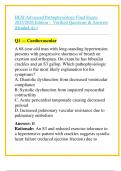
HESI Advanced Pathophysiology Final Exam:
2025/2026 Edition - Verified Questions & Answers
(Graded A+)
Q1 — Cardiovascular
A 68-year-old man with long-standing hypertension
presents with progressive shortness of breath on
exertion and orthopnea. On exam he has bibasilar
crackles and an S3 gallop. Which pathophysiologic
process is the most likely explanation for his
symptoms?
A. Diastolic dysfunction from decreased ventricular
compliance
B. Systolic dysfunction from impaired myocardial
contractility
C. Acute pericardial tamponade causing decreased
preload
D. Increased pulmonary vascular resistance due to
pulmonary embolism
Answer: B
Rationale: An S3 and reduced exercise tolerance in
a hypertensive patient with crackles suggests systolic
heart failure (reduced ejection fraction) due to
,impaired myocardial contractility. Diastolic
dysfunction causes preserved EF and tends to
present differently; tamponade and PE have different
acute presentations.
Q2 — Respiratory
Which of the following best explains hypoxemia
with a normal A–a gradient?
A. Right-to-left shunt
B. Hypoventilation
C. V/Q mismatch
D. Diffusion impairment
Answer: B
Rationale: Hypoventilation lowers PaO₂ and PaCO₂
but typically yields a normal A–a gradient because
alveolar gas composition is uniformly depressed.
V/Q mismatch, shunt, and diffusion defects increase
the A–a gradient.
Q3 — Renal
,A patient with long-standing diabetes develops
persistent albuminuria (microalbuminuria
progressing to macroalbuminuria). Which renal
pathology is most closely associated with this
finding?
A. Focal segmental glomerulosclerosis
B. Membranous nephropathy
C. Diabetic glomerulosclerosis (Kimmelstiel–
Wilson nodules)
D. Minimal change disease
Answer: C
Rationale: Diabetic nephropathy leads to
glomerulosclerosis with nodular mesangial
expansion (Kimmelstiel–Wilson lesions) and
progressive proteinuria. FSGS and membranous
disease have different etiologies/presentations;
minimal change usually occurs in children and
causes heavy proteinuria but not nodular
glomerulosclerosis.
Q4 — Hematology
Which laboratory finding is most characteristic of
iron deficiency anemia?
, A. Increased MCV and increased ferritin
B. Decreased MCV and low ferritin
C. Normal MCV and high transferrin saturation
D. Macrocytosis with hypersegmented neutrophils
Answer: B
Rationale: Iron deficiency anemia typically
produces microcytic (low MCV), hypochromic red
cells and low ferritin (low iron stores). Macrocytosis
with hypersegmented neutrophils suggests
B12/folate deficiency.
Q5 — Endocrine
A patient presents with weight gain, moon facies,
buffalo hump, and proximal muscle weakness. Lab
testing shows hyperglycemia and low-dose
dexamethasone fails to suppress cortisol. The most
likely diagnosis is:
A. Primary adrenal insufficiency (Addison disease)
B. Cushing disease (ACTH-secreting pituitary
adenoma)
C. Ectopic ACTH production from a small cell lung
carcinoma
D. Exogenous glucocorticoid use
2025/2026 Edition - Verified Questions & Answers
(Graded A+)
Q1 — Cardiovascular
A 68-year-old man with long-standing hypertension
presents with progressive shortness of breath on
exertion and orthopnea. On exam he has bibasilar
crackles and an S3 gallop. Which pathophysiologic
process is the most likely explanation for his
symptoms?
A. Diastolic dysfunction from decreased ventricular
compliance
B. Systolic dysfunction from impaired myocardial
contractility
C. Acute pericardial tamponade causing decreased
preload
D. Increased pulmonary vascular resistance due to
pulmonary embolism
Answer: B
Rationale: An S3 and reduced exercise tolerance in
a hypertensive patient with crackles suggests systolic
heart failure (reduced ejection fraction) due to
,impaired myocardial contractility. Diastolic
dysfunction causes preserved EF and tends to
present differently; tamponade and PE have different
acute presentations.
Q2 — Respiratory
Which of the following best explains hypoxemia
with a normal A–a gradient?
A. Right-to-left shunt
B. Hypoventilation
C. V/Q mismatch
D. Diffusion impairment
Answer: B
Rationale: Hypoventilation lowers PaO₂ and PaCO₂
but typically yields a normal A–a gradient because
alveolar gas composition is uniformly depressed.
V/Q mismatch, shunt, and diffusion defects increase
the A–a gradient.
Q3 — Renal
,A patient with long-standing diabetes develops
persistent albuminuria (microalbuminuria
progressing to macroalbuminuria). Which renal
pathology is most closely associated with this
finding?
A. Focal segmental glomerulosclerosis
B. Membranous nephropathy
C. Diabetic glomerulosclerosis (Kimmelstiel–
Wilson nodules)
D. Minimal change disease
Answer: C
Rationale: Diabetic nephropathy leads to
glomerulosclerosis with nodular mesangial
expansion (Kimmelstiel–Wilson lesions) and
progressive proteinuria. FSGS and membranous
disease have different etiologies/presentations;
minimal change usually occurs in children and
causes heavy proteinuria but not nodular
glomerulosclerosis.
Q4 — Hematology
Which laboratory finding is most characteristic of
iron deficiency anemia?
, A. Increased MCV and increased ferritin
B. Decreased MCV and low ferritin
C. Normal MCV and high transferrin saturation
D. Macrocytosis with hypersegmented neutrophils
Answer: B
Rationale: Iron deficiency anemia typically
produces microcytic (low MCV), hypochromic red
cells and low ferritin (low iron stores). Macrocytosis
with hypersegmented neutrophils suggests
B12/folate deficiency.
Q5 — Endocrine
A patient presents with weight gain, moon facies,
buffalo hump, and proximal muscle weakness. Lab
testing shows hyperglycemia and low-dose
dexamethasone fails to suppress cortisol. The most
likely diagnosis is:
A. Primary adrenal insufficiency (Addison disease)
B. Cushing disease (ACTH-secreting pituitary
adenoma)
C. Ectopic ACTH production from a small cell lung
carcinoma
D. Exogenous glucocorticoid use