

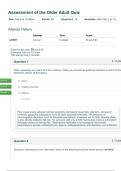
Assessment of the Older Adult Quiz
Due Feb 9 at 10:59pm Points 30 Questions 15 Available after Feb 2 at 11p
Attempt History
Attempt Time Score
LATEST Attempt 1 5 minutes 30 out of 30
Score for this quiz: 30 out of 30
Submitted Feb 8 at 12:52pm
This attempt took 5 minutes.
Question 1 pts
When assessing your client who has a history of falls, you should pay particular attention to which of the
following? (Select all that apply.)
Correct! Vision
Correct! Cognitive disorders
Correct! Hearing
Antibiotics
Poor visual acuity, reduced contrast sensitivity, decreased visual field, cataracts, and use of
nonmiotic glaucoma medications have all been associated with falls. The presence of
neurocognitive disorders, such as dementia and delirium, increases risk for falls. Hearing ability
is also directly related to fall risk. For someone with only a mild hearing loss, there is a threefold
increased chance of having falls. Medications implicated in increasing fall risk include
psychotropics, opioids, antiarrhythmics, digoxin, antihypertensives, and diuretics—not antibiotics.
Question 2 pts
During an assessment of an older adult, which of the following would the nurse see as a priority?
,Correct! Listening as key to an assessment
Using the Kleinman and associates model
Attempting to preserve helpful beliefs and practices
Providing ongoing assistance to persons who are physically or mentally ill
Listening is the key to any assessment. Actually, hearing what the patient and family says sets a
foundation on which to base an assessment. The model developed by Kleinman and associates
helps health care professionals obtain basic information needed in a culturally sensitive manner.
To do so, one must listen. Beliefs and practices need to be preserved whenever possible, and
nurses should not attempt to change them. Listening to the beliefs of others is important to assist
the nurse when negotiating health, treatment, or prevention options. Ongoing assistance to
persons who are physically and mentally ill requires ongoing assessments of which listening is
paramount.
Question 3 pts
As the nurse performing and collecting assessment data, you realize that during the process of
interviewing the client that a majority of the information is coming from the client’s family members.
What is this approach for collecting assessment data called?
Self-report
Correct! Report-by-proxy
Observation
Dual communications
The report-by-proxy approach means that the nurse asks another person to report his or her
observations. With the self-report approach, the person is expected to respond to the question
about his or her health status. With the observation approach, the nurse collects and records the
data. Dual communications is communication between two sources with cables (e.g., telephone,
computer).
Question 4 pts
Due Feb 9 at 10:59pm Points 30 Questions 15 Available after Feb 2 at 11p
Attempt History
Attempt Time Score
LATEST Attempt 1 5 minutes 30 out of 30
Score for this quiz: 30 out of 30
Submitted Feb 8 at 12:52pm
This attempt took 5 minutes.
Question 1 pts
When assessing your client who has a history of falls, you should pay particular attention to which of the
following? (Select all that apply.)
Correct! Vision
Correct! Cognitive disorders
Correct! Hearing
Antibiotics
Poor visual acuity, reduced contrast sensitivity, decreased visual field, cataracts, and use of
nonmiotic glaucoma medications have all been associated with falls. The presence of
neurocognitive disorders, such as dementia and delirium, increases risk for falls. Hearing ability
is also directly related to fall risk. For someone with only a mild hearing loss, there is a threefold
increased chance of having falls. Medications implicated in increasing fall risk include
psychotropics, opioids, antiarrhythmics, digoxin, antihypertensives, and diuretics—not antibiotics.
Question 2 pts
During an assessment of an older adult, which of the following would the nurse see as a priority?
,Correct! Listening as key to an assessment
Using the Kleinman and associates model
Attempting to preserve helpful beliefs and practices
Providing ongoing assistance to persons who are physically or mentally ill
Listening is the key to any assessment. Actually, hearing what the patient and family says sets a
foundation on which to base an assessment. The model developed by Kleinman and associates
helps health care professionals obtain basic information needed in a culturally sensitive manner.
To do so, one must listen. Beliefs and practices need to be preserved whenever possible, and
nurses should not attempt to change them. Listening to the beliefs of others is important to assist
the nurse when negotiating health, treatment, or prevention options. Ongoing assistance to
persons who are physically and mentally ill requires ongoing assessments of which listening is
paramount.
Question 3 pts
As the nurse performing and collecting assessment data, you realize that during the process of
interviewing the client that a majority of the information is coming from the client’s family members.
What is this approach for collecting assessment data called?
Self-report
Correct! Report-by-proxy
Observation
Dual communications
The report-by-proxy approach means that the nurse asks another person to report his or her
observations. With the self-report approach, the person is expected to respond to the question
about his or her health status. With the observation approach, the nurse collects and records the
data. Dual communications is communication between two sources with cables (e.g., telephone,
computer).
Question 4 pts


