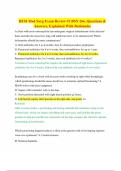
HESI Med Surg Exam Review 1 BSN 266, Questions & Answers, Explained With Rationales
HESI Med Surg Exam Review 1 BSN 266, Questions & Answers, Explained With Rationales-A client with acute osteomyelitis has undergone surgical debridement of the diseased bone and asks the nurse how long will antibiotics have to be administered. Which information should the nurse communicate? A. Oral antibiotics for 2 to 4 months, then for dental procedure prophylaxis. B. Parenteral antibiotics for 4 to 6 weeks, then oral antibiotics for up to 1 year. C. Parenteral antibiotics for 4 to 8 weeks, then oral antibiotics for 4 to 8 weeks. Parenteral antibiotics for 2 to 3 weeks, then oral antibiotics for 4 weeks-C Treatment of acute osteomyelitis requires the administration of high doses of parenteral antibiotics for 4 to 8 weeks, followed by oral antibiotics for another 4 to 8 weeks In planning care for a client with an acute stroke resulting in right-sided hemiplegia, which positioning should the nurse should use to maintain optimal functioning? A. Mid-Fowlers with knees supported. B. Supine with trochanter rolls to the hips. C. Sim's position alternated with right lateral position q2 hours. D. Left lateral, supine, brief periods on the right side, and prone -D Rationale After an acute stroke, a positioning and turning schedule that minimizes lying on the affected side, which can impair circulation and cause pain, and includes the prone position to help prevent flexion contractures of the hips, prepares the client for optimal functioning and ambulation. Which preexisting diagnosis places a client at the greatest risk of developing superior vena cava syndrome? A. Carotid stenosis. B. Steatosis hepatitis. C. Metastatic cancer. D. Clavicular fracture.-C Rationale Superior vena cava syndrome occurs when the superior vena cava (SVC) is compressed by outside structures, such as a growing tumor that impedes the return blood flow to the heart. Superior vena cava syndrome is likely to occur with metastatic cancer from a primary tumor in the upper lobe of the right lung that compresses the superior vena cava. The nurse is giving discharge instructions to a client with chronic prostatitis. What instruction should the nurse provide the client to reduce the risk of spreading the infection to other areas of the client's urinary tract? A. Wear a condom when having sexual intercourse. B. Avoid consuming alcohol and caffeinated beverages. C. Empty the bladder completely with each voiding. D. Have intercourse or masturbate at least twice a week.-D Rationale The prostate is not easily penetrated by antibiotics and can serve as a reservoir for microorganisms, which can infect other areas of the genitourinary tract. Draining the prostate regularly through intercourse or masturbation decreases the number of microorganisms present and reduces the risk for further infection from stored contaminated seminal fluids During the initial outbreak of genital herpes simplex for a female client, what should be the nurse's primary focus in planning care? A. Promotion of comfort. B. Prevention of pregnancy. C. Instruction in condom use. Information about transmission-A Rationale The initial outbreak of genital herpes simplex in a woman causes severe discomfort. Promotion of comfort is the first priority A client who has a chronic cough with blood-tinged sputum returns to the unit after a bronchoscopy. What nursing interventions should be implemented in the immediate postprocedural period? A. Keep the client on bed rest for eight hours. B. Check vital signs every 15 minutes for two hours. C. Allow the client nothing by mouth until the gag reflex returns. D. Encourage fluid intake to promote elimination of the contrast media.-C Rationale The nasal pharynx and oral pharynx are anesthetized with local anesthetic spray prior to bronchoscopy, and the bronchoscope is coated with lidocaine (Xylocaine) gel to inhibit the gag reflex and prevent laryngeal spasm during insertion. The client should be NPO until the client's gag reflex returns to prevent aspiration from any oral intake or secretions.
Document information
- Uploaded on
- September 3, 2025
- Number of pages
- 45
- Written in
- 2025/2026
- Type
- Exam (elaborations)
- Contains
- Questions & answers