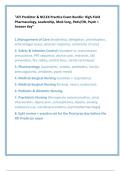
"ATI Predictor & NCLEX Practice Exam Bundle: High-Yield
Pharmacology, Leadership, Med-Surg, Peds/OB, Psych +
Answer Key"
1.Management of Care (leadership, delegation, prioritization,
ethical/legal issues, disaster response, continuity of care)
2. Safety & Infection Control (standard vs. transmission
precautions, PPE sequence, device care, restraints, fall
prevention, fire safety, central lines, sterile technique)
3. Pharmacology (autonomic, cardiac, antibiotics, insulin,
anticoagulants, antidotes, psych meds)
4. Medical-Surgical Nursing I (cardiac + respiratory).
5. Medical-Surgical Nursing II (renal, neuro, endocrine).
6. Pediatric & Obstetric Nursing.
7. Psychiatric Nursing (therapeutic communication, crisis
intervention, depression, schizophrenia, bipolar, anxiety,
substance use, suicide precautions, psychopharmacology)
8. light review + practice set for the final prep day before the
ATI Predictor exam
,Leadership / Delegation (4 items)
Question 1
A registered nurse (RN) is leading a team on a busy medical-
surgical unit. The team includes a licensed practical nurse (LPN)
and an unlicensed assistive personnel (UAP). Which task is most
appropriate for the RN to delegate to the UAP?
A. Reinforcing teaching about a continuous positive airway
pressure (CPAP) machine with a patient newly diagnosed with
sleep apnea.
B. Performing routine vital signs on a stable patient who is 4
hours post-catheterization.
C. Assessing a new ostomy site for a patient who had colorectal
surgery yesterday.
D. Administering a scheduled antihypertensive medication via a
nasogastric tube to a patient with dysphagia.
• Topic/Subtopic: Delegation — Scope of Practice for UAP
• NCLEX Category: Management of Care / Assignment,
Delegation and Supervision
• Cognitive Level: Application
• Difficulty: 2 (Medium)
• Learning Objective: Distinguish between tasks that require
nursing judgment and those that can be safely delegated to
unlicensed staff.
Answer & Rationale
• Correct Answer: B
,• Rationale: Performing routine vital signs on a stable patient is
within the scope of a UAP's duties, as it is a standardized,
procedure-based task with predictable outcomes. Assessment
(C), teaching (A), and medication administration (D) all require
the clinical judgment and licensure of a nurse.
• Distractor Analysis: A (Teaching requires assessment of
understanding by a licensed nurse); C (Assessment is a licensed
nursing function); D (Medication administration via a tube
requires assessment and verification by a nurse).
• Test-Taking Tip: Remember the "five rights of delegation":
right task, right circumstance, right person, right
direction/communication, and right supervision.
Question 2
An RN is assigning patients to an LPN on a rehabilitation unit.
Which patient should the RN assign to the LPN?
A. A 45-year-old patient with Guillain-Barré syndrome who
requires frequent neurologic assessments and suctioning.
B. A 72-year-old patient with a recent above-the-knee
amputation who needs assistance with ambulation using a
walker.
C. A 38-year-old patient with a new spinal cord injury at T6 who
is experiencing autonomic dysreflexia.
D. A 65-year-old patient with heart failure who has stable vital
signs and needs education on a 2-gram sodium diet.
, • Topic/Subtopic: Assignment — Matching Patient Needs to
LPN Scope
• NCLEX Category: Management of Care / Assignment,
Delegation and Supervision
• Cognitive Level: Analysis
• Difficulty: 3 (Medium)
• Learning Objective: Assign patient care based on the
complexity of patient needs and the scope of practice of team
members.
Answer & Rationale
• Correct Answer: D
• Rationale: A patient with stable vital signs requiring
reinforcement of previously taught education is within the
scope of practice for an LPN working under the supervision of
an RN. Patients A, B, and C have unstable or complex conditions
requiring the advanced assessment and critical thinking skills of
an RN.
• Distractor Analysis: A (Requires advanced respiratory and
neurologic assessment by an RN); B (Initial ambulation post-
amputation requires RN assessment for safety); C (Autonomic
dysreflexia is a medical emergency requiring immediate RN
intervention).
• Test-Taking Tip: Assign stable patients with predictable
outcomes to LPNs; RNs must care for unstable patients or those
with unpredictable outcomes.
Pharmacology, Leadership, Med-Surg, Peds/OB, Psych +
Answer Key"
1.Management of Care (leadership, delegation, prioritization,
ethical/legal issues, disaster response, continuity of care)
2. Safety & Infection Control (standard vs. transmission
precautions, PPE sequence, device care, restraints, fall
prevention, fire safety, central lines, sterile technique)
3. Pharmacology (autonomic, cardiac, antibiotics, insulin,
anticoagulants, antidotes, psych meds)
4. Medical-Surgical Nursing I (cardiac + respiratory).
5. Medical-Surgical Nursing II (renal, neuro, endocrine).
6. Pediatric & Obstetric Nursing.
7. Psychiatric Nursing (therapeutic communication, crisis
intervention, depression, schizophrenia, bipolar, anxiety,
substance use, suicide precautions, psychopharmacology)
8. light review + practice set for the final prep day before the
ATI Predictor exam
,Leadership / Delegation (4 items)
Question 1
A registered nurse (RN) is leading a team on a busy medical-
surgical unit. The team includes a licensed practical nurse (LPN)
and an unlicensed assistive personnel (UAP). Which task is most
appropriate for the RN to delegate to the UAP?
A. Reinforcing teaching about a continuous positive airway
pressure (CPAP) machine with a patient newly diagnosed with
sleep apnea.
B. Performing routine vital signs on a stable patient who is 4
hours post-catheterization.
C. Assessing a new ostomy site for a patient who had colorectal
surgery yesterday.
D. Administering a scheduled antihypertensive medication via a
nasogastric tube to a patient with dysphagia.
• Topic/Subtopic: Delegation — Scope of Practice for UAP
• NCLEX Category: Management of Care / Assignment,
Delegation and Supervision
• Cognitive Level: Application
• Difficulty: 2 (Medium)
• Learning Objective: Distinguish between tasks that require
nursing judgment and those that can be safely delegated to
unlicensed staff.
Answer & Rationale
• Correct Answer: B
,• Rationale: Performing routine vital signs on a stable patient is
within the scope of a UAP's duties, as it is a standardized,
procedure-based task with predictable outcomes. Assessment
(C), teaching (A), and medication administration (D) all require
the clinical judgment and licensure of a nurse.
• Distractor Analysis: A (Teaching requires assessment of
understanding by a licensed nurse); C (Assessment is a licensed
nursing function); D (Medication administration via a tube
requires assessment and verification by a nurse).
• Test-Taking Tip: Remember the "five rights of delegation":
right task, right circumstance, right person, right
direction/communication, and right supervision.
Question 2
An RN is assigning patients to an LPN on a rehabilitation unit.
Which patient should the RN assign to the LPN?
A. A 45-year-old patient with Guillain-Barré syndrome who
requires frequent neurologic assessments and suctioning.
B. A 72-year-old patient with a recent above-the-knee
amputation who needs assistance with ambulation using a
walker.
C. A 38-year-old patient with a new spinal cord injury at T6 who
is experiencing autonomic dysreflexia.
D. A 65-year-old patient with heart failure who has stable vital
signs and needs education on a 2-gram sodium diet.
, • Topic/Subtopic: Assignment — Matching Patient Needs to
LPN Scope
• NCLEX Category: Management of Care / Assignment,
Delegation and Supervision
• Cognitive Level: Analysis
• Difficulty: 3 (Medium)
• Learning Objective: Assign patient care based on the
complexity of patient needs and the scope of practice of team
members.
Answer & Rationale
• Correct Answer: D
• Rationale: A patient with stable vital signs requiring
reinforcement of previously taught education is within the
scope of practice for an LPN working under the supervision of
an RN. Patients A, B, and C have unstable or complex conditions
requiring the advanced assessment and critical thinking skills of
an RN.
• Distractor Analysis: A (Requires advanced respiratory and
neurologic assessment by an RN); B (Initial ambulation post-
amputation requires RN assessment for safety); C (Autonomic
dysreflexia is a medical emergency requiring immediate RN
intervention).
• Test-Taking Tip: Assign stable patients with predictable
outcomes to LPNs; RNs must care for unstable patients or those
with unpredictable outcomes.