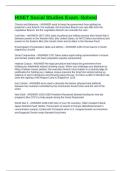
HISET Social Studies Exam -Solved
Checks and Balances - ANSWER-used to keep the government from getting too
powerful in one branch. For example, the Executive Branch can veto bills from the
Legislative Branch, but the Legislative Branch can override the veto.
Cold War - ANSWER-1947-1991 state of political and military tension after World War II
between powers in the Western Bloc (the United States, its NATO allies and others) and
powers in the Eastern Bloc (the Soviet Union and its allies in the Warsaw Pact).
Emancipation Proclamation (date and define) - ANSWER-1863 Freed slaves in South
(signed by Lincoln)
Great Compromise - ANSWER-1787 Gave states equal voting representation in House
and Senate (states with lower population equally represented)
Habeas Corpus - ANSWER-the legal procedure that keeps the government from
holding you indefinitely without showing cause. When you challenge your detention by
filing a habeas corpus petition, the executive branch must explain to a neutral judge its
justification for holding you. Habeas corpus prevents the King from simply locking up
subjects in secret dungeons and throwing away the key. It's been a pillar of Western law
since the signing of the Magna Carta in England in 1215.
Iron Curtain - ANSWER-term used to describe the barrier (physical and political)
between the countries controlled by the Communist Soviet Union and the rest of the
world
New Deal - ANSWER-1933-1938 President Roosevelt allowed funding for new job
programs (like CCC) to help people during the Great Depression
World War II - ANSWER-1939-1945 War of over 30 countries. Hitler invaded Poland,
Japan bombed Pearl Harbor. Persecution of Jewish in Europe (killed/imprisoned in
concentration camps). Ended with D-Dayand when U.S. dropped bombs on Hiroshima
and Nagasaki Soviet troops liberated Auschwitz
Checks and Balances - ANSWER-used to keep the government from getting too
powerful in one branch. For example, the Executive Branch can veto bills from the
Legislative Branch, but the Legislative Branch can override the veto.
Cold War - ANSWER-1947-1991 state of political and military tension after World War II
between powers in the Western Bloc (the United States, its NATO allies and others) and
powers in the Eastern Bloc (the Soviet Union and its allies in the Warsaw Pact).
Emancipation Proclamation (date and define) - ANSWER-1863 Freed slaves in South
(signed by Lincoln)
Great Compromise - ANSWER-1787 Gave states equal voting representation in House
and Senate (states with lower population equally represented)
Habeas Corpus - ANSWER-the legal procedure that keeps the government from
holding you indefinitely without showing cause. When you challenge your detention by
filing a habeas corpus petition, the executive branch must explain to a neutral judge its
justification for holding you. Habeas corpus prevents the King from simply locking up
subjects in secret dungeons and throwing away the key. It's been a pillar of Western law
since the signing of the Magna Carta in England in 1215.
Iron Curtain - ANSWER-term used to describe the barrier (physical and political)
between the countries controlled by the Communist Soviet Union and the rest of the
world
New Deal - ANSWER-1933-1938 President Roosevelt allowed funding for new job
programs (like CCC) to help people during the Great Depression
World War II - ANSWER-1939-1945 War of over 30 countries. Hitler invaded Poland,
Japan bombed Pearl Harbor. Persecution of Jewish in Europe (killed/imprisoned in
concentration camps). Ended with D-Dayand when U.S. dropped bombs on Hiroshima
and Nagasaki Soviet troops liberated Auschwitz