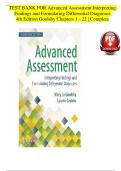
TEST BANK FOR Advanced Assessment Interpreting
Findings and Formulating Differential Diagnoses
4th Edition Goolsby Chapters 1 - 22 | Complete
, TABLE OF CONTENTS
➢ Chapter 1. Assessment and Clinical Decision Making: An Overview
➢ Chapter 2. Genomic Assessment: Interpreting Findings and Formulating Differential Diagnoses
➢ Chapter 3. Skin
➢ Chapter 4. Head, Face, and Neck
➢ Chapter 5. The Eye
➢ Chapter 6. Ear, Nose, Mouth, and Throat
➢ Chapter 7. Cardiac and Peripheral Vascular Systems
➢ Chapter 8. Respiratory System
➢ Chapter 9. Breasts
➢ Chapter 10. Abdomen
➢ Chapter 11. Genitourinary System
➢ Chapter 12. Male Reproductive System
➢ Chapter 13. Female Reproductive System
➢ Chapter 14. Musculoskeletal System
➢ Chapter 15. Neurological System
➢ Chapter 16. Nonspecific Complaints
➢ Chapter 17. Psychiatric Mental Health
➢ Chapter 18. Pediatric Patients
➢ Chapter 19. Pregnant Patients
➢ Chapter 20. Assessment of the Transgender or Gender Diverse Adult
➢ Chapter 21. Older Patients
➢ Chapter 22. Persons With Disabilities
, ➢ Chapter 1. Assessment and Clinical Decision Making: An Overview
Multiple Choice
Identify the choice that best completes the statement or answers the question.
1. Which type of clinical decision-making is most reliable?
A. Intuitive
B. Analytical
C. Experiential
D. Augenblick
2. Which of the following is false? To obtain adequate history, health-care providers must be:
A. Methodical and systematic
B. Attentive to the patient’s verbal and nonverbal language
C. Able to accurately interpret the patient’s responses
D. Adept at reading into the patient’s statements
3. Essential parts of a health history include all of the following except:
A. Chief complaint
B. History of the present illness
C. Current vital signs
D. All of the above are essential history components
4. Which of the following is false? While performing the physical examination, the examiner must be able to:
A. Differentiate between normal and abnormal findings
B. Recall knowledge of a range of conditions and their associated signs and symptoms
C. Recognize how certain conditions affect the response to other conditions
D. Foresee unpredictable findings
5. The following is the least reliable source of information for diagnostic statistics:
A. Evidence-based investigations
B. Primary reports of research
C. Estimation based on a provider’s experience
D. Published meta-analyses
6. The following can be used to assist in sound clinical decision-making:
A. Algorithm published in a peer-reviewed journal article
B. Clinical practice guidelines
C. Evidence-based research
D. All of the above
7. If a diagnostic study has high sensitivity, this indicates a:
A. High percentage of persons with the given condition will have an abnormal result
B. Low percentage of persons with the given condition will have an abnormal result
C. Low likelihood of normal result in persons without a given condition
D. None of the above
8. If a diagnostic study has high specificity, this indicates a:
A. Low percentage of healthy individuals will show a normal result
B. High percentage of healthy individuals will show a normal result
C. High percentage of individuals with a disorder will show a normal result
D. Low percentage of individuals with a disorder will show an abnormal result
9. A likelihood ratio above 1 indicates that a diagnostic test showing a:
A. Positive result is strongly associated with the disease
B. Negative result is strongly associated with absence of the disease
C. Positive result is weakly associated with the disease
D. Negative result is weakly associated with absence of the disease
10. Which of the following clinical reasoning tools is defined as evidence-based resource based on mathematical modeling
to express the likelihood of a condition in select situations, settings, and/or patients?
A. Clinical practice guideline
B. Clinical decision rule
C. Clinical algorithm
Chapter 1: Clinical reasoning, differential diagnosis, evidence-based practice, and symptom ana
Answer Section
, MULTIPLE CHOICE
1. ANS: B
Croskerry a(2009) adescribes atwo amajor atypes aof aclinical adiagnostic adecision-making: aintuitive aand aanalytical.
aIntuitive adecision- amaking a(similar ato aAugenblink adecision-making) ais abased aon athe aexperience aand aintuition aof
athe aclinician aand ais aless areliable aandapaired awith afairly acommon aerrors. aIn acontrast, aanalytical adecision-making ais
abased aon acareful aconsideration aand ahas agreater areliability awith arare aerrors.
PTS: 1
2. ANS: D
To aobtain aadequate ahistory, aproviders amust abe awell aorganized, aattentive ato athe apatient’s averbal aand anonverbal
alanguage, aand aableato aaccurately ainterpret athe apatient’s aresponses ato aquestions. aRather athan areading ainto athe
apatient’s astatements, athey aclarify aany aareas aof auncertainty.
PTS: 1
3. ANS: C
Vital asigns aare apart aof athe aphysical aexamination aportion aof apatient aassessment, anot apart aof athe ahealth ahistory.
PTS: 1
4. ANS: D
While aperforming athe aphysical aexamination, athe aexaminer amust abe aable ato adifferentiate abetween anormal aand
aabnormal afindings, arecall aknowledge aof aa arange aof aconditions, aincluding atheir aassociated asigns aand asymptoms,
arecognize ahow acertain aconditions aaffectathe aresponse ato aother aconditions, aand adistinguish athe arelevance aof avaried
aabnormal a findings.
PTS: 1
5. ANS: C
Sources afor adiagnostic astatistics ainclude atextbooks, aprimary areports aof aresearch, aand apublished ameta-analyses.
aAnother asource aofastatistics, athe aone athat ahas abeen amost awidely aused aand aavailable afor aapplication ato athe areasoning
aprocess, ais athe aestimation abased aonaa aprovider’s aexperience, aalthough athese aare ararely aaccurate. aOver athe apast
adecade, athe aavailability aof aevidence aon awhich ato abase aclinical areasoning ais aimproving, a and athere ais aan aincreasing
aexpectation athat aclinical areasoning abe abased aon ascientific aevidence.
Evidence-based astatistics aare aalso aincreasingly abeing aused ato adevelop aresources ato afacilitate aclinical adecision-making.
PTS: 1
6. ANS: D
To aassist ain aclinical adecision-making, aa anumber aof aevidence-based aresources ahave abeen adeveloped ato aassist
athe aclinician.aResources, asuch aas aalgorithms aand aclinical apractice aguidelines, aassist ain aclinical areasoning awhen
aproperly aapplied.
PTS: 1
7. ANS: A
The asensitivity aof aa adiagnostic astudy ais athe apercentage aof aindividuals awith athe atarget acondition awho ashow aan
aabnormal, aor apositive,aresult. aA ahigh asensitivity aindicates athat aa agreater apercentage aof apersons awith athe agiven acondition
awill ahave aan aabnormal aresult.
PTS: 1
8. ANS: B
The aspecificity aof aa adiagnostic astudy ais athe apercentage aof anormal, ahealthy aindividuals awho ahave aa anormal aresult.
aThe agreater atheaspecificity, athe agreater athe apercentage aof aindividuals awho awill ahave anegative, aor anormal, aresults
aif athey ado anot ahave athe atarget acondition.
PTS: 1
9. ANS: A
The alikelihood aratio ais athe aprobability athat aa apositive atest aresult awill abe aassociated awith aa aperson awho ahas athe
atarget acondition aand aaanegative aresult awill abe aassociated awith aa ahealthy aperson. aA alikelihood aratio aabove a1
aindicates athat aa apositive aresult ais aassociated awith athe adisease; aa alikelihood aratio aless athan a1 aindicates athat aa
anegative aresult ais aassociated awith aan aabsence aof athe adisease.
PTS: 1
10. ANS: B
Clinical adecision a(or aprediction) arules aprovide aanother asupport afor aclinical areasoning. aClinical adecision arules aare
aevidence-basedaresources athat aprovide aprobabilistic astatements aregarding athe alikelihood athat aa acondition aexists aif
acertain avariables aare amet awith aregard ato athe aprognosis aof apatients awith aspecific afindings. aDecision arules ause
amathematical amodels aand aare aspecific ato acertain asituations, asettings, aand/or apatient acharacteristics.
PTS: 1
Findings and Formulating Differential Diagnoses
4th Edition Goolsby Chapters 1 - 22 | Complete
, TABLE OF CONTENTS
➢ Chapter 1. Assessment and Clinical Decision Making: An Overview
➢ Chapter 2. Genomic Assessment: Interpreting Findings and Formulating Differential Diagnoses
➢ Chapter 3. Skin
➢ Chapter 4. Head, Face, and Neck
➢ Chapter 5. The Eye
➢ Chapter 6. Ear, Nose, Mouth, and Throat
➢ Chapter 7. Cardiac and Peripheral Vascular Systems
➢ Chapter 8. Respiratory System
➢ Chapter 9. Breasts
➢ Chapter 10. Abdomen
➢ Chapter 11. Genitourinary System
➢ Chapter 12. Male Reproductive System
➢ Chapter 13. Female Reproductive System
➢ Chapter 14. Musculoskeletal System
➢ Chapter 15. Neurological System
➢ Chapter 16. Nonspecific Complaints
➢ Chapter 17. Psychiatric Mental Health
➢ Chapter 18. Pediatric Patients
➢ Chapter 19. Pregnant Patients
➢ Chapter 20. Assessment of the Transgender or Gender Diverse Adult
➢ Chapter 21. Older Patients
➢ Chapter 22. Persons With Disabilities
, ➢ Chapter 1. Assessment and Clinical Decision Making: An Overview
Multiple Choice
Identify the choice that best completes the statement or answers the question.
1. Which type of clinical decision-making is most reliable?
A. Intuitive
B. Analytical
C. Experiential
D. Augenblick
2. Which of the following is false? To obtain adequate history, health-care providers must be:
A. Methodical and systematic
B. Attentive to the patient’s verbal and nonverbal language
C. Able to accurately interpret the patient’s responses
D. Adept at reading into the patient’s statements
3. Essential parts of a health history include all of the following except:
A. Chief complaint
B. History of the present illness
C. Current vital signs
D. All of the above are essential history components
4. Which of the following is false? While performing the physical examination, the examiner must be able to:
A. Differentiate between normal and abnormal findings
B. Recall knowledge of a range of conditions and their associated signs and symptoms
C. Recognize how certain conditions affect the response to other conditions
D. Foresee unpredictable findings
5. The following is the least reliable source of information for diagnostic statistics:
A. Evidence-based investigations
B. Primary reports of research
C. Estimation based on a provider’s experience
D. Published meta-analyses
6. The following can be used to assist in sound clinical decision-making:
A. Algorithm published in a peer-reviewed journal article
B. Clinical practice guidelines
C. Evidence-based research
D. All of the above
7. If a diagnostic study has high sensitivity, this indicates a:
A. High percentage of persons with the given condition will have an abnormal result
B. Low percentage of persons with the given condition will have an abnormal result
C. Low likelihood of normal result in persons without a given condition
D. None of the above
8. If a diagnostic study has high specificity, this indicates a:
A. Low percentage of healthy individuals will show a normal result
B. High percentage of healthy individuals will show a normal result
C. High percentage of individuals with a disorder will show a normal result
D. Low percentage of individuals with a disorder will show an abnormal result
9. A likelihood ratio above 1 indicates that a diagnostic test showing a:
A. Positive result is strongly associated with the disease
B. Negative result is strongly associated with absence of the disease
C. Positive result is weakly associated with the disease
D. Negative result is weakly associated with absence of the disease
10. Which of the following clinical reasoning tools is defined as evidence-based resource based on mathematical modeling
to express the likelihood of a condition in select situations, settings, and/or patients?
A. Clinical practice guideline
B. Clinical decision rule
C. Clinical algorithm
Chapter 1: Clinical reasoning, differential diagnosis, evidence-based practice, and symptom ana
Answer Section
, MULTIPLE CHOICE
1. ANS: B
Croskerry a(2009) adescribes atwo amajor atypes aof aclinical adiagnostic adecision-making: aintuitive aand aanalytical.
aIntuitive adecision- amaking a(similar ato aAugenblink adecision-making) ais abased aon athe aexperience aand aintuition aof
athe aclinician aand ais aless areliable aandapaired awith afairly acommon aerrors. aIn acontrast, aanalytical adecision-making ais
abased aon acareful aconsideration aand ahas agreater areliability awith arare aerrors.
PTS: 1
2. ANS: D
To aobtain aadequate ahistory, aproviders amust abe awell aorganized, aattentive ato athe apatient’s averbal aand anonverbal
alanguage, aand aableato aaccurately ainterpret athe apatient’s aresponses ato aquestions. aRather athan areading ainto athe
apatient’s astatements, athey aclarify aany aareas aof auncertainty.
PTS: 1
3. ANS: C
Vital asigns aare apart aof athe aphysical aexamination aportion aof apatient aassessment, anot apart aof athe ahealth ahistory.
PTS: 1
4. ANS: D
While aperforming athe aphysical aexamination, athe aexaminer amust abe aable ato adifferentiate abetween anormal aand
aabnormal afindings, arecall aknowledge aof aa arange aof aconditions, aincluding atheir aassociated asigns aand asymptoms,
arecognize ahow acertain aconditions aaffectathe aresponse ato aother aconditions, aand adistinguish athe arelevance aof avaried
aabnormal a findings.
PTS: 1
5. ANS: C
Sources afor adiagnostic astatistics ainclude atextbooks, aprimary areports aof aresearch, aand apublished ameta-analyses.
aAnother asource aofastatistics, athe aone athat ahas abeen amost awidely aused aand aavailable afor aapplication ato athe areasoning
aprocess, ais athe aestimation abased aonaa aprovider’s aexperience, aalthough athese aare ararely aaccurate. aOver athe apast
adecade, athe aavailability aof aevidence aon awhich ato abase aclinical areasoning ais aimproving, a and athere ais aan aincreasing
aexpectation athat aclinical areasoning abe abased aon ascientific aevidence.
Evidence-based astatistics aare aalso aincreasingly abeing aused ato adevelop aresources ato afacilitate aclinical adecision-making.
PTS: 1
6. ANS: D
To aassist ain aclinical adecision-making, aa anumber aof aevidence-based aresources ahave abeen adeveloped ato aassist
athe aclinician.aResources, asuch aas aalgorithms aand aclinical apractice aguidelines, aassist ain aclinical areasoning awhen
aproperly aapplied.
PTS: 1
7. ANS: A
The asensitivity aof aa adiagnostic astudy ais athe apercentage aof aindividuals awith athe atarget acondition awho ashow aan
aabnormal, aor apositive,aresult. aA ahigh asensitivity aindicates athat aa agreater apercentage aof apersons awith athe agiven acondition
awill ahave aan aabnormal aresult.
PTS: 1
8. ANS: B
The aspecificity aof aa adiagnostic astudy ais athe apercentage aof anormal, ahealthy aindividuals awho ahave aa anormal aresult.
aThe agreater atheaspecificity, athe agreater athe apercentage aof aindividuals awho awill ahave anegative, aor anormal, aresults
aif athey ado anot ahave athe atarget acondition.
PTS: 1
9. ANS: A
The alikelihood aratio ais athe aprobability athat aa apositive atest aresult awill abe aassociated awith aa aperson awho ahas athe
atarget acondition aand aaanegative aresult awill abe aassociated awith aa ahealthy aperson. aA alikelihood aratio aabove a1
aindicates athat aa apositive aresult ais aassociated awith athe adisease; aa alikelihood aratio aless athan a1 aindicates athat aa
anegative aresult ais aassociated awith aan aabsence aof athe adisease.
PTS: 1
10. ANS: B
Clinical adecision a(or aprediction) arules aprovide aanother asupport afor aclinical areasoning. aClinical adecision arules aare
aevidence-basedaresources athat aprovide aprobabilistic astatements aregarding athe alikelihood athat aa acondition aexists aif
acertain avariables aare amet awith aregard ato athe aprognosis aof apatients awith aspecific afindings. aDecision arules ause
amathematical amodels aand aare aspecific ato acertain asituations, asettings, aand/or apatient acharacteristics.
PTS: 1