

100% satisfaction guarantee Immediately available after payment Both online and in PDF No strings attached 4.2 TrustPilot
logo-home
Exam (elaborations)

MGT 330 Final Exam 2025

Rating
-
Sold
-
Pages
19
Grade
A+
Uploaded on
01-09-2025
Written in
2025/2026

Human Resource Management (HRM) - -•System of organizational activities to attract, develop, and motivate an effective and qualified workforce. Value - -People create _____ Planning, Programming, Evaluating - -What are the 3 stages in Human Resources (HR) planning HR Planning - -HR Managers must know the company's business plans HR Programming - -HR Managers implement specific activities HR Evaluating - -HR Managers evaluate whether activities are producing results needed to pursue business plans Demand Forecasts - -Determine how many and what type of people are needed Laboe Supply Forecasts - -Forecasting how many and what types of employees are available Include projecting workforce demographic trends Reconciling Supply and Demand - -When managers need to hire, they use fair and competitive compensation policies to attract talent Job Analysis - -A tool for determining what is done on a given job and what should be done on that job Job description - -Describes the essential tasks, duties, and responsibilities involved in performing the job Job specification - -Describes the knowledge, skills, abilities, and other characteristics (KSAOs) needed to perform the job Recruitment - -The development of a pool of applicants for jobs in an organization Selection - -Choosing from among qualified applicants to hire into an organization Unstructured/nondirective interview - -Interviewer asks different interviewees different questions MGT 330 MGT 330 Structured Interview - -Interviewer asks all applicants the same questions and compares their responses to a standardized set of answers - Situational - Behavioral Reliability - -The consistency of test scores over a time and across alternative measurements Vaidity - -The degree to which a selection test predicts or correlates with job performance Layoffs - -May involve downsizing or restructuring Outplacement - -______ helps dismissed people regain employment elsewhere Termination - -_______ may involve poor performance or other reasons Employment-at-will - -Legal concept that an employee may be terminated for any reason Termination interview - -The manager discusses a dismissal decision with the employee Adverse impact - -One common reason employers are sued for discrimination is ___________; when a seemingly neutral employment practice has a disproportionately negative effect on a protected group Needs assessment - -Analysis identifying the jobs, people, and departments that need training Development - -Helping managers and professional employees learn the broad skills needed for their present and future jobs Orientation training - -Training designed to introduce new employees to the company and familiarize them with policies, procedures, culture and the like Team training - -Training that provides employees with the skills and perspectives they need to collaborate with others Diversity Training - -Programs that focus on identifying and reducing hidden biases against people with differences and developing the skills needed to manage a diversified workforce Management Development Programs - -Training for new or experienced managers, often focused on leadership and other "people skills." MGT 330 MGT 330 Performance Appraisal (PA) - -Assessment of an employee's job performance. •Administrative •Developmental Management by objectives (MBO) - -involves a subordinate and a supervisor agreeing in advance on specific performance goals (objectives). 360-degree appraisal - -process of using multiple sources of appraisal to gain a comprehensive perspective on one's performance. Cafeteria or Flexible Benefit Programs - -Employees choose from a menu of options to create a benefit package tailored to their needs. Employees are given credits to spend on benefits that fit their unique needs The Equal Pay Act (E P A) of 19 63 - -prohibits unequal pay for men and women who perform equal work Labor Relations - -The system of relationships and interactions between workers and management Managing Diversity and Inclusion - -Managing a diverse workforce by recognizing the characteristics common to groups while dealing with people as individuals and supporting, nurturing, and using their differences to the organization's advantage Glass ceiling - -A metaphor alluding to the invisible barriers that prevent minorities and women from being promoted to top corporate positions Affirmative action - -Special efforts to recruit and hire qualified members of groups that were discriminated against in the past. Sexual Harassment - -Conduct of a sexual nature that has negative consequences for employment Violate Title V I I of the Civil Rights Act of 19 64, regardless of the sex of the harasser and the victim Quid pro quo harassment - -form of sexual harassment in which sexual favors are requested in return for job-related benefits Hostile environment - -Occurs when unwelcome sexual conduct has the effect of unreasonably interfering with job performance or creating an intimidating or hostile, working environment People with disabilities - -The largest unemployed minority in the US is _____ MGT 330 MGT 330 Disability - -a physical or mental impairment that substantially limits one or more major life activities Monolithic Organization - -Has a low degree of structural integration—employing few women, minorities, or other groups that differ from the majority—and thus has a homogeneous employee population Pluralistic Organization - -Has a relatively diverse employee population and makes an effort to involve employees from different gender, racial, or cultural backgrounds Multicultural Organization - -Values cultural diversity and seeks to utilize and encourage it Organizational Assessment - -Assess the organization's workforce, culture, policies, and practices in recruitment, promotions, benefits, and compensation Identify problem areas and opportunities Attract a Diverse Group of Qualified Employees - -_______ involves - recruiting - accommodating work and family needs - alternative work arrangements Awareness Building - -Designed to increase recognition of meaning and importance of valuing diversity Also means teaching the unwritten "rules" or cultural values to those who need them; or changing the rules when needed Skill Building - -Designed to develop the behaviors needed to work best with one another and with customers in a diverse environment Mostly interpersonal skills such as active listening, coaching, and giving feedback Expatriates - -are parent-company nationals who are sent to work at a foreign subsidiary Host-country nationals - -individuals from the country where an overseas subsidiary is located Third-country nationals - -individuals from a country other than the home country or the host country of an overseas subsidiary MGT 330 MGT 330 Ethnocentrism - -judging others by the standards of one's group or culture, which are seen as superior Culture shock - -the disorientation and stress associated with being in a foreign environment Power distance - -the extent to which a society accepts the fact that power in organizations is distributed unequally Individualism/collectivism - -the extent to which people act on their own or as a part of a group Uncertainty avoidance - -the extent to which people in a society feel threatened by uncertain and ambiguous situations Masculinity/femininity - -the extent to which a society values quantity of life over quality of life Vision - -A mental image of a possible and desirable future state of the organization Necessary for effective leadership Leaders - -Effectively orchestrating important change Setting direction for the firm Inspiring people to attain the vision Managers - -Dealing with day-to-day complexities of organization Planning and budgeting routines Structuring the organization, staffing it with capable people, and monitoring results Supervisory Leadership - -Behavior that provides guidance, support, and corrective feedback for day-to-day activities Strategic Leadership - -Behavior that gives purpose and meaning to organizations, envisioning and creating a positive future Followers - -Think independently while remaining committed to organizational goals. Demonstrate enthusiasm and commitment to the organization, a person, or a purpose outside their own interests. Master important skills MGT 330 MGT 330 Hold high performance standards Power - -The ability to influence others Legitimate power - -Your supervisor asks you to work an extra shift and you agree Reward power - -The manager gives you a large bonus for exceptional performance Coercive power - -The accounting director assigns you several unpopular tasks Referent power - -Your boss is a great person, so you're willing to work hard for her Expert power - -The marketing team leader is very experienced, so you listen to him Trait Approach - -A leadership perspective that attempts to determine the personal characteristics that great leaders share - Drive. - Leadership motivation. - Integrity. - Self-confidence. - Knowledge of the business Behavioral Approach - -A leadership perspective that attempts to identify what good leaders do—that is, what behaviors they exhibit Task performance behaviors - -Actions taken to ensure that the work group or organization reaches its goals Group maintenance behaviors - -Actions taken to ensure the satisfaction of group members, develop and maintain harmonious work relationships, and preserve social stability Leader-member exchange (LMX) theory - -Highlights importance of leader behaviors not just toward the group but also toward individuals on a personal basis Managers must consider cross-cultural differences Autocratic leadership - -A form of leadership in which the leader makes decisions on his or her own and then announces those decisions to the group Democratic leadership - -A form of leadership in which the leader solicits input from subordinates MGT 330 MGT 330 Laissez-faire - -Leadership philosophy characterized by an absence of managerial decision making Situational Approach - -Leadership perspective proposing that universally important traits and behaviors do not exist, and effective leadership behavior varies from situation to situation Tannenbaum and Schmidt (19 58) said managers should consider forces in the manager, the subordinate, and the organization Vroom Model - -A situational model that focuses on the participative dimension of leadership Fiedler's Contingency Model of Leadership Effectiveness - -A situational approach to leadership postulating that effectiveness depends on the personal style of the leader and the degree to which the situation gives the leader power, control, and influence over the situation Hersey and Blanchard's Situational Theory - -A life-cycle theory of leadership postulating that a manager should consider an employee's psychological and job maturity before deciding whether task performance or maintenance behaviors are more important Job maturity - -The level of the employee's skills and technical knowledge relative to the task being performed Psychological maturity - -An employee's self-confidence and self-respect Path-Goal Theory - -Concerns how leaders influence subordinates' perceptions of their work goals and the paths they follow toward attainment of those goals The Two key situational factors when using the Path-Goal framework - -___________ are Personal characteristics of followers and Environmental pressures and demands Substitutes for Leadership - -Factors in the workplace that can exert the same influence on employees as leaders would provide Charismatic Leaders - -A person who is dominant, self-confident, convinced of the moral righteousness of his beliefs, and able to arouse a sense of excitement and adventure in followers Transformational Leaders - -A leader who motivates people to transcend their personal interests for the good of the group MGT 330 MGT 330 Transactional leaders - -view management as a series of transactions in which they use their legitimate, reward, and coercive powers to give commands and exchange rewards for services rendered Level 5 leadership - -a combination of strong professional will (determination) and humility that builds enduring greatness Authentic Leadership - -A style in which the leader is true to himself or herself while leading Pseudotransformational leaders - -talk about positive change but allow their self-interest to take precedence over followers' needs Servant-leader - -A leader who serves others' needs while strengthening the organization Shared leadership - -Rotating leadership, in which people rotate through the leadership role based on which person has the most relevant skills at a particular time Bridge leaders - -Leaders who bridge conflicting value systems or different cultures Lateral leadership - -Style in which colleagues at the same hierarchical level are invited to collaborate and facilitate joint problem solving Motivation - -Forces that energize, direct, and sustain a person's efforts Goal-Setting Theory - -A motivation theory stating that people have conscious goals that energize them and direct their thoughts and behaviors toward a particular end Motivational Goals - -The most powerful goals are meaningful; purposes that appeal to people's "higher" values add extra motivating power SMART Goals - -______ are specific, measurable, achievable, results based, and time specific Stretch Goals - -Targets that are particularly demanding, sometimes even thought to be impossible Two types: - Vertical - Horizontal Law of Effect - -A law formulated by Edward Thorndike in 19 11 stating that behavior that is followed by positive consequences will likely be repeated Reinforcers - -positive consequences that motivate behavior MGT 330 MGT 330 Organizational behavior modification (OB MOD) - -_______ is the application of reinforcement theory in organizational settings Positive reinforcement - -Applying a consequence that increases the likelihood of a person repeating the behavior that led to it Negative reinforcement. - -Removing or withholding an undesirable consequence Punishment - -Administering an aversive consequence Extinction - -Withdrawing or failing to provide a reinforcing consequence Expectancy Theory - -A theory proposing that people will behave based on their perceived likelihood that their effort will lead to a certain outcome and on how highly they value that outcome Expectancy - -People's perceived likelihood that their efforts will enable them to attain their performance goals True - -All else equal, high expectancies create higher motivation than do low expectancies Outcomes - -A consequence a person receives for his or her performance Instrumentality - -The perceived likelihood that performance will be followed by a particular outcome Valence - -The value an outcome holds for the person contemplating it Can be positive or negative Expectancy, instrumentality, and total valence - -High ____, _____, and ____ create high motivation Content Theory - -Identifies the needs that people want to satisfy Needs Hierarchy - -A human needs theory postulating that people are motivated to satisfy unmet needs in a specific order First - Physiological 2 - Safety 3 - Social 4 - Esteem Last - Self-actualization MGT 330 MGT 330 Maslow's need hierarchy - -created two general levels of needs: lower-level needs must be satisfied before higher-level needs become important ERG Theory - -A human needs theory postulating that people have three basic sets of needs that can operate simultaneously - Existence needs - Relatedness needs - Growth needs Existence needs - -All material and physiological desires Relatedness needs - -Involve relationships with other people and are satisfied through the process of mutually sharing thoughts and feelings Growth needs - -Motivate people to productively or creatively change themselves or their environment Need for achievement - -A strong orientation toward accomplishment and an obsession with success and goal attainment Need for affiliation - -A strong desire to be liked by other people Need for power - -A desire to influence or control other people Extrinsic Rewards - -Rewards given to a person by the boss, the company, or some other person Examples include pay, benefits, business class airline travel, or a large office Intrinsic Reward - -The reward a worker derives directly from performing the job itself Essential to the motivation underlying creativity Job rotation - -Changing from one task to another to alleviate boredom. Job enlargement - -Giving people additional tasks at the same time to alleviate boredom Job enrichment - -Changing a task to make it inherently more rewarding, motivating, and satisfying Hygiene Factors - -Characteristics of the workplace, such as company policies, working conditions, pay, and supervision, that can make people dissatisfied No matter how good these factors are, they will not make people truly satisfied or motivated to do a good job MGT 330 MGT 330 Motivators - -Factors that make a job more motivating, such as additional job responsibilities, opportunities for personal growth and recognition, and feelings of achievement Growth need strength - -the degree to which a person wants personal and psychological development Core dimensions to enriched jobs - -Skill variety Task identity Task significance Autonomy Feedback Empowerment - -The process of sharing power with employees, thereby enhancing their confidence in their ability to perform their jobs and their belief that they

Show more Read less
Institution
MGT 330
Course
MGT 330


Whoops! We can’t load your doc right now. Try again or contact support.

Written for

Institution
MGT 330
Course
MGT 330

Document information

Uploaded on
September 1, 2025
Number of pages
19
Written in
2025/2026
Type
Exam (elaborations)
Contains
Questions & answers

Content preview

MGT 330


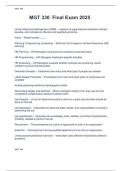
MGT 330 Final Exam 2025

Human Resource Management (HRM) - -•System of organizational activities to attract,
develop, and motivate an effective and qualified workforce.

Value - -People create _____

Planning, Programming, Evaluating - -What are the 3 stages in Human Resources (HR)
planning

HR Planning - -HR Managers must know the company's business plans

HR Programming - -HR Managers implement specific activities

HR Evaluating - -HR Managers evaluate whether activities are producing results
needed to pursue business plans

Demand Forecasts - -Determine how many and what type of people are needed

Laboe Supply Forecasts - -Forecasting how many and what types of employees are
available

Include projecting workforce demographic trends

Reconciling Supply and Demand - -When managers need to hire, they use fair and
competitive compensation policies to attract talent

Job Analysis - -A tool for determining what is done on a given job and what should be
done on that job

Job description - -Describes the essential tasks, duties, and responsibilities involved in
performing the job

Job specification - -Describes the knowledge, skills, abilities, and other characteristics
(KSAOs) needed to perform the job

Recruitment - -The development of a pool of applicants for jobs in an organization

Selection - -Choosing from among qualified applicants to hire into an organization

Unstructured/nondirective interview - -Interviewer asks different interviewees different
questions


MGT 330

,MGT 330


Structured Interview - -Interviewer asks all applicants the same questions and compares
their responses to a standardized set of answers

- Situational
- Behavioral

Reliability - -The consistency of test scores over a time and across alternative
measurements

Vaidity - -The degree to which a selection test predicts or correlates with job
performance

Layoffs - -May involve downsizing or restructuring

Outplacement - -______ helps dismissed people regain employment elsewhere

Termination - -_______ may involve poor performance or other reasons

Employment-at-will - -Legal concept that an employee may be terminated for any
reason

Termination interview - -The manager discusses a dismissal decision with the employee

Adverse impact - -One common reason employers are sued for discrimination is
___________; when a seemingly neutral employment practice has a disproportionately
negative effect on a protected group

Needs assessment - -Analysis identifying the jobs, people, and departments that need
training

Development - -Helping managers and professional employees learn the broad skills
needed for their present and future jobs

Orientation training - -Training designed to introduce new employees to the company
and familiarize them with policies, procedures, culture and the like

Team training - -Training that provides employees with the skills and perspectives they
need to collaborate with others

Diversity Training - -Programs that focus on identifying and reducing hidden biases
against people with differences and developing the skills needed to manage a
diversified workforce

Management Development Programs - -Training for new or experienced managers,
often focused on leadership and other "people skills."


MGT 330

, MGT 330


Performance Appraisal (PA) - -Assessment of an employee's job performance.

•Administrative
•Developmental

Management by objectives (MBO) - -involves a subordinate and a supervisor agreeing
in advance on specific performance goals (objectives).

360-degree appraisal - -process of using multiple sources of appraisal to gain a
comprehensive perspective on one's performance.

Cafeteria or Flexible Benefit Programs - -Employees choose from a menu of options to
create a benefit package tailored to their needs.
Employees are given credits to spend on benefits that fit their unique needs

The Equal Pay Act (E P A) of 19 63 - -prohibits unequal pay for men and women who
perform equal work

Labor Relations - -The system of relationships and interactions between workers and
management

Managing Diversity and Inclusion - -Managing a diverse workforce by recognizing the
characteristics common to groups while dealing with people as individuals and
supporting, nurturing, and using their differences to the organization's advantage

Glass ceiling - -A metaphor alluding to the invisible barriers that prevent minorities and
women from being promoted to top corporate positions

Affirmative action - -Special efforts to recruit and hire qualified members of groups that
were discriminated against in the past.

Sexual Harassment - -Conduct of a sexual nature that has negative consequences for
employment

Violate Title V I I of the Civil Rights Act of 19 64, regardless of the sex of the harasser
and the victim

Quid pro quo harassment - -form of sexual harassment in which sexual favors are
requested in return for job-related benefits

Hostile environment - -Occurs when unwelcome sexual conduct has the effect of
unreasonably interfering with job performance or creating an intimidating or hostile,
working environment

People with disabilities - -The largest unemployed minority in the US is _____


MGT 330

$24.49
Get access to the full document:

100% satisfaction guarantee
Immediately available after payment
Both online and in PDF
No strings attached

Get to know the seller
Seller avatar
AlexScorer
4.0
(1)

Get to know the seller

Seller avatar
AlexScorer Chamberlain College Of Nursing
View profile
Follow You need to be logged in order to follow users or courses
Sold
5
Member since
1 year
Number of followers
0
Documents
1535
Last sold
3 months ago
Best Scorers Review Guide

Hesitate not to get 100% Recent updated and Verified Documents .Total Guarantee to success

4.0

1 reviews

5
0
4
1
3
0
2
0
1
0

Recently viewed by you

Why students choose Stuvia

Created by fellow students, verified by reviews

Quality you can trust: written by students who passed their tests and reviewed by others who've used these notes.

Didn't get what you expected? Choose another document

No worries! You can instantly pick a different document that better fits what you're looking for.

Pay as you like, start learning right away

No subscription, no commitments. Pay the way you're used to via credit card and download your PDF document instantly.

Student with book image

“Bought, downloaded, and aced it. It really can be that simple.”

Alisha Student

Frequently asked questions
