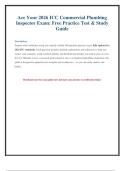
Ace Your 2026 ICC Commercial Plumbing
Inspector Exam: Free Practice Test & Study
Guide
Description:
Prepare with confidence using our expertly crafted 100-question practice exam, fully updated to
2026 IPC standards. Each question includes detailed explanations and references to help you
master code concepts, avoid common pitfalls, and build the knowledge you need to pass on your
first try. Whether you're a seasoned professional or new to commercial plumbing inspection, this
guide is designed to pinpoint your strengths and weaknesses—so you can study smarter, not
harder.
Download your free exam guide now and start your journey to certification today!
,Certify with Confidence: 2026 ICC Commercial Plumbing Inspector
Practice Exam & Study Guide
1. Sump pumps shall be permitted in elevator shafts provided that they are _______________ to
the plumbing system.
a. Directly connected
b. Independently piped
c. Indirectly connected
d. Not connected
Answer: c. Indirectly connected
Explanation: IPC 301.6 Exception allows sump pumps in elevator pits if they discharge through
an indirect waste connection by means of an air gap. This prevents potential sewer gases from en
tering the elevator shaft.
2. What type of water heaters are permitted in bedrooms?
a. Direct vent
b. Power vent
c. Direct vent and power vent
d. Atmospheric vent
Answer: c. Direct vent and power vent
Explanation: IFGC 303.3 (and similar sections in the IPC/IMC) permit direct-vent and power-v
ented appliances in bedrooms, bathrooms, and closets because they are sealed combustion syste
ms that obtain air from and vent directly to the outdoors, posing no risk of depleting indoor oxyg
en.
3. The International Residential Code is applicable to plumbing work in townhouses not more
than _______________ in height with a separate means of egress.
a. Three stories
b. Four stories
c. Two stories
d. Five stories
,Answer: a. Three stories
Explanation: The IRC is designed for one- and two-family dwellings and townhouses of three st
ories or less. Structures exceeding this height typically fall under the International Building Code
(IBC) and International Plumbing Code (IPC).
4. The provisions of the appendices do not apply unless _______________.
a. The builder chooses to use them
b. The contractor requests them
c. Specifically adopted
d. The project is commercial
Answer: c. Specifically adopted
Explanation: Appendices are not enforceable unless the local jurisdiction has explicitly adopted
them into law, as stated in the preface and administrative chapters of all ICC codes.
5. In order to safeguard life, health, and property, the IPC regulates all of the following within
the building environment, except _______________.
a. Materials
b. Installation standards
c. Cost
d. Sanitation
Answer: c. Cost
Explanation: The purpose of the code, as stated in Chapter 1, is to establish minimum requireme
nts to safeguard public health, safety, and welfare. It regulates materials, design, and installation,
but it does not regulate the financial cost of the project.
6. Where different sections of the code specify different requirements, the _______________
requirement shall apply.
a. Least restrictive
b. Most restrictive
c. Most recent
d. Easiest to implement
, Answer: b. Most restrictive
Explanation: This is a fundamental principle of code interpretation. When code sections conflict
, the provision that offers the highest level of safety and protection (the most restrictive) must be
followed.
7. Existing plumbing systems must be brought into compliance with the IPC if the system is
_______________.
a. Over 10 years old
b. A hazard to property
c. Not energy efficient
d. Made of outdated materials
Answer: b. A hazard to property
Explanation: IPC 102.7.1 requires that existing systems that constitute a distinct hazard to life, h
ealth, or property must be altered to comply with the code. General age or inefficiency is not a tri
gger for mandatory upgrade.
8. Where code provisions are in conflict with the referenced standard, the _______________
provisions shall apply.
a. Referenced standard's
b. Code
c. Manufacturer's
d. More lenient
Answer: b. Code
Explanation: As per standard code administration principles, the language of the adopted code it
self takes precedence over any conflicting language in a referenced standard.
9. Where the code official finds that a proposed alternative material does not comply with the
intent of the code provisions, the code official shall _______________.
a. Approve it conditionally
b. State the reason for disapproval in writing to the applicant
c. Refer it to the board of appeals automatically
d. Deny it without explanation
Inspector Exam: Free Practice Test & Study
Guide
Description:
Prepare with confidence using our expertly crafted 100-question practice exam, fully updated to
2026 IPC standards. Each question includes detailed explanations and references to help you
master code concepts, avoid common pitfalls, and build the knowledge you need to pass on your
first try. Whether you're a seasoned professional or new to commercial plumbing inspection, this
guide is designed to pinpoint your strengths and weaknesses—so you can study smarter, not
harder.
Download your free exam guide now and start your journey to certification today!
,Certify with Confidence: 2026 ICC Commercial Plumbing Inspector
Practice Exam & Study Guide
1. Sump pumps shall be permitted in elevator shafts provided that they are _______________ to
the plumbing system.
a. Directly connected
b. Independently piped
c. Indirectly connected
d. Not connected
Answer: c. Indirectly connected
Explanation: IPC 301.6 Exception allows sump pumps in elevator pits if they discharge through
an indirect waste connection by means of an air gap. This prevents potential sewer gases from en
tering the elevator shaft.
2. What type of water heaters are permitted in bedrooms?
a. Direct vent
b. Power vent
c. Direct vent and power vent
d. Atmospheric vent
Answer: c. Direct vent and power vent
Explanation: IFGC 303.3 (and similar sections in the IPC/IMC) permit direct-vent and power-v
ented appliances in bedrooms, bathrooms, and closets because they are sealed combustion syste
ms that obtain air from and vent directly to the outdoors, posing no risk of depleting indoor oxyg
en.
3. The International Residential Code is applicable to plumbing work in townhouses not more
than _______________ in height with a separate means of egress.
a. Three stories
b. Four stories
c. Two stories
d. Five stories
,Answer: a. Three stories
Explanation: The IRC is designed for one- and two-family dwellings and townhouses of three st
ories or less. Structures exceeding this height typically fall under the International Building Code
(IBC) and International Plumbing Code (IPC).
4. The provisions of the appendices do not apply unless _______________.
a. The builder chooses to use them
b. The contractor requests them
c. Specifically adopted
d. The project is commercial
Answer: c. Specifically adopted
Explanation: Appendices are not enforceable unless the local jurisdiction has explicitly adopted
them into law, as stated in the preface and administrative chapters of all ICC codes.
5. In order to safeguard life, health, and property, the IPC regulates all of the following within
the building environment, except _______________.
a. Materials
b. Installation standards
c. Cost
d. Sanitation
Answer: c. Cost
Explanation: The purpose of the code, as stated in Chapter 1, is to establish minimum requireme
nts to safeguard public health, safety, and welfare. It regulates materials, design, and installation,
but it does not regulate the financial cost of the project.
6. Where different sections of the code specify different requirements, the _______________
requirement shall apply.
a. Least restrictive
b. Most restrictive
c. Most recent
d. Easiest to implement
, Answer: b. Most restrictive
Explanation: This is a fundamental principle of code interpretation. When code sections conflict
, the provision that offers the highest level of safety and protection (the most restrictive) must be
followed.
7. Existing plumbing systems must be brought into compliance with the IPC if the system is
_______________.
a. Over 10 years old
b. A hazard to property
c. Not energy efficient
d. Made of outdated materials
Answer: b. A hazard to property
Explanation: IPC 102.7.1 requires that existing systems that constitute a distinct hazard to life, h
ealth, or property must be altered to comply with the code. General age or inefficiency is not a tri
gger for mandatory upgrade.
8. Where code provisions are in conflict with the referenced standard, the _______________
provisions shall apply.
a. Referenced standard's
b. Code
c. Manufacturer's
d. More lenient
Answer: b. Code
Explanation: As per standard code administration principles, the language of the adopted code it
self takes precedence over any conflicting language in a referenced standard.
9. Where the code official finds that a proposed alternative material does not comply with the
intent of the code provisions, the code official shall _______________.
a. Approve it conditionally
b. State the reason for disapproval in writing to the applicant
c. Refer it to the board of appeals automatically
d. Deny it without explanation