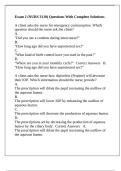
Nurs 3110 Exam Questions With Complete Solutions
Assess for the physical manifestations that occur with alterations
in oxygenation. Correct Answers
Assess for the risk factors affecting a patient's oxygenation.
Correct Answers
Braden scale Correct Answers sensory perception 1-4
moisture 1-4
activity 1-4
mobility 1-4
nutrition 1-4
friction and shear 1-3
out of 23 points.
high points means patient is able to walk and has no risk of
pressure ulcer
pg: 1193
Compare and contrast common alterations associated with
urinary elimination. Describe characteristics of normal and
abnormal urine. Correct Answers transient incontinence-
caused by medical conditions that in many cases are treatable
and reversible.
, functional incontinence- loss of continence because of causes
outside the urinary tract. altered mobility/cognitive impairment
urinary incontinence associated with chronic retention of urine
(poor bladder emptying)
stress urinary incontinence- involuntary leakage of small
volumes with increased intrabdominal pressure. trauma after
childbirth
urge or urgency urinary incontinence
reflex urinary incontinence- involuntary loss of urine occurring
at somewhat predictable intervals when patient reaches specific
bladder volume related to C1 and S2
Characteristics of urine: color pale straw color to amber
hematuria-blood in the urine
clarity-transparent is normal
odor-foul smell indicates UTI
Correctly write an outcome for a goal of care. Correct Answers
ex: Patient's lungs are clear to auscultation, and respiratory rate
is 20 breaths/min by 8/22.
Describe factors that influence personal hygiene practices.
Correct Answers social practices, personal preferences, body
image, socioeconomic status, health beliefs and motivation,
cultural variables, developmental stage, physical condition
Describe how evaluation leads to discontinuation, revision, or
modification of a plan of care. Correct Answers
Describe how hygiene care for the older adult differs from that
for the younger patient. Correct Answers older adults aren't
Assess for the physical manifestations that occur with alterations
in oxygenation. Correct Answers
Assess for the risk factors affecting a patient's oxygenation.
Correct Answers
Braden scale Correct Answers sensory perception 1-4
moisture 1-4
activity 1-4
mobility 1-4
nutrition 1-4
friction and shear 1-3
out of 23 points.
high points means patient is able to walk and has no risk of
pressure ulcer
pg: 1193
Compare and contrast common alterations associated with
urinary elimination. Describe characteristics of normal and
abnormal urine. Correct Answers transient incontinence-
caused by medical conditions that in many cases are treatable
and reversible.
, functional incontinence- loss of continence because of causes
outside the urinary tract. altered mobility/cognitive impairment
urinary incontinence associated with chronic retention of urine
(poor bladder emptying)
stress urinary incontinence- involuntary leakage of small
volumes with increased intrabdominal pressure. trauma after
childbirth
urge or urgency urinary incontinence
reflex urinary incontinence- involuntary loss of urine occurring
at somewhat predictable intervals when patient reaches specific
bladder volume related to C1 and S2
Characteristics of urine: color pale straw color to amber
hematuria-blood in the urine
clarity-transparent is normal
odor-foul smell indicates UTI
Correctly write an outcome for a goal of care. Correct Answers
ex: Patient's lungs are clear to auscultation, and respiratory rate
is 20 breaths/min by 8/22.
Describe factors that influence personal hygiene practices.
Correct Answers social practices, personal preferences, body
image, socioeconomic status, health beliefs and motivation,
cultural variables, developmental stage, physical condition
Describe how evaluation leads to discontinuation, revision, or
modification of a plan of care. Correct Answers
Describe how hygiene care for the older adult differs from that
for the younger patient. Correct Answers older adults aren't