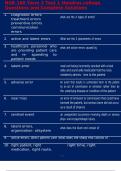
NUR 160 Term 2 Test 1 Hondros college
Questions and Complete Solutions
1. Diagnostic errors
what are the 4 types of errors?
treatment errors
preventive errors
communication
errors
2. active and latent errors What are the 2 placements of errors
3. healthcare personnel who what are active errors caused by
are providing patient care
and re- sponding to
patient needs
4. latent error med cart being incorrectly stocked with a look
alike and sound alike medication that the nurse
mistakenly adminis- ters to the patient
5. adverse error An event that results in unintended harm to the patient
by an act of commission or omission rather than by
the underlying disease or condition of the patient
6. near miss an error of omission or commission that could have
harmed the patient, but serious harm did not occur
as a result of chance
7. sentinel event an unexpected occurrence involving death or serious
phys- ical or psychologic injury
8. latent errors, what does the blunt end consist of
organization- al/system
9. active errors, direct patient care what does the sharp end consist of
10. right patient, right right time, right
medication, right route,
,NUR 160 Term 2 Test 1 Hondros college
Questions and Complete Solutions
what are the 7 rights of medication
administration
,NUR 160 Term 2 Test 1 Hondros college
Questions and Complete Solutions
dose, right education, right
doc- umentation
11. advance directives Signed and witness documents that provide specific
in-
structions for healthcare treatment in the event that
the person is unable to make these decisions
personally at the time they are needed.
12. living will and durable what are the 2 types of advance directives
power of attorney for
healthcare
active listening, maintaining silence, nodding, touch,
13. nonverbal therapeutic
con- veying acceptance are all what type of
commu- nication
communication
14. vernal therapeutic
closed questioning, open-ended questioning,
communica- tion
restating, paraphrasing, clarifying, focusing, reflecting,
stating obser- vations, ottering information,
summarizing are all what type of communication
15. cataracts, glaucoma,
mac- ular degeneration, what are the 4 main causes of visual impairment
diabetic retinopathy
16. presbyopia farsightedness resulting from a loss of elasticity of the
lens of the eye
17. 10 to 22 mm Hg what is the normal range of intraocular pressure
18. bacteria requires a host, synthesizes DNA, RNA and
proteins. can produce independently. causes cellular
injury by releasing toxins that are either
endotoxins or exotoxins
, NUR 160 Term 2 Test 1 Hondros college
Questions and Complete Solutions
19. viral infection a pathogen with a nucleic acid within a protein
shell re- quiring invasion of a host for replication.
causes cellular in-
Questions and Complete Solutions
1. Diagnostic errors
what are the 4 types of errors?
treatment errors
preventive errors
communication
errors
2. active and latent errors What are the 2 placements of errors
3. healthcare personnel who what are active errors caused by
are providing patient care
and re- sponding to
patient needs
4. latent error med cart being incorrectly stocked with a look
alike and sound alike medication that the nurse
mistakenly adminis- ters to the patient
5. adverse error An event that results in unintended harm to the patient
by an act of commission or omission rather than by
the underlying disease or condition of the patient
6. near miss an error of omission or commission that could have
harmed the patient, but serious harm did not occur
as a result of chance
7. sentinel event an unexpected occurrence involving death or serious
phys- ical or psychologic injury
8. latent errors, what does the blunt end consist of
organization- al/system
9. active errors, direct patient care what does the sharp end consist of
10. right patient, right right time, right
medication, right route,
,NUR 160 Term 2 Test 1 Hondros college
Questions and Complete Solutions
what are the 7 rights of medication
administration
,NUR 160 Term 2 Test 1 Hondros college
Questions and Complete Solutions
dose, right education, right
doc- umentation
11. advance directives Signed and witness documents that provide specific
in-
structions for healthcare treatment in the event that
the person is unable to make these decisions
personally at the time they are needed.
12. living will and durable what are the 2 types of advance directives
power of attorney for
healthcare
active listening, maintaining silence, nodding, touch,
13. nonverbal therapeutic
con- veying acceptance are all what type of
commu- nication
communication
14. vernal therapeutic
closed questioning, open-ended questioning,
communica- tion
restating, paraphrasing, clarifying, focusing, reflecting,
stating obser- vations, ottering information,
summarizing are all what type of communication
15. cataracts, glaucoma,
mac- ular degeneration, what are the 4 main causes of visual impairment
diabetic retinopathy
16. presbyopia farsightedness resulting from a loss of elasticity of the
lens of the eye
17. 10 to 22 mm Hg what is the normal range of intraocular pressure
18. bacteria requires a host, synthesizes DNA, RNA and
proteins. can produce independently. causes cellular
injury by releasing toxins that are either
endotoxins or exotoxins
, NUR 160 Term 2 Test 1 Hondros college
Questions and Complete Solutions
19. viral infection a pathogen with a nucleic acid within a protein
shell re- quiring invasion of a host for replication.
causes cellular in-