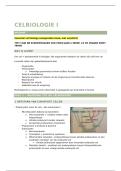
CELBIOLOGIE I
VOORAF
Essential cell biology (aangeraden boek, niet verplicht)
TIP!!! KIJK NR EXAMENVRAGEN VAN VORIG JAAR è ZEKER 1/3 VD VRAGEN KOMT
TERUG
WAT IS LEVEN?
Een cel = basiseenheid in biologie; alle organismen bestaan uit cellen/ zijn zelf een cel
Levende cellen zijn gekarakteriseerd door
- Organisatie
- Homeostase
o Inwendige parameters binnen buffers houden
- Groei & ontwikkeling
- Opname energie en materie uit de omgeving en transformatie daarvan
- Reproductie
- Respons tov stimuli
- Adaptatie aan de omgeving
Morfologische (= bouw,vorm) diversiteit is gekoppeld aan diversiteit in functie
DEEL 1 : INLEIDING TOT DE CELBIOLOGIE
1 ONTSTAAN VAN EUKARYOTE CELLEN
! Prokaryoten (voor de cel) , dan eukaryoten !
- Microfossielen (lijkend op bacteriën)
o Foto-autotrofie = voedsel maken adhv
fotosynthese
o Initieel prokaryoot zonder celwand
o Ancestrale prokaryoten à bacterien
- Prokaryoten à Archeae & bacteria
- Eukaryoten
o Kernmembraan
o Cytoskelet + motorische systemen
o Mitochondria (energie) : endosymbiose tussen aërobe prokaryoten en een
anaërobe voorloper van de eukaryote cel
Aerobe prokaryoot opgenomen door anaerobe eukaryote cel
o Plastiden (plant) : resultaat van endosymbiose tussen fotosynthetische
prokaryoten en een vroege aerobe eukaryote cel
, PROKARYOOT EUKARYOOT
Uitsluitend eencellig Eencellig of meercellig
Celmembraan én celwand Geen celwand bij dieren
Geen kern Kern
Cirkelvormig chromosoom Chromosomen in kern
Niet gecompartimenteerd Celorganellen
Deling door doorsnoering Deling door mitose of meiose
2 DE CHEMISCHE BOUWSTENEN VAN CELLEN
Bouwstenen :
- Suikers – polysachariden
- Nucleotiden - nucleïnezuren
- Vetzuren - lipiden
- Aminozuren – eiwitten / proteïnen
Plant : 95% water
Bacterie : 70% water, 30% chemicaliën (24% macromoleculen à DNA, RNA, proteïnen,
polysacchariden)
- Macromoleculaire assemblage = superstructuur macromoleculen
DE CELLULAIRE BOUWSTENEN
! Structuren niet kunnen tekenen , HERKENNEN (adhv chemische groepen) !
- Koolwaterstoffen (C-H)
o Apolair
- C-O verbindingen
o Alcoholen -OH
o Aldehyden -CHO
o Ketonen -CO
o Esters -COO
o Carbonzuren -COOH
- C-N verbindingen
o Amines – RNH2
o Amiden = CZ + amine -CONH2
- Sulhydryl groepen
o C-SH
o Cysteïne
o Disulfide bruggen (S-S)
- Fosfaten
o H3PO4
o Fosfaat + -OH à Phosphate ester
o Fosfaat + - COOH / + fosfaten à hoog energetische verbinding
, HYDROFIEL VS HYDROFOOB
- Karakter bepaalt interacties van de molecule met omgeving
o Hydrofiel : lost op in water
Ionen : water wordt aangetrokken tot -/+ ionen
Polaire substanties : waterstofbruggen
o Hydrofoob : water vormt netwerk opzich, stof lost niet op
C-H verbindingen
BOUWSTENEN EIWITTEN : AMINOZUREN
Eiwit = lineaire polymeer bestaande uit aminozuren met 3D structuur die gebonden zijn
door peptidebindingen.
- Karakteristieke structuur
o Proteïnogene : meteen ingebouwd in peptideketen (20 AZ)
o Niet – proteïnogene : niet in genetische code voor eiwitsynthese, vervullen
wel andere functies (bestaat geen codon voor)
o Centraal C-atoom
o 1 H-atoom, aminogroep (NH2), carboxyl-groep (COOH) en variabele R-groep
o N-terminus (NH2-groep) & C-terminus (COOH-groep)
o Optische isomeren (L- en D-vormen)
Proteïnen : L-vorm
Vaak voorkomende aminozuren (20) zijn verdeeld in 4 groepen adhv hun zijketens
1. Niet-polaire aminozuren (10)
o Dragen geen lading
o Hydrofoob
o Specifieke R-groep
o Cysteïne : disulfide bruggen tussen meerdere cysteïnes
2. Basische R-groep
o Positief geladen, NH3+
o Hydrofiel
o Lysine, arginine, histidine
3. Zuren
o Negatief geladen, COO-
o Hydrofiel
o Aspartic, glutamic
4. Ongeladen
o Hydrofiel / hydrofoob
o Asn, Gln, Ser, Thr, Tyr
o CO-NH2 / hydroxyl groep (R-OH)
Peptide bindingen = bindingen tussen aminozuren (C-N)
- Polypeptide ruggengraat (-N-C-C-N-)
- N à C- terminus
VOORAF
Essential cell biology (aangeraden boek, niet verplicht)
TIP!!! KIJK NR EXAMENVRAGEN VAN VORIG JAAR è ZEKER 1/3 VD VRAGEN KOMT
TERUG
WAT IS LEVEN?
Een cel = basiseenheid in biologie; alle organismen bestaan uit cellen/ zijn zelf een cel
Levende cellen zijn gekarakteriseerd door
- Organisatie
- Homeostase
o Inwendige parameters binnen buffers houden
- Groei & ontwikkeling
- Opname energie en materie uit de omgeving en transformatie daarvan
- Reproductie
- Respons tov stimuli
- Adaptatie aan de omgeving
Morfologische (= bouw,vorm) diversiteit is gekoppeld aan diversiteit in functie
DEEL 1 : INLEIDING TOT DE CELBIOLOGIE
1 ONTSTAAN VAN EUKARYOTE CELLEN
! Prokaryoten (voor de cel) , dan eukaryoten !
- Microfossielen (lijkend op bacteriën)
o Foto-autotrofie = voedsel maken adhv
fotosynthese
o Initieel prokaryoot zonder celwand
o Ancestrale prokaryoten à bacterien
- Prokaryoten à Archeae & bacteria
- Eukaryoten
o Kernmembraan
o Cytoskelet + motorische systemen
o Mitochondria (energie) : endosymbiose tussen aërobe prokaryoten en een
anaërobe voorloper van de eukaryote cel
Aerobe prokaryoot opgenomen door anaerobe eukaryote cel
o Plastiden (plant) : resultaat van endosymbiose tussen fotosynthetische
prokaryoten en een vroege aerobe eukaryote cel
, PROKARYOOT EUKARYOOT
Uitsluitend eencellig Eencellig of meercellig
Celmembraan én celwand Geen celwand bij dieren
Geen kern Kern
Cirkelvormig chromosoom Chromosomen in kern
Niet gecompartimenteerd Celorganellen
Deling door doorsnoering Deling door mitose of meiose
2 DE CHEMISCHE BOUWSTENEN VAN CELLEN
Bouwstenen :
- Suikers – polysachariden
- Nucleotiden - nucleïnezuren
- Vetzuren - lipiden
- Aminozuren – eiwitten / proteïnen
Plant : 95% water
Bacterie : 70% water, 30% chemicaliën (24% macromoleculen à DNA, RNA, proteïnen,
polysacchariden)
- Macromoleculaire assemblage = superstructuur macromoleculen
DE CELLULAIRE BOUWSTENEN
! Structuren niet kunnen tekenen , HERKENNEN (adhv chemische groepen) !
- Koolwaterstoffen (C-H)
o Apolair
- C-O verbindingen
o Alcoholen -OH
o Aldehyden -CHO
o Ketonen -CO
o Esters -COO
o Carbonzuren -COOH
- C-N verbindingen
o Amines – RNH2
o Amiden = CZ + amine -CONH2
- Sulhydryl groepen
o C-SH
o Cysteïne
o Disulfide bruggen (S-S)
- Fosfaten
o H3PO4
o Fosfaat + -OH à Phosphate ester
o Fosfaat + - COOH / + fosfaten à hoog energetische verbinding
, HYDROFIEL VS HYDROFOOB
- Karakter bepaalt interacties van de molecule met omgeving
o Hydrofiel : lost op in water
Ionen : water wordt aangetrokken tot -/+ ionen
Polaire substanties : waterstofbruggen
o Hydrofoob : water vormt netwerk opzich, stof lost niet op
C-H verbindingen
BOUWSTENEN EIWITTEN : AMINOZUREN
Eiwit = lineaire polymeer bestaande uit aminozuren met 3D structuur die gebonden zijn
door peptidebindingen.
- Karakteristieke structuur
o Proteïnogene : meteen ingebouwd in peptideketen (20 AZ)
o Niet – proteïnogene : niet in genetische code voor eiwitsynthese, vervullen
wel andere functies (bestaat geen codon voor)
o Centraal C-atoom
o 1 H-atoom, aminogroep (NH2), carboxyl-groep (COOH) en variabele R-groep
o N-terminus (NH2-groep) & C-terminus (COOH-groep)
o Optische isomeren (L- en D-vormen)
Proteïnen : L-vorm
Vaak voorkomende aminozuren (20) zijn verdeeld in 4 groepen adhv hun zijketens
1. Niet-polaire aminozuren (10)
o Dragen geen lading
o Hydrofoob
o Specifieke R-groep
o Cysteïne : disulfide bruggen tussen meerdere cysteïnes
2. Basische R-groep
o Positief geladen, NH3+
o Hydrofiel
o Lysine, arginine, histidine
3. Zuren
o Negatief geladen, COO-
o Hydrofiel
o Aspartic, glutamic
4. Ongeladen
o Hydrofiel / hydrofoob
o Asn, Gln, Ser, Thr, Tyr
o CO-NH2 / hydroxyl groep (R-OH)
Peptide bindingen = bindingen tussen aminozuren (C-N)
- Polypeptide ruggengraat (-N-C-C-N-)
- N à C- terminus