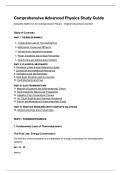
Comprehensive Advanced Physics Study Guide
Complete Reference for Undergraduate Physics - Original Educational Content
Table of Contents
PART I: THERMODYNAMICS
1. Fundamental Laws of Thermodynamics
2. Real Engine Cycles and Efficiency
3. Entropy and Irreversible Processes
4. Phase Transitions and Critical Phenomena
5. Heat Pumps and Refrigeration Systems
PART II: CLASSICAL MECHANICS
6. Dynamics in Non-Inertial Reference Frames
7. Lagrangian and Hamiltonian Mechanics
8. Oscillations and Normal Modes
9. Rigid Body Dynamics and Gyroscopes
10. Fluid Mechanics and Flow
PART III: ELECTROMAGNETISM
11. Maxwell's Equations and Electromagnetic Theory
12. Electromagnetic Waves and Propagation
13. Radiation from Accelerating Charges
14. AC Circuit Analysis and Complex Impedance
15. Energy and Momentum in Electromagnetic Fields
PART IV: PRACTICE PROBLEMS WITH COMPLETE SOLUTIONS
16. Worked Examples and Problem Sets
PART I: THERMODYNAMICS
1. Fundamental Laws of Thermodynamics
The First Law: Energy Conservation
The first law of thermodynamics is a statement of energy conservation for thermodynamic
systems:
ΔU = Q - W
Where:
, ΔU = change in internal energy of the system
Q = heat added to the system
W = work done BY the system
Sign Conventions:
Q > 0: heat flows into the system
Q < 0: heat flows out of the system
W > 0: system does work on surroundings (expansion)
W < 0: surroundings do work on system (compression)
Different Forms of Work:
1. PV Work (most common): W = ∫ P dV
2. Mechanical work: W = F·ds
3. Electrical work: W = ∫ V dQ (voltage × charge)
The Second Law: Direction of Natural Processes
The second law has several equivalent statements:
1. Clausius Statement: Heat cannot spontaneously flow from cold to hot
2. Kelvin Statement: No heat engine can convert heat completely to work in a cyclic process
3. Entropy Statement: The entropy of an isolated system never decreases
Mathematical Form:
For any process: ΔS ≥ ∫ dQ/T
Equality holds for reversible processes, inequality for irreversible processes.
Entropy and Probability:
S = k_B ln(Ω)
Where Ω is the number of microstates corresponding to a macrostate.
The Third Law: Absolute Zero
As T → 0, the entropy of a perfect crystal approaches zero: S(T=0) = 0
This provides an absolute reference point for entropy calculations.
2. Real Engine Cycles and Efficiency
, Carnot Cycle: The Theoretical Limit
The Carnot cycle consists of four reversible processes:
1. Isothermal expansion at T_h (heat Q_h absorbed)
2. Adiabatic expansion (T decreases from T_h to T_c)
3. Isothermal compression at T_c (heat Q_c rejected)
4. Adiabatic compression (T increases from T_c to T_h)
Carnot Efficiency:
η_C = 1 - T_c/T_h = (T_h - T_c)/T_h
This is the maximum possible efficiency for any heat engine operating between temperatures
T_h and T_c.
Example Calculation:
A Carnot engine operates between 600K and 300K reservoirs.
η_C = 1 - 300/600 = 0.5 = 50%
If Q_h = 1000J, then:
Work output: W = η_C × Q_h = 500J
Heat rejected: Q_c = Q_h - W = 500J
Otto Cycle: Gasoline Engine Model
The Otto cycle models the operation of gasoline engines:
1. Adiabatic Compression (1→2):
Volume decreases from V_1 to V_2
Temperature rises due to compression
No heat transfer (Q = 0)
2. Constant Volume Heat Addition (2→3):
Combustion occurs rapidly at constant volume
Heat Q_in added to system
Pressure and temperature increase dramatically
3. Adiabatic Expansion (3→4):
Power stroke - gas expands and does work
Temperature and pressure decrease
No heat transfer (Q = 0)
4. Constant Volume Heat Rejection (4→1):
Exhaust valve opens
Heat Q_out rejected at constant volume
Complete Reference for Undergraduate Physics - Original Educational Content
Table of Contents
PART I: THERMODYNAMICS
1. Fundamental Laws of Thermodynamics
2. Real Engine Cycles and Efficiency
3. Entropy and Irreversible Processes
4. Phase Transitions and Critical Phenomena
5. Heat Pumps and Refrigeration Systems
PART II: CLASSICAL MECHANICS
6. Dynamics in Non-Inertial Reference Frames
7. Lagrangian and Hamiltonian Mechanics
8. Oscillations and Normal Modes
9. Rigid Body Dynamics and Gyroscopes
10. Fluid Mechanics and Flow
PART III: ELECTROMAGNETISM
11. Maxwell's Equations and Electromagnetic Theory
12. Electromagnetic Waves and Propagation
13. Radiation from Accelerating Charges
14. AC Circuit Analysis and Complex Impedance
15. Energy and Momentum in Electromagnetic Fields
PART IV: PRACTICE PROBLEMS WITH COMPLETE SOLUTIONS
16. Worked Examples and Problem Sets
PART I: THERMODYNAMICS
1. Fundamental Laws of Thermodynamics
The First Law: Energy Conservation
The first law of thermodynamics is a statement of energy conservation for thermodynamic
systems:
ΔU = Q - W
Where:
, ΔU = change in internal energy of the system
Q = heat added to the system
W = work done BY the system
Sign Conventions:
Q > 0: heat flows into the system
Q < 0: heat flows out of the system
W > 0: system does work on surroundings (expansion)
W < 0: surroundings do work on system (compression)
Different Forms of Work:
1. PV Work (most common): W = ∫ P dV
2. Mechanical work: W = F·ds
3. Electrical work: W = ∫ V dQ (voltage × charge)
The Second Law: Direction of Natural Processes
The second law has several equivalent statements:
1. Clausius Statement: Heat cannot spontaneously flow from cold to hot
2. Kelvin Statement: No heat engine can convert heat completely to work in a cyclic process
3. Entropy Statement: The entropy of an isolated system never decreases
Mathematical Form:
For any process: ΔS ≥ ∫ dQ/T
Equality holds for reversible processes, inequality for irreversible processes.
Entropy and Probability:
S = k_B ln(Ω)
Where Ω is the number of microstates corresponding to a macrostate.
The Third Law: Absolute Zero
As T → 0, the entropy of a perfect crystal approaches zero: S(T=0) = 0
This provides an absolute reference point for entropy calculations.
2. Real Engine Cycles and Efficiency
, Carnot Cycle: The Theoretical Limit
The Carnot cycle consists of four reversible processes:
1. Isothermal expansion at T_h (heat Q_h absorbed)
2. Adiabatic expansion (T decreases from T_h to T_c)
3. Isothermal compression at T_c (heat Q_c rejected)
4. Adiabatic compression (T increases from T_c to T_h)
Carnot Efficiency:
η_C = 1 - T_c/T_h = (T_h - T_c)/T_h
This is the maximum possible efficiency for any heat engine operating between temperatures
T_h and T_c.
Example Calculation:
A Carnot engine operates between 600K and 300K reservoirs.
η_C = 1 - 300/600 = 0.5 = 50%
If Q_h = 1000J, then:
Work output: W = η_C × Q_h = 500J
Heat rejected: Q_c = Q_h - W = 500J
Otto Cycle: Gasoline Engine Model
The Otto cycle models the operation of gasoline engines:
1. Adiabatic Compression (1→2):
Volume decreases from V_1 to V_2
Temperature rises due to compression
No heat transfer (Q = 0)
2. Constant Volume Heat Addition (2→3):
Combustion occurs rapidly at constant volume
Heat Q_in added to system
Pressure and temperature increase dramatically
3. Adiabatic Expansion (3→4):
Power stroke - gas expands and does work
Temperature and pressure decrease
No heat transfer (Q = 0)
4. Constant Volume Heat Rejection (4→1):
Exhaust valve opens
Heat Q_out rejected at constant volume