

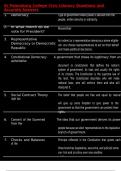
St Petersburg College Civic Literacy Questions and
Accurate Answers
1. Democracy Type of government where power is derived from the
people, either directly or indirectly.
2. In what month do we November
vote for President?
3. Representative An indirect or a representative democracy where eligible
Democracy or Democratic vot- ers choose representatives to act on their behalf
Republic and make political decisions.
4. Constitutional Democracy A government that draws its legitimacy from an
authoritative
document (a constitution) that defines the nation's
system of government, its laws and usually the rights
of its citizens. The Constitution is the supreme law of
the land. The Constitution describes who will make
national laws, who will enforce them and who will
interpret it.
5. Social Contract Theory The belief that people are free and equal by natural
right but
will give up some freedom to give power to the
government so that the government can protect their
rights.
6. Consent of the Governed The idea that our government derives its power
from the
people because we elect representatives to the legislative
branch of government.
7. Checks and Balances Principle reflected in the Constitution that grants each
of the
three branches (legislative, executive, and judicial) some
con- trol and scrutiny over one another.
,St Petersburg College Civic Literacy Questions and
Accurate Answers
8. Separation of Powers Refers to the division of government branches: each
with
separate independent power and responsibilities, so
that the powers of one branch do not conflict with the
others.
,St Petersburg College Civic Literacy Questions and
Accurate Answers
9. The Rule of Law Magna Carta 1512
was established by the
, in
which no is above the law
and every- one is equal
under the law
10. Due process of law Fair treatment through the normal judicial system.
11. Equality under the Law Equal treatment and equal protection without the
guarantee
of equal outcomes.
12. Popular Sovereignty A belief that ultimate power resides in the people.
13. Natural rights Rights people have by virtue of being human beings;
both the Declaration of Independence and
Constitution address the government's role in
protecting these rights.
14. Federalism A political system in which power is divided between
a cen- tral government and multiple constituent,
provincial, or state governments.
15. Concurrent powers Powers that are held by both the federal and the local
govern-
ments (e.g. taxing, roads, elections, lower courts).
16. Equal Protection Clause Clause in the Fourteenth Amendment that forbids any
state
to deny to any person equal protection of the laws.
This clause is the major constitutional restraint on the
power of governments to discriminate against persons
because of race, national origin, or sex.
, St Petersburg College Civic Literacy Questions and
Accurate Answers
17. Article I, Section 4, of the Unit- Grants the states the authority to determine the
rules by which
ed States they elect their United States Senators and Representatives,
Constitution unless the United States Congress acts to change
those rules.
Accurate Answers
1. Democracy Type of government where power is derived from the
people, either directly or indirectly.
2. In what month do we November
vote for President?
3. Representative An indirect or a representative democracy where eligible
Democracy or Democratic vot- ers choose representatives to act on their behalf
Republic and make political decisions.
4. Constitutional Democracy A government that draws its legitimacy from an
authoritative
document (a constitution) that defines the nation's
system of government, its laws and usually the rights
of its citizens. The Constitution is the supreme law of
the land. The Constitution describes who will make
national laws, who will enforce them and who will
interpret it.
5. Social Contract Theory The belief that people are free and equal by natural
right but
will give up some freedom to give power to the
government so that the government can protect their
rights.
6. Consent of the Governed The idea that our government derives its power
from the
people because we elect representatives to the legislative
branch of government.
7. Checks and Balances Principle reflected in the Constitution that grants each
of the
three branches (legislative, executive, and judicial) some
con- trol and scrutiny over one another.
,St Petersburg College Civic Literacy Questions and
Accurate Answers
8. Separation of Powers Refers to the division of government branches: each
with
separate independent power and responsibilities, so
that the powers of one branch do not conflict with the
others.
,St Petersburg College Civic Literacy Questions and
Accurate Answers
9. The Rule of Law Magna Carta 1512
was established by the
, in
which no is above the law
and every- one is equal
under the law
10. Due process of law Fair treatment through the normal judicial system.
11. Equality under the Law Equal treatment and equal protection without the
guarantee
of equal outcomes.
12. Popular Sovereignty A belief that ultimate power resides in the people.
13. Natural rights Rights people have by virtue of being human beings;
both the Declaration of Independence and
Constitution address the government's role in
protecting these rights.
14. Federalism A political system in which power is divided between
a cen- tral government and multiple constituent,
provincial, or state governments.
15. Concurrent powers Powers that are held by both the federal and the local
govern-
ments (e.g. taxing, roads, elections, lower courts).
16. Equal Protection Clause Clause in the Fourteenth Amendment that forbids any
state
to deny to any person equal protection of the laws.
This clause is the major constitutional restraint on the
power of governments to discriminate against persons
because of race, national origin, or sex.
, St Petersburg College Civic Literacy Questions and
Accurate Answers
17. Article I, Section 4, of the Unit- Grants the states the authority to determine the
rules by which
ed States they elect their United States Senators and Representatives,
Constitution unless the United States Congress acts to change
those rules.


