

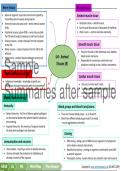
Nerve tissue Muscle tissue
• Allows an organism to perceive stimuli and respond by Striated muscle tissue
transmitting nerve impulses along neurons.
• Forms the brain and spinal cord – central nervous system • Attached to bone – skeletal muscle.
(CNS). • Each muscle fibre consists of thousands of myofibrils.
• Peripheral nervous system (PNS) – nerve tissue outside • Work in pairs – contract and relax voluntarily.
the CNS which conducts impulses to and from the brain.
• Sensory neurons - conduct impulses from the receptors
to the CNS. Smooth muscle tissue
• Motor neurons - conduct impulses from the CNS to the
effectors. • Found in the walls of the alimentary canal, bladder,
• Interneurons - conduct impulses between sensory and U4: Animal blood vessels and uterus.
• Responsible for involuntary contractions and
Sample
motor neurons in the brain and spinal cord.
Tissues (B) relaxations resulting in slow, rhythmic movements.
Traditional biotechnology
Cardiac muscle tissue
• Indigenous knowledge – knowledge acquired over
• Only occurs in the heart’s walls.
Summaries after sample
generations through interactions with the environment.
• Causes uninterrupted, involuntary contraction
and relaxation of the heart.
Medical biotechnology
Immunity Blood groups and blood transfusions
• Natural immunity - first line of defence against pathogens • There are 4 human blood groups – A, B, AB and O.
are the external barriers that prevent harmful substances • Blood from different blood groups mustn’t be mixed
from entering. – causes agglutination and death.
• Acquired immunity - the memory of response stored by
the body when pathogens are destroyed.
Cloning
Immunisation and vaccines • DNA cloning - taking a part of DNA from an organism to a foreign host
cell to obtain a desired characteristic.
• Immunisation – injecting a vaccine to develop immunity. • Reproductive cloning – creating an organism containing the same DNA
• Vaccines stimulate the production of antibodies and as another organism.
develop a memory of the response. • Therapeutic cloning - human embryos are cloned for stem cell research.
•
GR10 LS M1 Mind Map The Answer Copyright © www.summariessa.co.za (DO NOT COPY)
,Sample
Summaries after sample
,Sample
Summaries after sample
, Organic compounds
Inorganic compounds
Carbohydrates
Water
• Made of carbon, hydrogen and oxygen.
• Water breaks polymers down into their monomers.
• Monosaccharides – 1 saccharide.
• Acts as a transporting agent.
• Disaccharides – 2 monosaccharides.
• Lubricant.
• Polysaccharides – chain of monosaccharides
• Regulates body temp.
that bind by a condensation reaction.
• Animals with hydrostatic skeletons and vacuoles of
plant cells use water to provide rigidity and shape.
Lipids (fats and oils)
• Made of carbon, hydrogen and oxygen. U1: The
• Saturated fats – mainly derived from animals.
Mineral salts
• Unsaturated fats – mainly derived from plants. Chemistry of Life • Macronutrients – mineral salts required in
• HDL reduces excess cholesterol in the blood via the liver. large quantities.
• High levels of LDL cause fatty deposits in arteries. • Micronutrients – mineral salts required in
small quantities.
• Eutrophication - the increased growth in algae
Proteins that blocks sunlight – causes death of water
• Polymer with amino acids as monomers. plants and animals.
• Peptide bond – the bond between two amino acids. o
Nucleic acids
• Dipeptide – 2 linked amino acids.
• Tripeptide – 3 linked amino acids. • Catabolic
DNA:
• Polypeptide – long chain of linked amino acids. oreaction
Found in sthe nucleus of a cells.
• Protein – 51+ linked amino acids. o Carries hereditary characteristics and controls the structure and function of cells.
• RNA:
o Found in the nucleus and cytoplasm.
Enzyme o Ensures amino acids bind to one another in a certain sequence during protein
synthesis.
•Cataboli
Proteins that accelerate chemical reactions in cells.
• Enzymes
c lower the activation energy.
• Anabolic reaction: simple molecules -> complex molecule. Vitamins
reaction
• Catabolic reaction: complex molecule -> simple molecules.
s
• Enzymes are sensitive to temp and pH. •Catabolic
Needed for normal metabolism, growth and development.
•reaction s – absorbed when dissolved in water.
Water-soluble
• Fat-soluble – absorbed when dissolved in fat.
GR10 LS M1 Mind Map The Answer Copyright © www.summariessa.co.za (DO NOT COPY)
• Allows an organism to perceive stimuli and respond by Striated muscle tissue
transmitting nerve impulses along neurons.
• Forms the brain and spinal cord – central nervous system • Attached to bone – skeletal muscle.
(CNS). • Each muscle fibre consists of thousands of myofibrils.
• Peripheral nervous system (PNS) – nerve tissue outside • Work in pairs – contract and relax voluntarily.
the CNS which conducts impulses to and from the brain.
• Sensory neurons - conduct impulses from the receptors
to the CNS. Smooth muscle tissue
• Motor neurons - conduct impulses from the CNS to the
effectors. • Found in the walls of the alimentary canal, bladder,
• Interneurons - conduct impulses between sensory and U4: Animal blood vessels and uterus.
• Responsible for involuntary contractions and
Sample
motor neurons in the brain and spinal cord.
Tissues (B) relaxations resulting in slow, rhythmic movements.
Traditional biotechnology
Cardiac muscle tissue
• Indigenous knowledge – knowledge acquired over
• Only occurs in the heart’s walls.
Summaries after sample
generations through interactions with the environment.
• Causes uninterrupted, involuntary contraction
and relaxation of the heart.
Medical biotechnology
Immunity Blood groups and blood transfusions
• Natural immunity - first line of defence against pathogens • There are 4 human blood groups – A, B, AB and O.
are the external barriers that prevent harmful substances • Blood from different blood groups mustn’t be mixed
from entering. – causes agglutination and death.
• Acquired immunity - the memory of response stored by
the body when pathogens are destroyed.
Cloning
Immunisation and vaccines • DNA cloning - taking a part of DNA from an organism to a foreign host
cell to obtain a desired characteristic.
• Immunisation – injecting a vaccine to develop immunity. • Reproductive cloning – creating an organism containing the same DNA
• Vaccines stimulate the production of antibodies and as another organism.
develop a memory of the response. • Therapeutic cloning - human embryos are cloned for stem cell research.
•
GR10 LS M1 Mind Map The Answer Copyright © www.summariessa.co.za (DO NOT COPY)
,Sample
Summaries after sample
,Sample
Summaries after sample
, Organic compounds
Inorganic compounds
Carbohydrates
Water
• Made of carbon, hydrogen and oxygen.
• Water breaks polymers down into their monomers.
• Monosaccharides – 1 saccharide.
• Acts as a transporting agent.
• Disaccharides – 2 monosaccharides.
• Lubricant.
• Polysaccharides – chain of monosaccharides
• Regulates body temp.
that bind by a condensation reaction.
• Animals with hydrostatic skeletons and vacuoles of
plant cells use water to provide rigidity and shape.
Lipids (fats and oils)
• Made of carbon, hydrogen and oxygen. U1: The
• Saturated fats – mainly derived from animals.
Mineral salts
• Unsaturated fats – mainly derived from plants. Chemistry of Life • Macronutrients – mineral salts required in
• HDL reduces excess cholesterol in the blood via the liver. large quantities.
• High levels of LDL cause fatty deposits in arteries. • Micronutrients – mineral salts required in
small quantities.
• Eutrophication - the increased growth in algae
Proteins that blocks sunlight – causes death of water
• Polymer with amino acids as monomers. plants and animals.
• Peptide bond – the bond between two amino acids. o
Nucleic acids
• Dipeptide – 2 linked amino acids.
• Tripeptide – 3 linked amino acids. • Catabolic
DNA:
• Polypeptide – long chain of linked amino acids. oreaction
Found in sthe nucleus of a cells.
• Protein – 51+ linked amino acids. o Carries hereditary characteristics and controls the structure and function of cells.
• RNA:
o Found in the nucleus and cytoplasm.
Enzyme o Ensures amino acids bind to one another in a certain sequence during protein
synthesis.
•Cataboli
Proteins that accelerate chemical reactions in cells.
• Enzymes
c lower the activation energy.
• Anabolic reaction: simple molecules -> complex molecule. Vitamins
reaction
• Catabolic reaction: complex molecule -> simple molecules.
s
• Enzymes are sensitive to temp and pH. •Catabolic
Needed for normal metabolism, growth and development.
•reaction s – absorbed when dissolved in water.
Water-soluble
• Fat-soluble – absorbed when dissolved in fat.
GR10 LS M1 Mind Map The Answer Copyright © www.summariessa.co.za (DO NOT COPY)


