DOWNLOAD THE Test Bank for Abnormal Psychology 9th Edition Oltmanns
Chapter 2
Causes of Abnormal Behavior
Total Assessment Guide (T.A.G.)
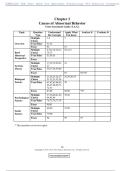
Topic Question Understand Apply What Analyze It Evaluate It
Type the Concepts You Know
Multiple 1,2 3
Choice
Overview True/False 51,52
Essay 82 81
Multiple 4,5,6,7,8,10,11, 9,12,13
Brief Choice 14,15
Historical True/False 53,54,55
Perspective Essay
Multiple 17,18,19,20,21, 16
Systems Choice 22
Theory True/False 56,57,58,59,60
Essay 83 84,*85
Multiple 23,24,25,26,27, 28,29,30,34
Biological Choice 31,32,33,35,36
Factors True/False 61,62,63,64,65, 70
66,67,68,69,71,
72,73
Essay 87,88 86,89 *85
Multiple 37,38,40,41,43, 39,42
Psychological Choice 44,45,46
Factors True/False 74,75,76,77,78
Essay 90,91
Multiple 48,49 47,50
Social Choice
Factors True/False 79,80
Essay 94 95 93
* This question covers two topics.
30
Copyright © 2019, 2015, 2012 Pearson Education, Inc. All rights reserved.
mynursytest.store
,DOWNLOAD THE Test Bank for Abnormal Psychology 9th Edition Oltmanns
Chapter 2: Causes of Abnormal Behavior
Multiple Choice
2.1.1. The etiology of a problem behavior is its
a. cause.
b. paradigm.
c. treatment.
d. classification.
Answer: a.
Difficulty: Easy
Question ID: 2.1.1
Topic: Overview
Skill: Understand the Concepts
LO 2.1: Outline the historical origins of psychology paradigms
2.1.2. Most forms of abnormal behavior are thought to be caused by
a. genetics.
b. learning.
c. a single cause.
d. multiple factors.
Answer: d.
Difficulty: Easy
Question ID: 2.1.2
Topic: Overview
Skill: Understand the Concepts
LO 2.1: Outline the historical origins of psychology paradigms
2.1.3. A researcher described her approach to understanding mental disorders as biopsychosocial. When
you ask her to explain what she means, what is she likely to say?
a. Biological abnormalities give rise to psychological disturbances that have social consequences.
b. Biological, psychological, and social factors are just as likely to be the cause of these disorders.
c. The integration of biological, psychological, and social factors provides the most fruitful avenue
for discovering the cause of most mental disorders.
d. The search for etiologies is best accomplished by viewing the evidence through the lens provided
by one of the major paradigms.
Answer: c.
Difficulty: Easy
Question ID: 2.1.3
Topic: Overview
Skill: Apply What You Know
LO 2.1: Outline the historical origins of psychology paradigms
31
Copyright © 2019, 2015, 2012 Pearson Education, Inc. All rights reserved.
mynursytest.store
,DOWNLOAD THE Test Bank for Abnormal Psychology 9th Edition Oltmanns
2.1.4. The search for explanations of the etiology of abnormal behavior dates to ancient times. It was not
until the nineteenth and twentieth centuries that three major advances occurred: the work of Sigmund
Freud, the discovery of general paresis, and the
a. blank slate theory.
b. stationary universe model.
c. development of the germ theory.
d. development of academic psychology.
Answer: d.
Difficulty: Easy
Question ID: 2.1.4
Topic: Brief Historical Perspective
Skill: Understand the Concepts
LO 2.1: Outline the historical origins of psychology paradigms
2.1.5. What is the assertion of the psychodynamic paradigm?
a. Feelings, thoughts, and behaviors are shaped by the unconscious.
b. Behavior is a function of environment.
c. Behavior is a function of biology.
d. Abnormal behavior is caused by unconscious mental conflicts that have roots in early childhood
experience.
Answer: d.
Difficulty: Easy
Question ID: 2.1.5
Topic: Brief Historical Perspective
Skill: Understand the Concepts
LO 2.1: Outline the historical origins of psychology paradigms
2.1.6. DSM-5 uses the descriptive approach to classify abnormal behavior because experts do not know
what causes mental disorders and because it
a. helps diagnose the underlying cause of a mental disorder.
b. is easier to understand.
c. helps professionals to agree about the presence or absence of an emotional problem.
d. categorizes behavior with a known mental disorder.
Answer: c.
Difficulty: Easy
Question ID: 2.1.6
Topic: Brief Historical Perspective
Skill: Understand the Concepts
LO 2.1: Outline the historical origins of psychology paradigms
32
Copyright © 2019, 2015, 2012 Pearson Education, Inc. All rights reserved.
mynursytest.store
, DOWNLOAD THE Test Bank for Abnormal Psychology 9th Edition Oltmanns
2.1.7. According to Sigmund Freud, what are the three parts of the mind?
a. id, ego, superego
b. oral, anal, phallic
c. reality, pleasure, spiritual
d. conscious, preconscious, unconscious
Answer: a.
Difficulty: Easy
Question ID: 2.1.7
Topic: Brief Historical Perspective
Skill: Understand the Concepts
LO 2.1: Outline the historical origins of psychology paradigms
2.1.8. According to Freudian theory, what part of the mind is roughly equivalent to the conscience?
a. id
b. ego
c. libido
d. superego
Answer: d.
Difficulty: Easy
Question ID: 2.1.8
Topic: Brief Historical Perspective
Skill: Understand the Concepts
LO 2.1: Outline the historical origins of psychology paradigms
2.1.9. When we are around someone we dislike intensely we often “bend over backward” to be nice to
this individual. Which defense mechanism is illustrated here?
a. denial
b. projection
c. sublimation
d. reaction formation
Answer: d.
Difficulty: Moderate
Question ID: 2.1.9
Topic: Brief Historical Perspective
Skill: Apply What You Know
LO 2.1: Outline the historical origins of psychology paradigms
33
Copyright © 2019, 2015, 2012 Pearson Education, Inc. All rights reserved.
mynursytest.store
Chapter 2
Causes of Abnormal Behavior
Total Assessment Guide (T.A.G.)
Topic Question Understand Apply What Analyze It Evaluate It
Type the Concepts You Know
Multiple 1,2 3
Choice
Overview True/False 51,52
Essay 82 81
Multiple 4,5,6,7,8,10,11, 9,12,13
Brief Choice 14,15
Historical True/False 53,54,55
Perspective Essay
Multiple 17,18,19,20,21, 16
Systems Choice 22
Theory True/False 56,57,58,59,60
Essay 83 84,*85
Multiple 23,24,25,26,27, 28,29,30,34
Biological Choice 31,32,33,35,36
Factors True/False 61,62,63,64,65, 70
66,67,68,69,71,
72,73
Essay 87,88 86,89 *85
Multiple 37,38,40,41,43, 39,42
Psychological Choice 44,45,46
Factors True/False 74,75,76,77,78
Essay 90,91
Multiple 48,49 47,50
Social Choice
Factors True/False 79,80
Essay 94 95 93
* This question covers two topics.
30
Copyright © 2019, 2015, 2012 Pearson Education, Inc. All rights reserved.
mynursytest.store
,DOWNLOAD THE Test Bank for Abnormal Psychology 9th Edition Oltmanns
Chapter 2: Causes of Abnormal Behavior
Multiple Choice
2.1.1. The etiology of a problem behavior is its
a. cause.
b. paradigm.
c. treatment.
d. classification.
Answer: a.
Difficulty: Easy
Question ID: 2.1.1
Topic: Overview
Skill: Understand the Concepts
LO 2.1: Outline the historical origins of psychology paradigms
2.1.2. Most forms of abnormal behavior are thought to be caused by
a. genetics.
b. learning.
c. a single cause.
d. multiple factors.
Answer: d.
Difficulty: Easy
Question ID: 2.1.2
Topic: Overview
Skill: Understand the Concepts
LO 2.1: Outline the historical origins of psychology paradigms
2.1.3. A researcher described her approach to understanding mental disorders as biopsychosocial. When
you ask her to explain what she means, what is she likely to say?
a. Biological abnormalities give rise to psychological disturbances that have social consequences.
b. Biological, psychological, and social factors are just as likely to be the cause of these disorders.
c. The integration of biological, psychological, and social factors provides the most fruitful avenue
for discovering the cause of most mental disorders.
d. The search for etiologies is best accomplished by viewing the evidence through the lens provided
by one of the major paradigms.
Answer: c.
Difficulty: Easy
Question ID: 2.1.3
Topic: Overview
Skill: Apply What You Know
LO 2.1: Outline the historical origins of psychology paradigms
31
Copyright © 2019, 2015, 2012 Pearson Education, Inc. All rights reserved.
mynursytest.store
,DOWNLOAD THE Test Bank for Abnormal Psychology 9th Edition Oltmanns
2.1.4. The search for explanations of the etiology of abnormal behavior dates to ancient times. It was not
until the nineteenth and twentieth centuries that three major advances occurred: the work of Sigmund
Freud, the discovery of general paresis, and the
a. blank slate theory.
b. stationary universe model.
c. development of the germ theory.
d. development of academic psychology.
Answer: d.
Difficulty: Easy
Question ID: 2.1.4
Topic: Brief Historical Perspective
Skill: Understand the Concepts
LO 2.1: Outline the historical origins of psychology paradigms
2.1.5. What is the assertion of the psychodynamic paradigm?
a. Feelings, thoughts, and behaviors are shaped by the unconscious.
b. Behavior is a function of environment.
c. Behavior is a function of biology.
d. Abnormal behavior is caused by unconscious mental conflicts that have roots in early childhood
experience.
Answer: d.
Difficulty: Easy
Question ID: 2.1.5
Topic: Brief Historical Perspective
Skill: Understand the Concepts
LO 2.1: Outline the historical origins of psychology paradigms
2.1.6. DSM-5 uses the descriptive approach to classify abnormal behavior because experts do not know
what causes mental disorders and because it
a. helps diagnose the underlying cause of a mental disorder.
b. is easier to understand.
c. helps professionals to agree about the presence or absence of an emotional problem.
d. categorizes behavior with a known mental disorder.
Answer: c.
Difficulty: Easy
Question ID: 2.1.6
Topic: Brief Historical Perspective
Skill: Understand the Concepts
LO 2.1: Outline the historical origins of psychology paradigms
32
Copyright © 2019, 2015, 2012 Pearson Education, Inc. All rights reserved.
mynursytest.store
, DOWNLOAD THE Test Bank for Abnormal Psychology 9th Edition Oltmanns
2.1.7. According to Sigmund Freud, what are the three parts of the mind?
a. id, ego, superego
b. oral, anal, phallic
c. reality, pleasure, spiritual
d. conscious, preconscious, unconscious
Answer: a.
Difficulty: Easy
Question ID: 2.1.7
Topic: Brief Historical Perspective
Skill: Understand the Concepts
LO 2.1: Outline the historical origins of psychology paradigms
2.1.8. According to Freudian theory, what part of the mind is roughly equivalent to the conscience?
a. id
b. ego
c. libido
d. superego
Answer: d.
Difficulty: Easy
Question ID: 2.1.8
Topic: Brief Historical Perspective
Skill: Understand the Concepts
LO 2.1: Outline the historical origins of psychology paradigms
2.1.9. When we are around someone we dislike intensely we often “bend over backward” to be nice to
this individual. Which defense mechanism is illustrated here?
a. denial
b. projection
c. sublimation
d. reaction formation
Answer: d.
Difficulty: Moderate
Question ID: 2.1.9
Topic: Brief Historical Perspective
Skill: Apply What You Know
LO 2.1: Outline the historical origins of psychology paradigms
33
Copyright © 2019, 2015, 2012 Pearson Education, Inc. All rights reserved.
mynursytest.store