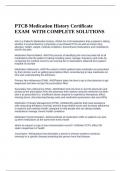
PTCB Medication History EXAM WITH
COMPLETE SOLUTIONS
Medication History -ANSinfo, past or current, collected by a health care professional by
asking specific questions with the purpose of obtaining the information needed in
building or maintaining a patient's profile to help provide care for the patient
Medication History -ANSobtaining an accurate and up-to-date medication history is
important for a patient treatment, quality of life, and/or survival.
Medication Reconciliation -ANSprocess of identifying the most accurate list of all
medications that the patient is taking, including name, dosage, frequency, and route, by
comparing the medical record to an external list of medications obtained from a patient,
hospital, or other provider
Medication adherence -ANStaking medications correctly, the extent to which patients
take medication as prescribed by their doctors, getting prescriptions filled, take
medication on time, and understanding the directions
Adherent -ANSpatient take 80% of their prescribed medicine(s) (AMA).
Nonadherent -ANSpatient take less than 80% of their prescribed medication(s)
Primary Non-adherence (PNA): -ANSpatient goes to the physician to get diagnosed and
does not get the prescription filled (within 180 days), estimated 20% to 35%
Secondary nonadherence (SNA) -ANSpatient went to physician, picked up prescription,
started taking, but did not take as prescribed or sufficient doses required, missing doses
or discontinuing early. Medication possession rate of <80%. Nearly half of all patients on
chronic medications and estimated 20% of patients discontinue therapy after the first
prescription.
MTM (Medication Therapy Management): -ANSidentify patients that need assistance
Synchronize medications: Coordinate refills to pick up at the same time
Vaccination -ANSa product that stimulates a person's immune system to produce
immunity to a specific disease, protecting the person from that disease
Immunization -ANSaction of making a person immune to infection, by inoculation
-LOGIST -ANSOne who studies
COMPLETE SOLUTIONS
Medication History -ANSinfo, past or current, collected by a health care professional by
asking specific questions with the purpose of obtaining the information needed in
building or maintaining a patient's profile to help provide care for the patient
Medication History -ANSobtaining an accurate and up-to-date medication history is
important for a patient treatment, quality of life, and/or survival.
Medication Reconciliation -ANSprocess of identifying the most accurate list of all
medications that the patient is taking, including name, dosage, frequency, and route, by
comparing the medical record to an external list of medications obtained from a patient,
hospital, or other provider
Medication adherence -ANStaking medications correctly, the extent to which patients
take medication as prescribed by their doctors, getting prescriptions filled, take
medication on time, and understanding the directions
Adherent -ANSpatient take 80% of their prescribed medicine(s) (AMA).
Nonadherent -ANSpatient take less than 80% of their prescribed medication(s)
Primary Non-adherence (PNA): -ANSpatient goes to the physician to get diagnosed and
does not get the prescription filled (within 180 days), estimated 20% to 35%
Secondary nonadherence (SNA) -ANSpatient went to physician, picked up prescription,
started taking, but did not take as prescribed or sufficient doses required, missing doses
or discontinuing early. Medication possession rate of <80%. Nearly half of all patients on
chronic medications and estimated 20% of patients discontinue therapy after the first
prescription.
MTM (Medication Therapy Management): -ANSidentify patients that need assistance
Synchronize medications: Coordinate refills to pick up at the same time
Vaccination -ANSa product that stimulates a person's immune system to produce
immunity to a specific disease, protecting the person from that disease
Immunization -ANSaction of making a person immune to infection, by inoculation
-LOGIST -ANSOne who studies