
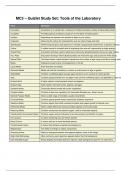
MC3 – Quizlet Study Set: Tools of the Laboratory
Term Definition
Inoculation Introduction of a sample into a container of media to produce a colony of observable growth.
Incubation Providing optimal conditions (usually 37°C) that allow microbial growth.
Isolation Separating one species from another to obtain a pure culture.
Inspection Observing the culture for characteristics such as colony shape and color.
Identification Determining the genus and species of a microbe using physical, biochemical, or genetic methods.
Colony A visible mound of microbial cells all originating from one cell, representing a single species.
Streak Plate Inoculation technique used to isolate pure cultures by spreading bacteria across an agar surface.
Pour Plate Inoculation technique where diluted samples are mixed with agar and poured into Petri dishes.
Spread Plate Technique where a liquid sample is spread over the surface of agar using a tool like a hockey stick.
Media Substances used to grow microorganisms in the lab.
Liquid Media Broth that does not solidify.
Semisolid Media Media with clot-like consistency; contains a small amount of agar or gelatin.
Solid Media Contains a solidifying agent (usually agar) and forms a firm surface for colony growth.
Agar Complex polysaccharide from red algae; most common solidifying agent; not digestible by most mic
Nutrient Broth A liquid medium containing beef extract and peptone.
Nutrient Agar Solid medium with beef extract, peptone, and agar.
Synthetic Media Chemically defined media with known ingredients.
Complex Media Contains at least one ingredient not chemically definable (e.g., blood, serum).
General Purpose Media Grows a wide range of microbes; usually nonsynthetic.
Enriched Media Contains special growth factors required by fastidious organisms.
Selective Media Contains agents that inhibit unwanted microbes and support growth of desired ones.
Differential Media Shows visible differences among microbial species on the same plate.
Reducing Media Contains substances that absorb oxygen; used for anaerobic bacteria.
Carbohydrate Fermentation Media Contains sugars and pH indicators to test fermentation and identify microbes.
Pure Culture A culture containing only one known species.
Mixed Culture A culture with two or more identified species.
Contaminated Culture A culture that contains unwanted microorganisms.
Magnification The ability to enlarge an object using lenses.
Resolving Power Ability to distinguish between two adjacent objects; clarity of the image.
Bright-field Microscope Most commonly used; specimen appears darker than the background.
Dark-field Microscope Shows brightly illuminated specimen against a dark background; good for live specimens.
Term Definition
Inoculation Introduction of a sample into a container of media to produce a colony of observable growth.
Incubation Providing optimal conditions (usually 37°C) that allow microbial growth.
Isolation Separating one species from another to obtain a pure culture.
Inspection Observing the culture for characteristics such as colony shape and color.
Identification Determining the genus and species of a microbe using physical, biochemical, or genetic methods.
Colony A visible mound of microbial cells all originating from one cell, representing a single species.
Streak Plate Inoculation technique used to isolate pure cultures by spreading bacteria across an agar surface.
Pour Plate Inoculation technique where diluted samples are mixed with agar and poured into Petri dishes.
Spread Plate Technique where a liquid sample is spread over the surface of agar using a tool like a hockey stick.
Media Substances used to grow microorganisms in the lab.
Liquid Media Broth that does not solidify.
Semisolid Media Media with clot-like consistency; contains a small amount of agar or gelatin.
Solid Media Contains a solidifying agent (usually agar) and forms a firm surface for colony growth.
Agar Complex polysaccharide from red algae; most common solidifying agent; not digestible by most mic
Nutrient Broth A liquid medium containing beef extract and peptone.
Nutrient Agar Solid medium with beef extract, peptone, and agar.
Synthetic Media Chemically defined media with known ingredients.
Complex Media Contains at least one ingredient not chemically definable (e.g., blood, serum).
General Purpose Media Grows a wide range of microbes; usually nonsynthetic.
Enriched Media Contains special growth factors required by fastidious organisms.
Selective Media Contains agents that inhibit unwanted microbes and support growth of desired ones.
Differential Media Shows visible differences among microbial species on the same plate.
Reducing Media Contains substances that absorb oxygen; used for anaerobic bacteria.
Carbohydrate Fermentation Media Contains sugars and pH indicators to test fermentation and identify microbes.
Pure Culture A culture containing only one known species.
Mixed Culture A culture with two or more identified species.
Contaminated Culture A culture that contains unwanted microorganisms.
Magnification The ability to enlarge an object using lenses.
Resolving Power Ability to distinguish between two adjacent objects; clarity of the image.
Bright-field Microscope Most commonly used; specimen appears darker than the background.
Dark-field Microscope Shows brightly illuminated specimen against a dark background; good for live specimens.


