

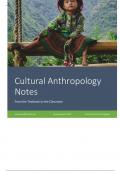
Cultural Anthropology
Notes
From the Textbook to the Classroom
Spring Semester 2025 Intro to Cultural Anthropology
,The content of these notes are summaries of Dr. Louise Badiane’s classroom lectures and
Chapters from the 42nd edition of Roberta Edward Lenkeit’s Introducing Cultural Anthropology.
Reading my notes do not replace the benefits of engaging with the original content and taking
your own notes.
Table of Contents
Chapter One: What are the Anthropological Subfields and Perspectives? 2
Chapter Two: Defining Culture 8
Chapter Three: Fieldwork 11
Chapter Four: Language 17
Chapter Seven: Marriage, Family, and Residence 22
Chapter Eight: Kinship and Decent 29
Chapter Eleven: Belief Systems 34
1
,Chapter One: What are the anthropological subfields and perspectives?
Anthropology:
Anthropology is the study of humanity in the broadest context. The four main subfields
of anthropology are archaeology, biological anthropology, linguistic anthropology, and cultural
anthropology.
Cultural Anthropology:
Also known as Socio-Cultural Anthropology, cultural anthropology involves the
observation and comparison of adaptations made by human groups to a variety of
environments. Behavioral adaptations that humans make to live in a particular environment is
called culture.
The traditional area of focus in cultural anthropology ethnography and ethnology
Ethnography is the study of one culture, subculture, or microculture through conducting
fieldwork. Ethnographers often spend a minimum of one year in the field in order to observe a
full cycle of cultural events. Anthropologists often spend many years within their culture of
interest. Ethnography can be thought of as observation part of anthropological study.
Fieldwork is often conducted in groups, with each member focusing on one aspect of a
culture. Breaking down fieldwork into smaller tasks allows teams to create a more complete
picture of a culture for their final ethnography (ethnography can also refer to the final report
written after fieldwork has been completed).
Enology is the comparative study of culture. The goal of ethnological work is to discover
universal truths about culture around the world.
Archaeology:
Archaeology is the reconstruction of cultures through the study of their material
remains. Remains are divided into three categories. Features are non-portable evidence of
technology such as roads, buildings and floors. Ecofacts are natural materials such as plant or
animal material. Finally, artifacts are portable objects made or altered by humans. The site is
the place were remains are excavated.
Archaeologist have many methods for obtaining information from remains, which is
detailed throughout Notes for Intro to Archaeology. Sometimes the analysis of remains needs to
go beyond typical methods. Sometimes archaeologist duplicate historic and prehistoric
2
, practices, tools, and environment to better understand past cultures. This practice is called
experimental archaeology.
Within the field of archaeology, there are a variety of subfields. Prehistoric archaeologist
study human cultures that existed before written history (10,000 years ago – approx. 80,000
years ago). Historical archaeology study human cultures that existed after the advent of written
history, from 10,000 years ago to the present.
Speaking of present. When archaeological methods are used to explore contemporary
cultures, we call that kind of study applied archaeology. A famous example of applied
archaeology is The Garbage Project by William Rathje. This study involved Rathje and his team
interviewing participants about their consumption habits and looking through their discarded
trash to confirm or deny their claims. Many anthropologists believe his approach to his research
was unethical because he obtained personal information about participants from their trash
without getting their consent. Because of its questionable ethics, applied anthropology is rarely
practiced.
Linguistic Anthropology:
Linguistic anthropology is the study of language. Linguistics is broken down into a few
subcategories. Descriptive linguistics focuses on the mechanics of language. Sounds used to
create language are described by the parts of the body used to create the sound, such as teeth,
tongue, lips and voice. For example, the sound for “a” from the word “made” would be
described as voice sound while “p” from “part” would be a lip sound.
Looking beyond the sounds used in language, anthropologist also explore morphology,
or the study of how words are formed using units of language such as roots, prefixes or suffixes.
For this class, all you need to know about these units of language that create words is that they
are called morphemes. Zooming out further, syntax the way in which words and morphemes
are used to form phrases and sentences.
Biological Anthropology:
Biological Anthropology is the study of humans as biological beings in the past and
present. This includes our evolutionary journey from primates, to hominins, to modern humans,
as well as primatology, or the study of modern primates. If you would like to know more about
this subfield, check out Notes for Biological Anthropology.
Anthropological Methods and Prospectives:
Even though anthropology is a science, it does not follow the typical scientific method
like other sciences. Anthropologists gather and compare as much data as possible before
3
Notes
From the Textbook to the Classroom
Spring Semester 2025 Intro to Cultural Anthropology
,The content of these notes are summaries of Dr. Louise Badiane’s classroom lectures and
Chapters from the 42nd edition of Roberta Edward Lenkeit’s Introducing Cultural Anthropology.
Reading my notes do not replace the benefits of engaging with the original content and taking
your own notes.
Table of Contents
Chapter One: What are the Anthropological Subfields and Perspectives? 2
Chapter Two: Defining Culture 8
Chapter Three: Fieldwork 11
Chapter Four: Language 17
Chapter Seven: Marriage, Family, and Residence 22
Chapter Eight: Kinship and Decent 29
Chapter Eleven: Belief Systems 34
1
,Chapter One: What are the anthropological subfields and perspectives?
Anthropology:
Anthropology is the study of humanity in the broadest context. The four main subfields
of anthropology are archaeology, biological anthropology, linguistic anthropology, and cultural
anthropology.
Cultural Anthropology:
Also known as Socio-Cultural Anthropology, cultural anthropology involves the
observation and comparison of adaptations made by human groups to a variety of
environments. Behavioral adaptations that humans make to live in a particular environment is
called culture.
The traditional area of focus in cultural anthropology ethnography and ethnology
Ethnography is the study of one culture, subculture, or microculture through conducting
fieldwork. Ethnographers often spend a minimum of one year in the field in order to observe a
full cycle of cultural events. Anthropologists often spend many years within their culture of
interest. Ethnography can be thought of as observation part of anthropological study.
Fieldwork is often conducted in groups, with each member focusing on one aspect of a
culture. Breaking down fieldwork into smaller tasks allows teams to create a more complete
picture of a culture for their final ethnography (ethnography can also refer to the final report
written after fieldwork has been completed).
Enology is the comparative study of culture. The goal of ethnological work is to discover
universal truths about culture around the world.
Archaeology:
Archaeology is the reconstruction of cultures through the study of their material
remains. Remains are divided into three categories. Features are non-portable evidence of
technology such as roads, buildings and floors. Ecofacts are natural materials such as plant or
animal material. Finally, artifacts are portable objects made or altered by humans. The site is
the place were remains are excavated.
Archaeologist have many methods for obtaining information from remains, which is
detailed throughout Notes for Intro to Archaeology. Sometimes the analysis of remains needs to
go beyond typical methods. Sometimes archaeologist duplicate historic and prehistoric
2
, practices, tools, and environment to better understand past cultures. This practice is called
experimental archaeology.
Within the field of archaeology, there are a variety of subfields. Prehistoric archaeologist
study human cultures that existed before written history (10,000 years ago – approx. 80,000
years ago). Historical archaeology study human cultures that existed after the advent of written
history, from 10,000 years ago to the present.
Speaking of present. When archaeological methods are used to explore contemporary
cultures, we call that kind of study applied archaeology. A famous example of applied
archaeology is The Garbage Project by William Rathje. This study involved Rathje and his team
interviewing participants about their consumption habits and looking through their discarded
trash to confirm or deny their claims. Many anthropologists believe his approach to his research
was unethical because he obtained personal information about participants from their trash
without getting their consent. Because of its questionable ethics, applied anthropology is rarely
practiced.
Linguistic Anthropology:
Linguistic anthropology is the study of language. Linguistics is broken down into a few
subcategories. Descriptive linguistics focuses on the mechanics of language. Sounds used to
create language are described by the parts of the body used to create the sound, such as teeth,
tongue, lips and voice. For example, the sound for “a” from the word “made” would be
described as voice sound while “p” from “part” would be a lip sound.
Looking beyond the sounds used in language, anthropologist also explore morphology,
or the study of how words are formed using units of language such as roots, prefixes or suffixes.
For this class, all you need to know about these units of language that create words is that they
are called morphemes. Zooming out further, syntax the way in which words and morphemes
are used to form phrases and sentences.
Biological Anthropology:
Biological Anthropology is the study of humans as biological beings in the past and
present. This includes our evolutionary journey from primates, to hominins, to modern humans,
as well as primatology, or the study of modern primates. If you would like to know more about
this subfield, check out Notes for Biological Anthropology.
Anthropological Methods and Prospectives:
Even though anthropology is a science, it does not follow the typical scientific method
like other sciences. Anthropologists gather and compare as much data as possible before
3


