8/15/25, 7:58 AM
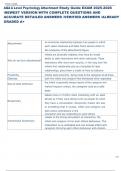
AQA A Level Psychology Attachment Study Guide EXAM 2025-2026
\NEWEST VERSION WITH COMPLETE QUESTIONS AND
ACCURATE DETAILED ANSWERS \VERIFIED ANSWERS \ALREADY
GRADED A+
an emotional relationship between two people in which
Attachment
each seeks closeness and feels more secure when in
the presence of the attachment figure
infants are physically helpless, they have an innate
ability to seek interactions with other individuals. These
Why do we form attachments?
interactions offer short term security, in the long term the
infants first relationship acts as a template for later
relationships, gives them a model of how to behave
Proximity infants seek proximity- being close to the caregiver at all times
Distress both the infant and caregiver feel distressed when separated
the infant is generally always aware of the caregiver and
Secure-base behaviour
makes frequent contact, the caregiver acts as a safe
base
babies move in rhythm when interacting with an adult
almost as if they were taking turns as people do when
Reciprocity
they have a conversation. Reciprocity means two way
or something that it mutual, infant and caregiver are
both active contributors in the
interaction and are responding to each others
relates to the timing and pattern of interaction, the
Interactional Synchrony infant and caregiver mirror each others behaviour. The
interaction is co-ordinated and can include infant and
caregiver mirroring each others behaviour and emotion
1/18
,8/15/25, 7:58 AM TNCC Flashcards
Aim: the investigate interactions between caregiver and
infant using controlled observations
Method: selected 4 different stimuli (3 faces and a gesture) and
observed the
behaviour of infants response - watched and recorded on tape
(seen in real time,
frame by frame and slo mo). the videos then judged by
Meltzoff and Moore Study
independent observers who had knowledge of what
the infants just saw, had to note all head and tongue
movements. (mouth opening, tongue protrusion,
termination of mouth/tongue), a dummy was put in
front of the infants mouth during display to prevent any
response, following the display the dummy was
removed and expression filmed
Findings: each observer scored the tapes twice- all scores
greater than 0.92
Conclusion: there is an association between the infant
behaviour and that of the adult model
+research support= Isabella et al- observed 30 mothers
with their infants assessing their level of synchrony and
attachment. The results show the better the synchrony
the better quality attachment they had= importance
of interactional synchrony in forming a good quality
Evaluation of Meltzoff and
Moore attachment
+reliability= high reliability due to inter-rater/observer
reliability- as all the tapes were watched twice by
independent observers and all scores higher than 0.92=
highly
reliable findings
- purpose of interactional synchrony= no explanation
was found- Feldman said that we cannot understand
the purpose of these interactions, these could mean
nothing and have no overall purpose= it is
ambiguous
2/18
, 8/15/25, 7:58 AM TNCC Flashcards
Aim: to assess whether there was a pattern of
attachment formation that was common to all infants
and identify distinct stages
Procedure: longitudinal study on 60 newborns and mothers from
w/c area in
Glasglow, monthly interviews in first year and another at
18 months- studied in their own home + interactions
observed and carers interviewed - evidence for
attachment= separation anxiety and stranger anxiety
Shaffer and Emerson Study
Results: different aspects of attachment developed at
different ages, strongly attached infants had mothers
who responded to their needs quickly - more
opportunity for attachment, weakly attached infants
had mothers who responded less quickly - less
opporunity for attachment
Conclusion: There is a pattern of attachment common to all
infants which is
biologically controlled. Attachments were most likely to
be formed with those who responded accurately to the
signals NOT who they spent most time with= sensitive
responsiveness
multiple attachments are normal and similar quality-
opposes Bowlby's idea that attachments are a
hierarchy of a prime and minor attachments
-used to look at the early formation of bonds between
non-human parents and their offspring
Use of animal studies
-this is of interest because attachment-like behaviour is
common to a range of species and so animal studies
can help us understand attachment in humans
scientific and objective study of animal behaviour
Ethology
usually with a focus on behaviour under natural
conditions and viewing behaviour an an evolutionary
adaptive trait
An innate readiness to develop a strong bond with the mother
Imprinting which takes place
during a specific time in attachment, likely the first few
3/18
AQA A Level Psychology Attachment Study Guide EXAM 2025-2026
\NEWEST VERSION WITH COMPLETE QUESTIONS AND
ACCURATE DETAILED ANSWERS \VERIFIED ANSWERS \ALREADY
GRADED A+
an emotional relationship between two people in which
Attachment
each seeks closeness and feels more secure when in
the presence of the attachment figure
infants are physically helpless, they have an innate
ability to seek interactions with other individuals. These
Why do we form attachments?
interactions offer short term security, in the long term the
infants first relationship acts as a template for later
relationships, gives them a model of how to behave
Proximity infants seek proximity- being close to the caregiver at all times
Distress both the infant and caregiver feel distressed when separated
the infant is generally always aware of the caregiver and
Secure-base behaviour
makes frequent contact, the caregiver acts as a safe
base
babies move in rhythm when interacting with an adult
almost as if they were taking turns as people do when
Reciprocity
they have a conversation. Reciprocity means two way
or something that it mutual, infant and caregiver are
both active contributors in the
interaction and are responding to each others
relates to the timing and pattern of interaction, the
Interactional Synchrony infant and caregiver mirror each others behaviour. The
interaction is co-ordinated and can include infant and
caregiver mirroring each others behaviour and emotion
1/18
,8/15/25, 7:58 AM TNCC Flashcards
Aim: the investigate interactions between caregiver and
infant using controlled observations
Method: selected 4 different stimuli (3 faces and a gesture) and
observed the
behaviour of infants response - watched and recorded on tape
(seen in real time,
frame by frame and slo mo). the videos then judged by
Meltzoff and Moore Study
independent observers who had knowledge of what
the infants just saw, had to note all head and tongue
movements. (mouth opening, tongue protrusion,
termination of mouth/tongue), a dummy was put in
front of the infants mouth during display to prevent any
response, following the display the dummy was
removed and expression filmed
Findings: each observer scored the tapes twice- all scores
greater than 0.92
Conclusion: there is an association between the infant
behaviour and that of the adult model
+research support= Isabella et al- observed 30 mothers
with their infants assessing their level of synchrony and
attachment. The results show the better the synchrony
the better quality attachment they had= importance
of interactional synchrony in forming a good quality
Evaluation of Meltzoff and
Moore attachment
+reliability= high reliability due to inter-rater/observer
reliability- as all the tapes were watched twice by
independent observers and all scores higher than 0.92=
highly
reliable findings
- purpose of interactional synchrony= no explanation
was found- Feldman said that we cannot understand
the purpose of these interactions, these could mean
nothing and have no overall purpose= it is
ambiguous
2/18
, 8/15/25, 7:58 AM TNCC Flashcards
Aim: to assess whether there was a pattern of
attachment formation that was common to all infants
and identify distinct stages
Procedure: longitudinal study on 60 newborns and mothers from
w/c area in
Glasglow, monthly interviews in first year and another at
18 months- studied in their own home + interactions
observed and carers interviewed - evidence for
attachment= separation anxiety and stranger anxiety
Shaffer and Emerson Study
Results: different aspects of attachment developed at
different ages, strongly attached infants had mothers
who responded to their needs quickly - more
opportunity for attachment, weakly attached infants
had mothers who responded less quickly - less
opporunity for attachment
Conclusion: There is a pattern of attachment common to all
infants which is
biologically controlled. Attachments were most likely to
be formed with those who responded accurately to the
signals NOT who they spent most time with= sensitive
responsiveness
multiple attachments are normal and similar quality-
opposes Bowlby's idea that attachments are a
hierarchy of a prime and minor attachments
-used to look at the early formation of bonds between
non-human parents and their offspring
Use of animal studies
-this is of interest because attachment-like behaviour is
common to a range of species and so animal studies
can help us understand attachment in humans
scientific and objective study of animal behaviour
Ethology
usually with a focus on behaviour under natural
conditions and viewing behaviour an an evolutionary
adaptive trait
An innate readiness to develop a strong bond with the mother
Imprinting which takes place
during a specific time in attachment, likely the first few
3/18