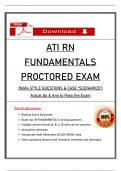
ATI RN
FUNDAMENTALS
PROCTORED EXAM
(NGN-STYLE QUESTIONS & CASE “SCENARIOS”)
Actual Qs & Ans to Pass the Exam
This ATI test contains:
Passing Score Guarantee
Exam has 70 FUNDAMENTALS nursing questions
multiple-choice format (A, B, C, D) with correct answers
structured rationales.
incorporate Next Generation NCLEX (NGN)-style.
Some questions feature brief “scenario” elements and rationales.
,### 1. A nurse is caring for a client who has diarrhea due to shigella. Which of
the following precau ons should the nurse implement for this client?
A. Airborne precau ons
B. Droplet precau ons
C. Contact precau ons
D. Protec ve environment precau ons
Correct Answer: C. Contact precau ons
Ra onale:
Shigella is transmi ed via fecal-oral route, o en through contaminated hands or
surfaces. Contact precau ons (using gloves and gowns) help prevent transmission.
Airborne and droplet precau ons are not indicated for shigella.
---
### 2. A nurse is assessing a client who reports increased pain following physical
therapy. Which of the following ques ons assess the quality of the client’s pain?
A. "Where is your pain located?"
B. "Is your pain sharp or dull?"
C. "How long have you had this pain?"
D. "What makes your pain be*er?"
,Correct Answer: B. "Is your pain sharp or dull?"
Ra onale:
Quality of pain refers to the characteris c or descrip on of pain (e.g., sharp, dull,
burning). Loca on, dura on, and relieving factors assess other dimensions of pain.
---
### 3. A nurse is caring for a client who is postopera ve following abdominal
surgery. Click to highlight the assessment findings below that the nurse should
report to the provider. To deselect a finding, click on the finding again.
Assessment findings:
- A. Urinary output
- B. Reported pain level
- C. Vital signs
Correct Answer: A. Urinary output and C. Vital signs
Ra onale:
Postopera ve clients should have adequate urinary output (typically >0.5
mL/kg/hr), and significant changes might indicate hypovolemia or renal
impairment needing provider no fica on. Vital signs are crucial to monitor for
signs of hemorrhage or infec on. Although pain should be managed, a reported
pain level alone does not always require provider no fica on unless it is
, uncontrolled or unusual. Therefore, urinary output and vital signs are priority
findings to report.
---
### 4. A nurse is caring for a client who reports difficulty falling asleep. Which of
the following recommenda ons should the nurse make?
A. Avoid caffeine at least 1 hour before bed me
B. Maintain a consistent me to wake up each day
C. Use electronic devices to help fall asleep
D. Take long naps during the day to reduce nigh6me sleepiness
Correct Answer: B. Maintain a consistent me to wake up each day
Ra onale:
Maintaining a consistent wake-up me helps regulate the sleep-wake cycle and
improves sleep quality. Avoiding caffeine several hours before bed me is
important, but 1 hour is too short. Electronic devices o en disrupt sleep due to
blue light, and long naps can worsen nigh6me insomnia.
---
### 5. A nurse is caring for a client who has a sodium level of 125 mEq/L. Which
of the following findings should the nurse expect?
FUNDAMENTALS
PROCTORED EXAM
(NGN-STYLE QUESTIONS & CASE “SCENARIOS”)
Actual Qs & Ans to Pass the Exam
This ATI test contains:
Passing Score Guarantee
Exam has 70 FUNDAMENTALS nursing questions
multiple-choice format (A, B, C, D) with correct answers
structured rationales.
incorporate Next Generation NCLEX (NGN)-style.
Some questions feature brief “scenario” elements and rationales.
,### 1. A nurse is caring for a client who has diarrhea due to shigella. Which of
the following precau ons should the nurse implement for this client?
A. Airborne precau ons
B. Droplet precau ons
C. Contact precau ons
D. Protec ve environment precau ons
Correct Answer: C. Contact precau ons
Ra onale:
Shigella is transmi ed via fecal-oral route, o en through contaminated hands or
surfaces. Contact precau ons (using gloves and gowns) help prevent transmission.
Airborne and droplet precau ons are not indicated for shigella.
---
### 2. A nurse is assessing a client who reports increased pain following physical
therapy. Which of the following ques ons assess the quality of the client’s pain?
A. "Where is your pain located?"
B. "Is your pain sharp or dull?"
C. "How long have you had this pain?"
D. "What makes your pain be*er?"
,Correct Answer: B. "Is your pain sharp or dull?"
Ra onale:
Quality of pain refers to the characteris c or descrip on of pain (e.g., sharp, dull,
burning). Loca on, dura on, and relieving factors assess other dimensions of pain.
---
### 3. A nurse is caring for a client who is postopera ve following abdominal
surgery. Click to highlight the assessment findings below that the nurse should
report to the provider. To deselect a finding, click on the finding again.
Assessment findings:
- A. Urinary output
- B. Reported pain level
- C. Vital signs
Correct Answer: A. Urinary output and C. Vital signs
Ra onale:
Postopera ve clients should have adequate urinary output (typically >0.5
mL/kg/hr), and significant changes might indicate hypovolemia or renal
impairment needing provider no fica on. Vital signs are crucial to monitor for
signs of hemorrhage or infec on. Although pain should be managed, a reported
pain level alone does not always require provider no fica on unless it is
, uncontrolled or unusual. Therefore, urinary output and vital signs are priority
findings to report.
---
### 4. A nurse is caring for a client who reports difficulty falling asleep. Which of
the following recommenda ons should the nurse make?
A. Avoid caffeine at least 1 hour before bed me
B. Maintain a consistent me to wake up each day
C. Use electronic devices to help fall asleep
D. Take long naps during the day to reduce nigh6me sleepiness
Correct Answer: B. Maintain a consistent me to wake up each day
Ra onale:
Maintaining a consistent wake-up me helps regulate the sleep-wake cycle and
improves sleep quality. Avoiding caffeine several hours before bed me is
important, but 1 hour is too short. Electronic devices o en disrupt sleep due to
blue light, and long naps can worsen nigh6me insomnia.
---
### 5. A nurse is caring for a client who has a sodium level of 125 mEq/L. Which
of the following findings should the nurse expect?