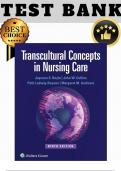
ALL CHAPTERS Test Bank for Transcultural Concepts in Nursing Care, 9th Edition (Boyle).
, ALL CHAPTERS Test Bank for Transcultural Concepts in Nursing Care, 9th Edition (Boyle).
Chapter 1 – Theoretical Foundations of Transcultural Nursing
1. Which statement most accurately reflects the core purpose of Leininger’s
Culture Care Diversity and Universality Theory?
A) To encourage nurses to adapt their own cultural values to match the
patient’s values.
B) To provide a framework for delivering culturally congruent care that fits
patients’ values, beliefs, and lifeways.
C) To promote cultural assimilation for improved patient outcomes.
D) To identify the most dominant cultural practices in the community for
uniform application.
ANS: B
Feedback: Leininger’s theory emphasizes providing culturally congruent care
that aligns with the patient’s values, beliefs, and lifeways, promoting health
and well-being. It does not promote assimilation or the adoption of the nurse’s
values. The goal is mutual respect and individualized care.
DIF: Moderate REF: Culture Care Diversity and Universality Theory
NAT: Client Needs: Safe and Effective Care Environment: Management of Care
BLM: Cognitive Level: Apply
2. A nurse is reviewing the historical development of transcultural nursing.
Which statement best describes its origins?
A) It began in the 1970s with the increase in immigration to North America.
B) It emerged in the mid-20th century from the integration of anthropology
and nursing sciences.
C) It was created after the establishment of the World Health Organization.
D) It started as a government program for refugee resettlement.
ANS: B
Feedback: Transcultural nursing developed in the mid-20th century through the
work of Madeleine Leininger, who integrated anthropological principles into
nursing to address the needs of diverse populations. The other statements are
historically inaccurate.
DIF: Easy REF: Historical Development of Transcultural Nursing
, ALL CHAPTERS Test Bank for Transcultural Concepts in Nursing Care, 9th Edition (Boyle).
NAT: Client Needs: Health Promotion and Maintenance
BLM: Cognitive Level: Understand
3. Which of the following best demonstrates how theory guides culturally
congruent care in diverse populations?
A) Using standardized care plans for all patients to ensure consistency.
B) Assessing each patient’s cultural beliefs and integrating them into the care
plan.
C) Limiting patient involvement in decision-making to avoid confusion.
D) Relying solely on interpreters for culturally competent care.
ANS: B
Feedback: The application of transcultural theory requires individualized
assessment and the integration of the patient’s cultural beliefs into the care
plan. Standardized approaches or limiting patient involvement do not reflect
culturally congruent practice. Interpreters support communication but are not
a substitute for theory-based assessment.
DIF: Moderate REF: Theory to Practice in Culturally Congruent Care
NAT: Client Needs: Psychosocial Integrity
BLM: Cognitive Level: Apply
4. According to Leininger’s theory, which nursing action best illustrates the
mode of cultural care accommodation/negotiation?
A) Encouraging a patient to abandon traditional healing practices in favor of
Western medicine.
B) Adjusting a medication schedule to align with a patient’s religious fasting
period.
C) Teaching a patient how to replace their traditional remedies with
prescription drugs.
D) Ignoring a patient’s cultural preferences to avoid conflict.
ANS: B
Feedback: Cultural care accommodation/negotiation involves adapting care to
support the patient’s cultural practices when it is safe to do so, as in adjusting a
medication schedule during fasting. This promotes respect and cooperation
, ALL CHAPTERS Test Bank for Transcultural Concepts in Nursing Care, 9th Edition (Boyle).
without compromising safety.
DIF: Moderate REF: Culture Care Modes in Practice
NAT: Client Needs: Physiological Integrity: Pharmacological and Parenteral
Therapies
BLM: Cognitive Level: Apply
5. Select all that apply: Which components are considered essential elements of
transcultural nursing as a discipline?
A) Cultural assessment
B) Cultural preservation
C) Cultural imposition
D) Cultural care repatterning
E) Cultural assimilation
ANS: A, B, D
Feedback: Transcultural nursing emphasizes comprehensive cultural
assessment, preserving beneficial cultural practices, and repatterning harmful
practices to improve outcomes. Cultural imposition and assimilation contradict
the principles of culturally congruent care.
DIF: Moderate REF: Core Elements of Transcultural Nursing
NAT: Client Needs: Safe and Effective Care Environment: Management of Care
BLM: Cognitive Level: Understand
6. Which best describes the relationship between cultural competence and
patient safety?
A) Cultural competence reduces legal liability but does not affect patient
outcomes.
B) Cultural competence directly impacts communication, adherence, and error
prevention.
C) Patient safety and cultural competence are unrelated concepts in nursing
practice.
D) Cultural competence primarily addresses ethical issues, not safety concerns.
ANS: B
Feedback: Cultural competence enhances patient safety by improving
, ALL CHAPTERS Test Bank for Transcultural Concepts in Nursing Care, 9th Edition (Boyle).
communication, understanding patient needs, and reducing errors due to
misinterpretation or cultural misunderstanding. This connection is well-
documented in safety and quality literature.
DIF: Moderate REF: Cultural Competence and Patient Safety Outcomes
NAT: Client Needs: Safe and Effective Care Environment: Safety and Infection
Control
BLM: Cognitive Level: Analyze
7. A nurse demonstrates cultural care preservation when:
A) Advising a patient to abandon all traditional health practices.
B) Supporting a patient’s continued use of culturally significant dietary
practices that meet nutritional needs.
C) Discouraging family involvement in patient care.
D) Ignoring a patient’s request for specific healing rituals.
ANS: B
Feedback: Cultural care preservation supports the maintenance of beneficial
cultural practices, such as dietary customs, as long as they do not harm health.
This mode honors patient preferences and promotes well-being.
DIF: Easy REF: Modes of Cultural Care
NAT: Client Needs: Health Promotion and Maintenance
BLM: Cognitive Level: Apply
8. Which nursing theorist is recognized as the founder of transcultural nursing?
A) Madeleine Leininger
B) Jean Watson
C) Hildegard Peplau
D) Dorothea Orem
ANS: A
Feedback: Madeleine Leininger is widely acknowledged as the founder of
transcultural nursing, pioneering the Culture Care Diversity and Universality
Theory. The other theorists are influential in nursing but in different specialty
areas.
DIF: Easy REF: Historical Figures in Transcultural Nursing
, ALL CHAPTERS Test Bank for Transcultural Concepts in Nursing Care, 9th Edition (Boyle).
NAT: Client Needs: Health Promotion and Maintenance
BLM: Cognitive Level: Remember
9. A nurse caring for a patient from a collectivist culture should anticipate
which potential difference in decision-making?
A) The patient will likely make all health decisions independently.
B) Family or community members may be actively involved in care decisions.
C) The patient will defer all decisions to the nurse.
D) The patient will refuse to involve others in private health matters.
ANS: B
Feedback: In collectivist cultures, decisions are often made collectively with
input from family or community, reflecting shared values and group harmony.
This contrasts with the more individualistic approach common in Western
cultures.
DIF: Moderate REF: Cultural Decision-Making Processes
NAT: Client Needs: Psychosocial Integrity
BLM: Cognitive Level: Apply
10. Which action demonstrates cultural care repatterning/restructuring?
A) Encouraging a patient to continue a high-salt diet for cultural reasons
despite hypertension.
B) Assisting a patient to modify a traditional recipe to reduce sodium while
preserving flavor.
C) Discouraging the patient from discussing their illness with elders.
D) Adopting the patient’s cultural diet regardless of its health impact.
ANS: B
Feedback: Cultural care repatterning involves working with the patient to
change harmful cultural practices into healthier forms without erasing cultural
identity. Modifying a recipe maintains cultural significance while improving
health.
DIF: Moderate REF: Culture Care Modes in Practice
NAT: Client Needs: Physiological Integrity: Basic Care and Comfort
BLM: Cognitive Level: Apply
, ALL CHAPTERS Test Bank for Transcultural Concepts in Nursing Care, 9th Edition (Boyle).
Chapter 1 – Theoretical Foundations of Transcultural Nursing
1. Which statement most accurately reflects the core purpose of Leininger’s
Culture Care Diversity and Universality Theory?
A) To encourage nurses to adapt their own cultural values to match the
patient’s values.
B) To provide a framework for delivering culturally congruent care that fits
patients’ values, beliefs, and lifeways.
C) To promote cultural assimilation for improved patient outcomes.
D) To identify the most dominant cultural practices in the community for
uniform application.
ANS: B
Feedback: Leininger’s theory emphasizes providing culturally congruent care
that aligns with the patient’s values, beliefs, and lifeways, promoting health
and well-being. It does not promote assimilation or the adoption of the nurse’s
values. The goal is mutual respect and individualized care.
DIF: Moderate REF: Culture Care Diversity and Universality Theory
NAT: Client Needs: Safe and Effective Care Environment: Management of Care
BLM: Cognitive Level: Apply
2. A nurse is reviewing the historical development of transcultural nursing.
Which statement best describes its origins?
A) It began in the 1970s with the increase in immigration to North America.
B) It emerged in the mid-20th century from the integration of anthropology
and nursing sciences.
C) It was created after the establishment of the World Health Organization.
D) It started as a government program for refugee resettlement.
ANS: B
Feedback: Transcultural nursing developed in the mid-20th century through the
work of Madeleine Leininger, who integrated anthropological principles into
nursing to address the needs of diverse populations. The other statements are
historically inaccurate.
DIF: Easy REF: Historical Development of Transcultural Nursing
, ALL CHAPTERS Test Bank for Transcultural Concepts in Nursing Care, 9th Edition (Boyle).
NAT: Client Needs: Health Promotion and Maintenance
BLM: Cognitive Level: Understand
3. Which of the following best demonstrates how theory guides culturally
congruent care in diverse populations?
A) Using standardized care plans for all patients to ensure consistency.
B) Assessing each patient’s cultural beliefs and integrating them into the care
plan.
C) Limiting patient involvement in decision-making to avoid confusion.
D) Relying solely on interpreters for culturally competent care.
ANS: B
Feedback: The application of transcultural theory requires individualized
assessment and the integration of the patient’s cultural beliefs into the care
plan. Standardized approaches or limiting patient involvement do not reflect
culturally congruent practice. Interpreters support communication but are not
a substitute for theory-based assessment.
DIF: Moderate REF: Theory to Practice in Culturally Congruent Care
NAT: Client Needs: Psychosocial Integrity
BLM: Cognitive Level: Apply
4. According to Leininger’s theory, which nursing action best illustrates the
mode of cultural care accommodation/negotiation?
A) Encouraging a patient to abandon traditional healing practices in favor of
Western medicine.
B) Adjusting a medication schedule to align with a patient’s religious fasting
period.
C) Teaching a patient how to replace their traditional remedies with
prescription drugs.
D) Ignoring a patient’s cultural preferences to avoid conflict.
ANS: B
Feedback: Cultural care accommodation/negotiation involves adapting care to
support the patient’s cultural practices when it is safe to do so, as in adjusting a
medication schedule during fasting. This promotes respect and cooperation
, ALL CHAPTERS Test Bank for Transcultural Concepts in Nursing Care, 9th Edition (Boyle).
without compromising safety.
DIF: Moderate REF: Culture Care Modes in Practice
NAT: Client Needs: Physiological Integrity: Pharmacological and Parenteral
Therapies
BLM: Cognitive Level: Apply
5. Select all that apply: Which components are considered essential elements of
transcultural nursing as a discipline?
A) Cultural assessment
B) Cultural preservation
C) Cultural imposition
D) Cultural care repatterning
E) Cultural assimilation
ANS: A, B, D
Feedback: Transcultural nursing emphasizes comprehensive cultural
assessment, preserving beneficial cultural practices, and repatterning harmful
practices to improve outcomes. Cultural imposition and assimilation contradict
the principles of culturally congruent care.
DIF: Moderate REF: Core Elements of Transcultural Nursing
NAT: Client Needs: Safe and Effective Care Environment: Management of Care
BLM: Cognitive Level: Understand
6. Which best describes the relationship between cultural competence and
patient safety?
A) Cultural competence reduces legal liability but does not affect patient
outcomes.
B) Cultural competence directly impacts communication, adherence, and error
prevention.
C) Patient safety and cultural competence are unrelated concepts in nursing
practice.
D) Cultural competence primarily addresses ethical issues, not safety concerns.
ANS: B
Feedback: Cultural competence enhances patient safety by improving
, ALL CHAPTERS Test Bank for Transcultural Concepts in Nursing Care, 9th Edition (Boyle).
communication, understanding patient needs, and reducing errors due to
misinterpretation or cultural misunderstanding. This connection is well-
documented in safety and quality literature.
DIF: Moderate REF: Cultural Competence and Patient Safety Outcomes
NAT: Client Needs: Safe and Effective Care Environment: Safety and Infection
Control
BLM: Cognitive Level: Analyze
7. A nurse demonstrates cultural care preservation when:
A) Advising a patient to abandon all traditional health practices.
B) Supporting a patient’s continued use of culturally significant dietary
practices that meet nutritional needs.
C) Discouraging family involvement in patient care.
D) Ignoring a patient’s request for specific healing rituals.
ANS: B
Feedback: Cultural care preservation supports the maintenance of beneficial
cultural practices, such as dietary customs, as long as they do not harm health.
This mode honors patient preferences and promotes well-being.
DIF: Easy REF: Modes of Cultural Care
NAT: Client Needs: Health Promotion and Maintenance
BLM: Cognitive Level: Apply
8. Which nursing theorist is recognized as the founder of transcultural nursing?
A) Madeleine Leininger
B) Jean Watson
C) Hildegard Peplau
D) Dorothea Orem
ANS: A
Feedback: Madeleine Leininger is widely acknowledged as the founder of
transcultural nursing, pioneering the Culture Care Diversity and Universality
Theory. The other theorists are influential in nursing but in different specialty
areas.
DIF: Easy REF: Historical Figures in Transcultural Nursing
, ALL CHAPTERS Test Bank for Transcultural Concepts in Nursing Care, 9th Edition (Boyle).
NAT: Client Needs: Health Promotion and Maintenance
BLM: Cognitive Level: Remember
9. A nurse caring for a patient from a collectivist culture should anticipate
which potential difference in decision-making?
A) The patient will likely make all health decisions independently.
B) Family or community members may be actively involved in care decisions.
C) The patient will defer all decisions to the nurse.
D) The patient will refuse to involve others in private health matters.
ANS: B
Feedback: In collectivist cultures, decisions are often made collectively with
input from family or community, reflecting shared values and group harmony.
This contrasts with the more individualistic approach common in Western
cultures.
DIF: Moderate REF: Cultural Decision-Making Processes
NAT: Client Needs: Psychosocial Integrity
BLM: Cognitive Level: Apply
10. Which action demonstrates cultural care repatterning/restructuring?
A) Encouraging a patient to continue a high-salt diet for cultural reasons
despite hypertension.
B) Assisting a patient to modify a traditional recipe to reduce sodium while
preserving flavor.
C) Discouraging the patient from discussing their illness with elders.
D) Adopting the patient’s cultural diet regardless of its health impact.
ANS: B
Feedback: Cultural care repatterning involves working with the patient to
change harmful cultural practices into healthier forms without erasing cultural
identity. Modifying a recipe maintains cultural significance while improving
health.
DIF: Moderate REF: Culture Care Modes in Practice
NAT: Client Needs: Physiological Integrity: Basic Care and Comfort
BLM: Cognitive Level: Apply