CFA Level 1 - 101 Must Knows
Study online at https://quizlet.com/_3fnugd
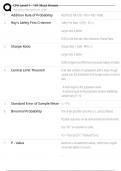
1. Addition Rule of Probability ADDITION: P(A or B) = P(A) + P(B) - P(AB)
2. Roy's Safety First Criterion Safety First Ratio = (E(R) - Rₜ) / σ
Larger ratio is better
If (Rₜ) is risk free rate, then it becomes Sharpe Ratio
3. Sharpe Ratio Sharpe Ratio = (E(R) - RFR) / σ
Larger ratio is better
If (Rt) is higher than RFR, then it becomes Safety First Ratio
4. Central Limit Theorem If we take samples of a population, with a large enough
sample size, the distribution of all sample means is normal
with:
- A mean equal to the population mean
- A variance equal to the population variance divided by
sample size (σ² / n)
5. Standard Error of Sample Mean σ / n^½
6. Binomial Probability One of two possible outcomes (i.e. success/failure)
Possible outcomes can be demonstrated in binomial tree
Use "nCr" on calculator to solve:
nCr = P(success)^x * P(failure)^(n-x)
7. P - Value Based on a calculated test statistic, rather than a signifi-
cance level (which is chosen)
, CFA Level 1 - 101 Must Knows
Study online at https://quizlet.com/_3fnugd
p-value = smallest significance level at which an analyst can
reject the null hypothesis
one-tailed test - "less than or equal to"
two-tailed test - "equal to"
8. Cumulative Distribution Func- Gives the probability that a random variable will have an
tion outcome less than or equal to a specific value (represented
by F(x))
F(x) = probability of an outcome less than or equal to x
Standard normal table (z) shows cumulative probabilities
9. Effective Annual Yield EAY = (1 + (i/n))^n - 1
Stated Rate = (EAY^(1/n) - 1) * n
10. Continuous Compounding ln(EAY) = continuously compounded stated rate
e^(continuously compounded stated rate) = EAY
11. Type I Error Incorrectly rejecting a true null hypothesis
(convicting an innocent person is Type I)
12. Type II Error Failure to reject a false null hypothesis
(failure to convict a guilty person is Type II)
13. Significance Level / Power of a Significance Level = Probability of Type I
Test
Power of a Test = (1 - Probability of Type I)
14. Covariance (Probability Model) Covariance of random variables A and B from probability
model
, CFA Level 1 - 101 Must Knows
Study online at https://quizlet.com/_3fnugd
On the calculator:
1) Enter returns for set A and joint probabilities for AB; find
mean A
2) Enter returns for set B and joint probabilities for AB; find
mean B
3) Multiply each joint probability AB by each set's returns
minus means
(ex: P(AB1)(A1 - Mean A)(B1 - Mean B) + P(AB2)(A2 - Mean
A)(B2 - Mean B) + ... + P(ABn)(An - Mean A)(Bn - Mean B))
4) The summed total is your covariance
15. Covariance (Sample) Covariance of random variables A and B from sample with
historical data with n observations
16. Correlation Coefficient COVab / σaσb
17. Bank Discount Yield (Discount (Discount / Face Value) * (360 / Days)
basis)
18. Money Market Yield (HPY) * (360 / Days)
19. Bond Equivalent Yield (HPY) * (365 / Days)
Most appropriate for comparing yields!
20. Technical Analysis Indicators Continuation:
TRIANGLE (or pennant) = Suggests a pause in the stock
, CFA Level 1 - 101 Must Knows
Study online at https://quizlet.com/_3fnugd
price movement that will be followed by a continuation of
the previous trend
Reversal:
HEAD AND SHOULDERS = Suggests a future decline in the
stock price regardless of prior trend
DOUBLE BOTTOM = Increasing stock price in the future
(reversal of a downtrend)
Trendlines:
SUPPORT / RESISTANCE = Range that stock price trades
in based on supply/demand. Stock is "supported" from
going below a certain low price, and "resists" going above
a certain high price
21. Price Elasticity %ΔQuantity / %ΔPrice = (ΔQ / ΔP) * (P₀ / Q₀)
Demand is elastic if less than -1
Demand is inelastic if 0 to -1
22. Income Elasticity %ΔQuantity / %ΔIncome
Positive for normal good
Negative for inferior good
23. Cross-Price Elasticity %ΔQuantity / %ΔPriceʳᵉˡᵃᵗᵉᵈ ᵍᵒᵒᵈ
Positive for substitutes
Negative for complements
24. Sources of Economic Growth Increases in:
- Labor
- Physical Capital
Study online at https://quizlet.com/_3fnugd
1. Addition Rule of Probability ADDITION: P(A or B) = P(A) + P(B) - P(AB)
2. Roy's Safety First Criterion Safety First Ratio = (E(R) - Rₜ) / σ
Larger ratio is better
If (Rₜ) is risk free rate, then it becomes Sharpe Ratio
3. Sharpe Ratio Sharpe Ratio = (E(R) - RFR) / σ
Larger ratio is better
If (Rt) is higher than RFR, then it becomes Safety First Ratio
4. Central Limit Theorem If we take samples of a population, with a large enough
sample size, the distribution of all sample means is normal
with:
- A mean equal to the population mean
- A variance equal to the population variance divided by
sample size (σ² / n)
5. Standard Error of Sample Mean σ / n^½
6. Binomial Probability One of two possible outcomes (i.e. success/failure)
Possible outcomes can be demonstrated in binomial tree
Use "nCr" on calculator to solve:
nCr = P(success)^x * P(failure)^(n-x)
7. P - Value Based on a calculated test statistic, rather than a signifi-
cance level (which is chosen)
, CFA Level 1 - 101 Must Knows
Study online at https://quizlet.com/_3fnugd
p-value = smallest significance level at which an analyst can
reject the null hypothesis
one-tailed test - "less than or equal to"
two-tailed test - "equal to"
8. Cumulative Distribution Func- Gives the probability that a random variable will have an
tion outcome less than or equal to a specific value (represented
by F(x))
F(x) = probability of an outcome less than or equal to x
Standard normal table (z) shows cumulative probabilities
9. Effective Annual Yield EAY = (1 + (i/n))^n - 1
Stated Rate = (EAY^(1/n) - 1) * n
10. Continuous Compounding ln(EAY) = continuously compounded stated rate
e^(continuously compounded stated rate) = EAY
11. Type I Error Incorrectly rejecting a true null hypothesis
(convicting an innocent person is Type I)
12. Type II Error Failure to reject a false null hypothesis
(failure to convict a guilty person is Type II)
13. Significance Level / Power of a Significance Level = Probability of Type I
Test
Power of a Test = (1 - Probability of Type I)
14. Covariance (Probability Model) Covariance of random variables A and B from probability
model
, CFA Level 1 - 101 Must Knows
Study online at https://quizlet.com/_3fnugd
On the calculator:
1) Enter returns for set A and joint probabilities for AB; find
mean A
2) Enter returns for set B and joint probabilities for AB; find
mean B
3) Multiply each joint probability AB by each set's returns
minus means
(ex: P(AB1)(A1 - Mean A)(B1 - Mean B) + P(AB2)(A2 - Mean
A)(B2 - Mean B) + ... + P(ABn)(An - Mean A)(Bn - Mean B))
4) The summed total is your covariance
15. Covariance (Sample) Covariance of random variables A and B from sample with
historical data with n observations
16. Correlation Coefficient COVab / σaσb
17. Bank Discount Yield (Discount (Discount / Face Value) * (360 / Days)
basis)
18. Money Market Yield (HPY) * (360 / Days)
19. Bond Equivalent Yield (HPY) * (365 / Days)
Most appropriate for comparing yields!
20. Technical Analysis Indicators Continuation:
TRIANGLE (or pennant) = Suggests a pause in the stock
, CFA Level 1 - 101 Must Knows
Study online at https://quizlet.com/_3fnugd
price movement that will be followed by a continuation of
the previous trend
Reversal:
HEAD AND SHOULDERS = Suggests a future decline in the
stock price regardless of prior trend
DOUBLE BOTTOM = Increasing stock price in the future
(reversal of a downtrend)
Trendlines:
SUPPORT / RESISTANCE = Range that stock price trades
in based on supply/demand. Stock is "supported" from
going below a certain low price, and "resists" going above
a certain high price
21. Price Elasticity %ΔQuantity / %ΔPrice = (ΔQ / ΔP) * (P₀ / Q₀)
Demand is elastic if less than -1
Demand is inelastic if 0 to -1
22. Income Elasticity %ΔQuantity / %ΔIncome
Positive for normal good
Negative for inferior good
23. Cross-Price Elasticity %ΔQuantity / %ΔPriceʳᵉˡᵃᵗᵉᵈ ᵍᵒᵒᵈ
Positive for substitutes
Negative for complements
24. Sources of Economic Growth Increases in:
- Labor
- Physical Capital