Psychological Assessment
Psychometrics Exam with Verified
Answers
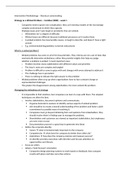
Psychometrics - Answer The science of psychological measurement
- Allows for psychology to be scientifically based
- Allows for professional standards
Standardization - Answer - Efforts made to minimize the influence of the testing situation and the
assessor
- Tests usually have detailed instructions about their use (think the WAIS)
Reliability - Answer The degree of consistency, stability, and predictability
- Error is inherent in psychological testing!
- Reliability estimates the range of possible error in a score
- Ability variables (IQ) tend to be more consistent than personality variables
- Reliability is SAMPLE SPECIFIC... shouldn't label a test as reliable or not, but rather has there been
evidence to show if it's reliable with certain sample?
Test-Retest Reliability - Answer Administering the test and then administering it again on another
occasion
- Reliability coefficient: correlation between the two scores
- Appropriate for stable, but not transient constructs
Reliability coefficient - Answer A correlation between 2 scores when the same test is administered at 2
different times
Factors that may influence test-retest reliability - Answer - interval between administrations
- practice effect
, Most common type of reliability - Answer Internal consistency/reliability
Internal Consistency - Answer - Degree of consistency of scores on items within a test
- Coefficient alpha/Cronbach's alpha
- Split half correlation
How does the number of items influence reliability? - Answer - Increase items, increase reliability
Inter-rater Reliability - Answer Used when there is judgment or subjectivity within scoring
- Compare ratings from different judges for the same examinee
- Then, analyze the percent agreement... correlation=kappa coefficient
Standard Error of Measurement (SEM) - Answer - The expected error due to unreliability
- SEM is a type of SD score and you can interpret it based on normal curve
- Clinical implications: a client's score is not necessarily their true or exact score
- SEM= SD*sqrt(1-r)
- r is the reliability coefficient
- More reliable a test is, the smaller the SEM is
What is needed for proper score interpretation? - Answer - Raw scores and percentages mean very little
- Instead, we must have:
1. Criterion-related cut-off scores (criterion-reference)
2. Population norms (norm-reference)
Criterion-related cut-off scores - Answer - Criteria set for a test to aid in interpretation
- The threshold created indicates a particular score in which something might happen
- Ex: scoring an 8 on the AUDIT crosses the criterion threshold and indicates an increased likelihood to
have an alcohol use disorder
- Ex: DSM criteria
Psychometrics Exam with Verified
Answers
Psychometrics - Answer The science of psychological measurement
- Allows for psychology to be scientifically based
- Allows for professional standards
Standardization - Answer - Efforts made to minimize the influence of the testing situation and the
assessor
- Tests usually have detailed instructions about their use (think the WAIS)
Reliability - Answer The degree of consistency, stability, and predictability
- Error is inherent in psychological testing!
- Reliability estimates the range of possible error in a score
- Ability variables (IQ) tend to be more consistent than personality variables
- Reliability is SAMPLE SPECIFIC... shouldn't label a test as reliable or not, but rather has there been
evidence to show if it's reliable with certain sample?
Test-Retest Reliability - Answer Administering the test and then administering it again on another
occasion
- Reliability coefficient: correlation between the two scores
- Appropriate for stable, but not transient constructs
Reliability coefficient - Answer A correlation between 2 scores when the same test is administered at 2
different times
Factors that may influence test-retest reliability - Answer - interval between administrations
- practice effect
, Most common type of reliability - Answer Internal consistency/reliability
Internal Consistency - Answer - Degree of consistency of scores on items within a test
- Coefficient alpha/Cronbach's alpha
- Split half correlation
How does the number of items influence reliability? - Answer - Increase items, increase reliability
Inter-rater Reliability - Answer Used when there is judgment or subjectivity within scoring
- Compare ratings from different judges for the same examinee
- Then, analyze the percent agreement... correlation=kappa coefficient
Standard Error of Measurement (SEM) - Answer - The expected error due to unreliability
- SEM is a type of SD score and you can interpret it based on normal curve
- Clinical implications: a client's score is not necessarily their true or exact score
- SEM= SD*sqrt(1-r)
- r is the reliability coefficient
- More reliable a test is, the smaller the SEM is
What is needed for proper score interpretation? - Answer - Raw scores and percentages mean very little
- Instead, we must have:
1. Criterion-related cut-off scores (criterion-reference)
2. Population norms (norm-reference)
Criterion-related cut-off scores - Answer - Criteria set for a test to aid in interpretation
- The threshold created indicates a particular score in which something might happen
- Ex: scoring an 8 on the AUDIT crosses the criterion threshold and indicates an increased likelihood to
have an alcohol use disorder
- Ex: DSM criteria