

CALA Study Guide (2025) EXAM QUESTIONS AND ALL CORRECT ANSWER
100% SOLVED AND GUARANTEED SUCCESS!!
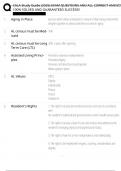
1. Aging in Place process which allows individuals to remain in their living environment
despite cognitive or physical decline occurred in aging
2. AL census must be Med- 10%
icaid
3. AL census must be Long 20%. 3 years after opening
Term Care (LTC)
4. Assisted Living Princi- Promotes maximum independence
ples Promotes dignity
Promotes self-direction & participation
Allows aging in place
5. AL Values DIPCI
Dignity
Individuality
Privacy
Choice
Indepence
6. Resident's Rights 1. The right to receive personalized services and care in accordance
with
the resident's individualized general service and/or health service plan;
2. The right to receive a level of care and services that addresses the
resident's changing physical and psychosocial status;
3. The right to have his or her independence and individuality;
4. The right to be treated with respect, courtesy, consideration and
dignity;
,CALA Study Guide (2025) EXAM QUESTIONS AND ALL CORRECT ANSWER
100% SOLVED AND GUARANTEED SUCCESS!!
5. The right to make choices with respect to services and lifestyle;
6. The right to privacy;
7. The right to have or not to have families' and friends' participation in
resident service planning and implementation;
8. The right to receive pain management as needed, in accordance with
N.J.A.C. 8:43E-6;
9. The right to choose a physician, advanced practice nurse, or physi-
cian
assistant;
10. The right to appeal an involuntary discharge as specified at N.J.A.C.
8:36-5.14(b);
11. The right to receive written documentation that fee increases based
on
a higher level of care are based on reassessment of the resident and in
accordance with N.J.A.C. 8:36-6.2;
12. The right to receive a written explanation of fee increases that are
not
related to increased services, upon request by the resident;
13. The right to participate, to the fullest extent that the resident is able,
in
planning his or her own medical treatment and care;
14. The right to refuse medication and treatment after the resident has
been informed, in language that the resident understands, of the pos-
, CALA Study Guide (2025) EXAM QUESTIONS AND ALL CORRECT ANSWER
100% SOLVED AND GUARANTEED SUCCESS!!
sible
consequences of this decision;
15. The right to refuse to participate in experimental research, includ-
ing
the investigations of new drugs and medical devices. The resident shall
be
included in experimental research only when he or she gives informed,
written
consent to such participation;
16. The right to be free from physical and mental
7. High Blood pressure Result of Hypertension
8. Cellular Theory Senescent changes are result of genetic program. leads to diminished
function and result in death of organ
9. Stress & Viral Theory Organs have fixed amount of energy available and they wear out. Resid-
ual damage resulting from stress, body no longer is able to resist stress
& dies off
10. Activity Theory Stay active, body will last at optimal age
11. Human Needs Theory Hierarchy of physiologic needs, safety and security, love and belonging,
self-esteem, self-actualization. Meaning fulfilled in self-creativity rela-
tionships w/ friends, family, and society
12. Skin Changes in aging Decrease in subcutaneous tissue
Loss of insulation
Increase chance of hypothermia
13.
100% SOLVED AND GUARANTEED SUCCESS!!
1. Aging in Place process which allows individuals to remain in their living environment
despite cognitive or physical decline occurred in aging
2. AL census must be Med- 10%
icaid
3. AL census must be Long 20%. 3 years after opening
Term Care (LTC)
4. Assisted Living Princi- Promotes maximum independence
ples Promotes dignity
Promotes self-direction & participation
Allows aging in place
5. AL Values DIPCI
Dignity
Individuality
Privacy
Choice
Indepence
6. Resident's Rights 1. The right to receive personalized services and care in accordance
with
the resident's individualized general service and/or health service plan;
2. The right to receive a level of care and services that addresses the
resident's changing physical and psychosocial status;
3. The right to have his or her independence and individuality;
4. The right to be treated with respect, courtesy, consideration and
dignity;
,CALA Study Guide (2025) EXAM QUESTIONS AND ALL CORRECT ANSWER
100% SOLVED AND GUARANTEED SUCCESS!!
5. The right to make choices with respect to services and lifestyle;
6. The right to privacy;
7. The right to have or not to have families' and friends' participation in
resident service planning and implementation;
8. The right to receive pain management as needed, in accordance with
N.J.A.C. 8:43E-6;
9. The right to choose a physician, advanced practice nurse, or physi-
cian
assistant;
10. The right to appeal an involuntary discharge as specified at N.J.A.C.
8:36-5.14(b);
11. The right to receive written documentation that fee increases based
on
a higher level of care are based on reassessment of the resident and in
accordance with N.J.A.C. 8:36-6.2;
12. The right to receive a written explanation of fee increases that are
not
related to increased services, upon request by the resident;
13. The right to participate, to the fullest extent that the resident is able,
in
planning his or her own medical treatment and care;
14. The right to refuse medication and treatment after the resident has
been informed, in language that the resident understands, of the pos-
, CALA Study Guide (2025) EXAM QUESTIONS AND ALL CORRECT ANSWER
100% SOLVED AND GUARANTEED SUCCESS!!
sible
consequences of this decision;
15. The right to refuse to participate in experimental research, includ-
ing
the investigations of new drugs and medical devices. The resident shall
be
included in experimental research only when he or she gives informed,
written
consent to such participation;
16. The right to be free from physical and mental
7. High Blood pressure Result of Hypertension
8. Cellular Theory Senescent changes are result of genetic program. leads to diminished
function and result in death of organ
9. Stress & Viral Theory Organs have fixed amount of energy available and they wear out. Resid-
ual damage resulting from stress, body no longer is able to resist stress
& dies off
10. Activity Theory Stay active, body will last at optimal age
11. Human Needs Theory Hierarchy of physiologic needs, safety and security, love and belonging,
self-esteem, self-actualization. Meaning fulfilled in self-creativity rela-
tionships w/ friends, family, and society
12. Skin Changes in aging Decrease in subcutaneous tissue
Loss of insulation
Increase chance of hypothermia
13.


