
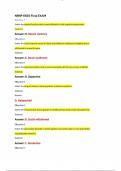
NRNP 6635 Final EXAM
Question 1 Select the mental function that is most affected in mild cognitive impairment. Selected Answer: D. Recent memory Question 2 Select the most frequent cause of infant and childhood intellectual disability that is attributed to a specific gene. Selected Answer: C. Down syndrome Question 3 Select the neurotransmitter that is most associated with the occurrence of ADHD. Selected Answer: B. Dopamine Question 4 Select the drug of choice to treat psychosis in delirious patients. Selected Answer: D. Haloperidol Question 5 Select the characteristic that is greater in childhood than adult onset schizophrenia. Selected Answer: B. Social withdrawal Question 6 Select the personality disorder in which patients are continually in crisis and exhibit unpredictable behavior. Selected Answer: C. Borderline Question 7 lOMoARcPSD| Select the factor that best correlates with attempted and completed suicide. Selected Answer: A. Mental illness Question 8 Select the brain region that shows the greatest anatomical abnormalities in schizophrenic patients. Selected By the end of the 20th century, however, researchers had made significant strides in revealing a potential neuropathological basis for schizophrenia, primarily in the limbic system and the basal ganglia, including neuropathological or neurochemical abnormalities in the cerebral cortex, the thalamus, and the brainstem. Because the basal ganglia and cerebellum are involved in the control of movement, disease in these areas is implicated in the pathophysiology of schizophrenia. Answer: D. Basal ganglia Question 9 Select the gender dysphoria in which genital surgery is usually not chosen. Selected Answer: but who maintain a gender identity that is the same as their birth-assigned gender known as crossdressers. C. Crossdresser Question 10 Select the antipsychotic drug for which the labeling carries a black box warning for agranulocytosis. Selected Answer: A. Clozapine Question 11 Select the time of onset for tolerance to develop from continuous use of hallucinogens such as LSD. Selected lOMoARcPSD| Answer: Tolerance, particularly to the sensory and other psychological effects, is evident as soon as the second or third day of successive LSD use. Four to 6 days free of LSD are necessary to lose significant tolerance. B.4-7 days Question 12 Select the most reliable method to make a diagnosis of schizophrenia. Selected Answer: Therefore, a patient’s history is essential for the diagnosis of schizophrenia; clinicians cannot diagnose schizophrenia simply by results of a mental status examination, which may vary. D. Patient history Question 13 Select the dysfunction that is common to 50% to 85% of schizophrenic patients. Selected Answer: Various studies have reported abnormal eye movements in 50 to 85 percent of patients with schizophrenia compared with about 25 percent in psychiatric patients without schizophrenia and fewer than 10 percent in nonpsychiatrically ill control participant. D. Eye movement Question 14 Select two of the “Four A’s” symptoms of schizophrenia described by Bleuler. Selected These symptoms included associational disturbances of thought, especially looseness, affective disturbances, autism, and ambivalence, summarized as the four As: associations, affect, autism, and ambivalence. Answers: A. autism B. ambivalence Question 15 Select the personality disorder in which patients exhibit covert obstructionism, procrastination and pessimism. Selected In psychoanalytic terms, this phenomenon is called masochism and includes failure, procrastination, silly or provocative behavior, self-demeaning clowning, and frankly self-destructive acts. Answer: D. Passive aggressive Question 16 lOMoARcPSD| Select the negative symptom of schizophrenia. Selected Answer: A. Anhedonia Question 17 Select the main cause female orgasmic disorder. Selected Answer: B. Genetic Question 18 Select the age range for 90% of patients treated for schizophrenia. Selected Answer: About 90 percent of patients in treatment for schizophrenia are between 15 and 55 years old. B. 10-55 Question 19 Select the non-drug therapy in which mastery of anxiety through desensitization is critical to successful treatment of sexual dysfunction. Selected Answer: The behavior therapist enables the patient to master the anxiety through a standard program of systematic desensitization, which is designed to inhibit the learned anxious response by encouraging behaviors antithetical to anxiety. ACBEHAVIORAL THERAPY C. Group Question 20 Select the disorder that is often comorbid with brief psychotic disorder. Selected Answer: Personality disorder is also a predisposing factor for other psychiatric disorders D. Personality Question 21 lOMoARcPSD| Select the psychoactive substance that is most frequently consumed worldwide. Selected Answer: Caffeine is the most widely consumed psychoactive substance in the world. B. Caffeine Question 22 Select the age range at which most children with gender dysphoria begin to show increased anxiety over anticipated changes to their bodies. Selected Answer: Gender identity crystallizes in most persons by age 2 or 3 years. Parents, however, typically report that the cross-gender behaviors were apparent before 3 years of age. Children typically begin to develop a sense of their gender identity around age 3. D. 3 to 4 Question 23 Select the theorist who first studied social and cultural influences on suicide. Selected Answer: The first major contribution to the study of the social and cultural influences on suicide was made at the end of the 19th century by the French sociologist Emile Durkheim. B. Durkheim Question 24 Select the disorder in which is characterized by lack breast development. Selected Answer: Turner’s syndrome in a patient aged 23. Note webbed neck, increased carrying angle, failure of breast development, and lack of pubic hair. B.5-α-reductase deficiency Question 25 Select the age range of the highest rate of substance dependence or abuse. Selected lOMoARcPSD| Answer: In 2012, the rate for dependence or abuse is highest among adults age 18 to 25 (19 percent) compared to youths age 12 to 17 (6 percent) and adults age 26 or older (7 percent). After age 21, a general decline occurred with age. B. 18-25 Question 26 Select two terms preferred to describe sexual orientation. Selected Answers: Hemosexual and Hecterosexual A. Gay D. Lesbian Question 27 Select the two patient populations in which delirium occurs most frequently. Selected Answers: B. Terminally ill C. Long-term care Question 28 Select the drug used to treat neuroleptic malignant syndrome. Selected Answer: C. Dantrolene Question 29 Select the drug that is most likely to cause parkinsonian movement symptoms. Selected Answer: D. Haloperidol Question 30 Select the two main conditions to initially identify in adult psychiatric emergencies. Selected Answers: B. Suicide D. Substance intoxication Question 31 lOMoARcPSD| Select the psychiatric emergency that is indicated by mothers who express inadequate distress over their children’s medical symptoms. Selected Answer: Careful observation may reveal that the mothers often do not exhibit appropriate signs of distress on hearing the details of the child’s medical symptoms. D. Munchausen’s syndrome Question 32 Select the drug that is least life-threatening when consumed in an overdose. Selected Answer: B. Zolpidem Question 33 Select the drug that is most safe and effective in treating mild to moderate memory loss in early Alzheimer’s disease. Selected Answer: A. Donepezil Question 34 Select the substance that is most commonly abused by adolescents. Selected Answer: B. Marijuana Question 35 Select the development time of symptoms in neuroleptic malignant syndrome. Selected Answer: The symptoms usually evolve over 24 to 72 hours, and the untreated syndrome lasts 10 to 14 days. D. 10-14 days Question 36 lOMoARcPSD| Select the patient population at most risk of mortality from delirium. Selected C. Answer: Alcohol withdrawal Question 37 Select the most distinguishing characteristic of delirium. Selected Answer: Classically, delirium has a sudden onset (hours or days), a brief and fluctuating course, and rapid improvement when the causative factor is identified and eliminated, but each of these characteristic features can vary in individual patients. B. Sudden onset Question 38 Select the category of symptoms that is most commonly comorbid with cognitive disorders. Selected Answer: A. Behavioral Question 39 Select the primary defense mechanism that is common in delusional disorder. Selected Answer: A.Projection Question 40 Select the neurotransmitter system that is most associated with the addictive rewarding properties of opioids. Selected Answer: A. Dopaminergic Question 41 Select the type of hallucinations most common in schizophrenia. lOMoARcPSD| Selected The most common hallucinations, however, are auditory, with voices that are often threatening, obscene, accusatory, or insulting. Answer: C. Auditory Question 42 Select the diagnostic criterion for catatonia resulting from a medical condition. Selected Answer: B. Waxy flexibility Question 43 Select the two factors that are not applicable to diagnosing schizoaffective disorder. Selected Answers: As with most psychiatric diagnoses, schizoaffective disorder should not be used if the symptoms are caused by substance abuse or a secondary medical condition. C. Medical condition D. Substance abuse Question 44 Select the percentage of substance-addicted persons with a concurrent psychiatric disorder. Selected Answer: B. 50 Question 45 Select the hepatic enzyme that performs the initial metabolism of alcohol. Selected Answer: A.ADH Question 46 Select the epidemiologic characteristic of tardive dyskinesia symptoms. Selected Answer: lOMoARcPSD| B. Absence in age less than 50 Question 47 Select the neurotransmitter that inhibits sexual orgasm. Selected Answer: A. Serotonin Question 48 Select the drug that is least likely to cause male sexual dysfunction. Selected Answer: B. Sertraline Question 49 Select the youngest age at which childhood-onset schizophrenia can be distinguished from autism spectrum. Selected Answer: A. 3 Question 50 Select the most effective form of questioning when taking a sex history. Selected Answer: B. Open ended Question 51 Select the initial intervention to treat children experiencing acute school refusal. Selected Answer: B. Return to school the next normal day lOMoARcPSD| Question 52 Select the primary method to assess cognition. Selected Answer: C. Mental status exam Question 53 Select the preferred drug used to treat alcohol withdrawal. Selected Answer: D. Lorazepam Question 54 Select the procedure most applicable to confirming a diagnosis of delirium. Selected Answer: C. EEG Question 55 Select the brain region that is associated with substance addiction. Selected Answer: A. Prefrontal cortex Question 56 Select the two defense mechanisms used commonly by patients with personality disorders. Selected Answers: C. Splitting/D. Projection Question 57 Select the lifetime prevalence of schizophrenia in the United States. Selected In the United States, the lifetime prevalence of schizophrenia is about 1 percent Answer: A. 0.1-1.0% Question 58 lOMoARcPSD| Select the subtype of schizophrenia in which auditory hallucinations are frequent. Selected Answer: D. Residual Question 59 Select the neurotransmitter deficiency that is most associated with delirium. Selected Answer: B. Acetylcholine Question 60 Select the rating scale used to assess medication-induced movement disorders. Selected Answer: C. AIMS Question 61 Select the symptom not present in paranoid personality disorder. Selected Answer: B. Fixed delusions Question 62 Select the percentage range of schizophrenic patients that remain significantly impaired throughout their lives. Selected C. Answer: 40 to 60 Question 63 Select the drug most likely to inhibit female orgasm. Selected Answer: Paroxetine Question 64 Select the two non-drug therapies most likely to be effective in treating paraphilic disorders. lOMoARcPSD| Selected Answers: A. Cognitive behavioral D. Insight Question 65 Select the two patient populations most likely suffer neuroleptic-induced parkinsonian symptoms. Selected Answers: A.Female E. Elderly Question 66 Select the factor that is most influential in determining gender role development. Selected Answer: C. Genetics Question 67 Select the most common paraphilic disorder. Selected Answer: F. Pedophilia Question 68 Select the therapy that is contrary to position statements of the American Academy of Child and Adolescent Psychiatry. Selected B. Answer: Conversion Question 69 Select the psychiatric disorder in which patients refuse mental health care and deny their lOMoARcPSD| most common cause of dementia in elderly persons. Selected Answer: G. Personality Question 70 Select the Selected Answer: H. Alzheimer’s disease Question 71 Select the substance of abuse with the strongest evidence for genetic association. Selected Answer: I. Alcohol Question 72 Select the characteristic found in persons with intersex conditions. Selected Answer: D. Chromosome X abnormality Question 73 Select the medical condition in which erectile dysfunction drugs (e.g., sildenafil) are likely to be ineffective. Selected Answer: D. Ischemic heart disease Question 74 Select the neurotransmitter that increases sexual desire. Selected Answer: B. Dopamine Question 75 problems. lOMoARcPSD| Select the infectious disease that when untreated may lead to an incorrect diagnosis of depression. Selected Answer: B. Lyme Question 76 Select the two essential features of sexual dysfunction. Selected Answers: A. Failure to achieve orgasm D. Pain during sexual activity Question 77 Select the personality disorder in which patients seek social withdrawal. Selected Answer: D. Schizotypal Question 78 Select the percentage of the U.S. population with a substance dependence problem as of year 2012. Selected Answer: B. 20% Question 79 Select the youngest age by which early-onset schizophrenia occurs. Selected Childhood-onset schizophrenia is defined by an onset of psychotic symptoms before the age of 13 years, Answer: B. 13 Question 80 Select two psychiatric disorders that are often misdiagnosed as childhood-onset or early onset schizophrenia. Selected Answers: A. Autism spectrum lOMoARcPSD| Bipolar I Question 81 Select the comorbid disorder that is more frequent in children with gender dysphoria. Selected Answer: A. Down syndrome Question 82 Select two treatments for adults who identify as transgender. Selected Answers: A. Hormonal B. Surgical Question 83 Select two comorbid factors common in schizophrenic patients. Selected Answers: A. Substance abuse C. Undiagnosed medical illness Question 84 Select the age at which sexual identity is self-evident. Selected Answer: B. 2 to 3 years Question 85 Select the pair of terms that represents the greatest conflict regarding sexual behavior. Selected Answer: C. medical and legal Question 86 Select the two characteristics that describe normal sexual behavior. Selected Answers: A. Varies from era to era
Document information
- Uploaded on
- August 2, 2025
- Number of pages
- 40
- Written in
- 2025/2026
- Type
- Exam (elaborations)
- Contains
- Questions & answers


