D?
VE
RO
PP
_A
IA
UV
ST
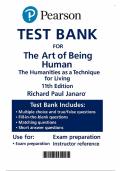
, TEST BANK
Jane Wells
Muskingum University
ST
UV
THE ART OF BEING
HUMAN
IA
Eleventh Edition
_A
Richard Paul Janaro
PP
Thelma C. Altshuler
RO
VE
Boston Columbus Indianapolis New York City San Francisco
Amsterdam Cape Town Dubai London Madrid Milan Munich Paris Montréal Toronto
D?
Delhi Mexico City São Paulo Sydney Hong Kong Seoul Singapore Taipei Tokyo
, This work is solely for the use of instructors and administrators
for the purpose of teaching courses and assessing student
learning. Unauthorized dissemination, publication or sale of the
work, in whole or in part (including posting on the internet) will
ST
destroy the integrity of the work and is strictly prohibited.
UV
IA
_A
Copyright © 2017, 2012, 2009 by Pearson Education, Inc. or its affiliates.
All Rights Reserved. Printed in the United States of America.
PP
This publication is protected by copyright, and permission should
be obtained from the publisher prior to any prohibited reproduction,
storage in a retrieval system, or transmission in any form or by any
means, electronic, mechanical, photocopying, recording, or otherwise.
For information regarding permissions, request forms and the
RO
appropriate contacts within the Pearson Education Global Rights &
Permissions department, please visit
www.pearsoned.com/permissions/.
10 9 8 7 6 5 4 3 2 1
VE
ISBN 10: 0-13-424044-8
ISBN 13: 978-0-13-424044-2
D?
, Janaro, The Art of Being Human 11/e
Test Bank Chapter 1
MULTIPLE CHOICE
ST
1. Heraclitus demonstrates the artistry of language when he offers a shorthand way of stating that
life constantly changes in the phrase
a. “A man cannot step into the same river twice.”
b. “And yet he seemed busier than he was.”
UV
c. “There is a crack in everything. That’s how the light gets in.”
d. “To be or not to be—that is the question.”
Answer: a
Question Title: TB_01_01_Gifts of the Humanities_Understand_LO 1.2
IA
Learning Objective: LO 1.2 Summarize the gifts of the humanities.
Topic: Gifts of the Humanities
Skill Level: Understand the Concepts
Difficulty Level: Medium
_A
Page number: 9
2. Concerning humanism, Renaissance scholars believed that people could become fully human
only if they
a. looked beyond Europe to the works of Asia and Africa.
PP
b. combatted the social injustices of the time.
c. developed skills in critical thinking.
d. studied the best works of classical Greece and Rome.
RO
Answer: d
Question Title: TB_01_02_Being Fully Human_Remember_LO 1.1
Learning Objective: LO 1.1 Define “the humanities.”
Topic: Being Fully Human
Skill Level: Remember the Facts
Difficulty Level: Easy
VE
Page number: 3
3. Redefining the humanities for the wider world means
a. learning about the great works of Greek and Roman culture.
D?
b. maximizing the number of years one can stay alive.
c. being open-minded and receptive to ideas from around the globe.
d. understanding that true beauty lies within us, not outside us.
Answer: c
Question Title: TB_01_03_Being Fully Human_Remember_LO 1.1
VE
RO
PP
_A
IA
UV
ST
, TEST BANK
Jane Wells
Muskingum University
ST
UV
THE ART OF BEING
HUMAN
IA
Eleventh Edition
_A
Richard Paul Janaro
PP
Thelma C. Altshuler
RO
VE
Boston Columbus Indianapolis New York City San Francisco
Amsterdam Cape Town Dubai London Madrid Milan Munich Paris Montréal Toronto
D?
Delhi Mexico City São Paulo Sydney Hong Kong Seoul Singapore Taipei Tokyo
, This work is solely for the use of instructors and administrators
for the purpose of teaching courses and assessing student
learning. Unauthorized dissemination, publication or sale of the
work, in whole or in part (including posting on the internet) will
ST
destroy the integrity of the work and is strictly prohibited.
UV
IA
_A
Copyright © 2017, 2012, 2009 by Pearson Education, Inc. or its affiliates.
All Rights Reserved. Printed in the United States of America.
PP
This publication is protected by copyright, and permission should
be obtained from the publisher prior to any prohibited reproduction,
storage in a retrieval system, or transmission in any form or by any
means, electronic, mechanical, photocopying, recording, or otherwise.
For information regarding permissions, request forms and the
RO
appropriate contacts within the Pearson Education Global Rights &
Permissions department, please visit
www.pearsoned.com/permissions/.
10 9 8 7 6 5 4 3 2 1
VE
ISBN 10: 0-13-424044-8
ISBN 13: 978-0-13-424044-2
D?
, Janaro, The Art of Being Human 11/e
Test Bank Chapter 1
MULTIPLE CHOICE
ST
1. Heraclitus demonstrates the artistry of language when he offers a shorthand way of stating that
life constantly changes in the phrase
a. “A man cannot step into the same river twice.”
b. “And yet he seemed busier than he was.”
UV
c. “There is a crack in everything. That’s how the light gets in.”
d. “To be or not to be—that is the question.”
Answer: a
Question Title: TB_01_01_Gifts of the Humanities_Understand_LO 1.2
IA
Learning Objective: LO 1.2 Summarize the gifts of the humanities.
Topic: Gifts of the Humanities
Skill Level: Understand the Concepts
Difficulty Level: Medium
_A
Page number: 9
2. Concerning humanism, Renaissance scholars believed that people could become fully human
only if they
a. looked beyond Europe to the works of Asia and Africa.
PP
b. combatted the social injustices of the time.
c. developed skills in critical thinking.
d. studied the best works of classical Greece and Rome.
RO
Answer: d
Question Title: TB_01_02_Being Fully Human_Remember_LO 1.1
Learning Objective: LO 1.1 Define “the humanities.”
Topic: Being Fully Human
Skill Level: Remember the Facts
Difficulty Level: Easy
VE
Page number: 3
3. Redefining the humanities for the wider world means
a. learning about the great works of Greek and Roman culture.
D?
b. maximizing the number of years one can stay alive.
c. being open-minded and receptive to ideas from around the globe.
d. understanding that true beauty lies within us, not outside us.
Answer: c
Question Title: TB_01_03_Being Fully Human_Remember_LO 1.1