MN551 Quiz 5 - MN 551 Quiz 5 Advanced Physiology and Pathophysiology Across the Life Span - Midterm Structure and function of the kidney
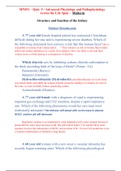
MN551 – Quiz 5 --Advanced Physiology and Pathophysiology Across the Life Span - Midterm Structure and function of the kidney S A 77 year old female hospital patient has contracted Clostridium difficile during her stay and is experiencing severe diarrhea. Which of the following statements best conveys a risk that this woman faces? She is susceptible to isotonic fluid volume deficit. ---This woman is at risk of isotonic fluid volume deficit and sodium imbalances as a result of her diarrhea. She is not likely to develop fluid volume excess or third spacing as consequences of diarrhea. Which diuretic acts by inhibiting sodium chloride reabsorption in the thick ascending limb of the loop of Henle? (Points : 0.4) Bumetanide (Bumex) Mannitol (Osmitrol) Hydrochlorothiazide (Hydrodiuril) hydrochlorothiazide act on the distal convoluted tubule and inhibit the sodium-chloride symporter leading to a retention of water in the urine, as water normally follows penetrating solutes. Acetazolamide (Diamox) A 77 year old female with a diagnosis of copd is experiencing impaired gas exchange and CO2 retention, despite a rapid respiratory rate. Which of the following phenomena would her care team most realistically anticipate? Her kidneys will adapt with an increase in plasma HCO3- and her pH will decrease. Respiratory acidosis is accompanied by renal adaptation with a more marked increase in plasma HCO3- and a lesser decrease in pH. Her pH is likely below 7.35, and the likely renal response involves the reabsorption of HCO3- and secretion of H+. Excess CO2 production is not a common manifestation of obstructive lung disease. A 68 year old woman with a new onset a vascular dementia has recently begun retaining urine. Which of the following physiological phenomena would her care providers most realistically expect to be currently occurring as a result of her urinary retention? Hypertrophy of the bladder muscle and increased bladder wall thickness. Early accompaniments to urinary retention include hypertrophy of the bladder muscle and increased thickness of the bladder wall. Renal effects are unlikely, and decompensation and loss of contraction power are most often later rather than early effects.
Document information
- Uploaded on
- November 6, 2020
- Number of pages
- 13
- Written in
- 2020/2021
- Type
- Exam (elaborations)
- Contains
- Questions & answers