

1
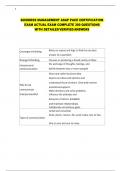
BUSINESS MANAGEMENT ASAP PACE CERTIFICATION
EXAM ACTUAL EXAM COMPLETE 300 QUESTIONS
WITH DETAILED VERIFIED ANSWERS
Convergent thinking Relies on reason and logic to find the one best
answer to a question
Divergent thinking Focuses on producing a broad variety of ideas
interpersonal the exchange of thoughts, feelings, and
communication beliefs between two or more people
Share and collect business data.
Express our ideas and opinions and
understand those of others. Give and receive
Why do we
emotional support.
communicate Make decisions and solve problems.
interpersonally? Influence the attitudes and
behaviors of others. Establish
and maintain relationships.
Collaborate and achieve goals.
verbal and nonverbal.
Email, phone, memos, IM, social media, face to face.
Types of communication
One on one and one to many.
,2
1. Casual
2. Critical
3. Crucial
casual communication: low intensity and
casual. "Did you see the show last night?"
Critical communication: a higher level of
importance, having a phone call with a
Levels of
Communication project owner about a status update.
Crucial communication: opposing opinions,
high stakes strong emotions, EX:
Performance reviews. Job offer scenario.
Negotiations.
Effective communicators adjust their
communication based on the level of
intensity and where they are on the
communication scale. You have to adapt
as the convo ebbs and flows.
Crucial Communication Opposing opinions, high stakes, strong emotions
Components
Sender > Message > Receiver
Sender sends and receiver receives.
Communication Cycle Sender encodes the message and sends it.
Receiver decodes the message
and interprets it. The receiver
responds and becomes the
sender.
, 3
Main 3 Components of 1. Word Choice
2. Tone of Voice
Communication
3. Body Language
Words - 10% importance, but still important.
Tone - 35% - Becomes important on the
telephone. We can read tone of voice in an
components of
communication email as well.
Body language - 55% VERY IMPORTANT
when doing face to face convo.
Context and listening are still important.
Word Choice (% of 10%
meaning)
Tone of Voice (% of 35%
meaning)
Body Language (% of 55%
meaning)
Choose words wisely. Words to avoid are:
Vague words, unclear words, buzzwords,
jargon, obscure, too many words. Indirect.
Overly technical and complicated words.
"per my last
Word Choice email" is bad
"first of all"
"what I said
was" These are
all bad.
WE WANT TO BE PRECISE IN ALL
COMMUNICATION AND
CLEAR TO THE RECEIVER. WE DONT WANT
TO USE TOO MANY WORDS TO CONVERY
BUSINESS MANAGEMENT ASAP PACE CERTIFICATION
EXAM ACTUAL EXAM COMPLETE 300 QUESTIONS
WITH DETAILED VERIFIED ANSWERS
Convergent thinking Relies on reason and logic to find the one best
answer to a question
Divergent thinking Focuses on producing a broad variety of ideas
interpersonal the exchange of thoughts, feelings, and
communication beliefs between two or more people
Share and collect business data.
Express our ideas and opinions and
understand those of others. Give and receive
Why do we
emotional support.
communicate Make decisions and solve problems.
interpersonally? Influence the attitudes and
behaviors of others. Establish
and maintain relationships.
Collaborate and achieve goals.
verbal and nonverbal.
Email, phone, memos, IM, social media, face to face.
Types of communication
One on one and one to many.
,2
1. Casual
2. Critical
3. Crucial
casual communication: low intensity and
casual. "Did you see the show last night?"
Critical communication: a higher level of
importance, having a phone call with a
Levels of
Communication project owner about a status update.
Crucial communication: opposing opinions,
high stakes strong emotions, EX:
Performance reviews. Job offer scenario.
Negotiations.
Effective communicators adjust their
communication based on the level of
intensity and where they are on the
communication scale. You have to adapt
as the convo ebbs and flows.
Crucial Communication Opposing opinions, high stakes, strong emotions
Components
Sender > Message > Receiver
Sender sends and receiver receives.
Communication Cycle Sender encodes the message and sends it.
Receiver decodes the message
and interprets it. The receiver
responds and becomes the
sender.
, 3
Main 3 Components of 1. Word Choice
2. Tone of Voice
Communication
3. Body Language
Words - 10% importance, but still important.
Tone - 35% - Becomes important on the
telephone. We can read tone of voice in an
components of
communication email as well.
Body language - 55% VERY IMPORTANT
when doing face to face convo.
Context and listening are still important.
Word Choice (% of 10%
meaning)
Tone of Voice (% of 35%
meaning)
Body Language (% of 55%
meaning)
Choose words wisely. Words to avoid are:
Vague words, unclear words, buzzwords,
jargon, obscure, too many words. Indirect.
Overly technical and complicated words.
"per my last
Word Choice email" is bad
"first of all"
"what I said
was" These are
all bad.
WE WANT TO BE PRECISE IN ALL
COMMUNICATION AND
CLEAR TO THE RECEIVER. WE DONT WANT
TO USE TOO MANY WORDS TO CONVERY


