

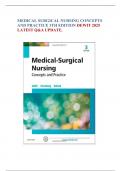
MEDICAL SURGICAL NURSING CONCEPTS
AND PRACTICE 3TH EDITION DEWIT 2025
LATEST Q&A UPDATE.
,Chapter 01: Caring for Medical-Surgical Patients
deWit: Medical-Surgical Nursing: Concepts & Practice, 3rd Edition
MULTIPLE CHOICE
1. Which statement accurately describes the primary purpose of the state nurse practice act (NPA)?
a. To test and license LPN/LVNs.
b. To define the scope of LPN/LVN practice.
c. To improve the quality of care provided by the LPN/LVN.
d. To limit the LPN/LVN employment placement.
>> CORRECT ANS >>B
While improving quality of care provided by the LPN/LVN may be a result of the NPA, the primary purpose of the NPA of each
state defines the scope of nursing practice in that state.
2. The charge nurse asks the new vocational nurse to start an intravenous infusion, a skill that the vocational nurse has not
been taught during her educational program. How should the vocational nurse respond?
a. Ask a more experienced nurse to demonstrate the procedure.
b. Look up the procedure in the procedure manual.
c. Attempt to perform the procedure with supervision.
d. Inform the charge nurse of her lack of training in this procedure.
>> CORRECT ANS >>D
The charge nurse should be informed of the lack of training to perform the procedure, and the vocational nurse should seek
further training to gain proficiency. Although the other options might be helpful, they are not safe.
3. Which patient statement indicates a need for further discharge teaching that the vocational nurse should address?
a. “I have no idea of how this drug will affect me.”
b. “Do you know if my physician is coming back today?”
c. “Will my insurance pay for my stay?”
d. “Am I going to have to go to a nursing home?”
>> CORRECT ANS >>A
Lack of knowledge at discharge about medication effects and side effects is a concern that should be addressed by the vocatio nal
nurse. The other concerns in the options are the responsibility of other departments to which the nurse might refer the patie nt.
4. According to most state NPAs, the vocational nurse acting as charge nurse in a long-term care facility acts in which
capacity?
a. Working under direct supervision of an RN on the unit
b. Working with the RN in the building
c. Working under general supervision by the RN available on site or by phone
d. Working as an independent vocational nurse
>> CORRECT ANS >>C
The vocational nurse in the capacity of the charge nurse in a long-term care facility acts with the general supervision of an RN
available on site or by phone.
,5. The nurse is educating a patient that is a member of a health maintenance organization (HMO). Which information
should the nurse include?
a. Seek the opinion of an alternate health care provider.
b. Obtain insurance approval for medical services prior to treatment.
c. Provide detailed documentation of all care received for his condition.
d. Wait at least 6 months to see a specialist.
>> CORRECT ANS >>B
Most HMOs require preprocedure authorization for treatment. Patients are not required to seek a second opinion, provide
documentation of care, or wait a specific time period before visiting a specialist.
6. The patient complains to the nurse that he is confused about his “deductible” that he owes the hospital. Which
statement accurately explains a deductible?
a. An amount of money put aside for the payment of future medical bills
b. A one-time fee for service
c. An amount of money deducted from the bill by the insurance company
d. An annual amount of money the patient must pay out-of-pocket for medical care
>> CORRECT ANS >>D
The deductible is the annual amount the insured must pay out-of-pocket prior to the insurance company assuming the cost. This
practice improves the profit of the insurance company.
PTS: 1 DIF: Cognitive Level: Comprehension REF: 7
OBJ: 9 TOP: Health Care Financing
KEY: Nursing Process Step: Implementation
7. The nurse compares the characteristics of a health maintenance organization (HMO) and a preferred provider
organization (PPO). Which information should the nurse include about HMOs?
a. HMOs require a set fee of each member monthly.
b. HMOs allow the member to select his health care provider.
c. HMOs permit admission to any facility the member prefers.
d. HMOs offer unlimited diagnostic tests and treatments.
>> CORRECT ANS >>A
HMOs require a set fee from each member monthly (capitation). The patient will be treated by the HMO staff in HMO -approved
facilities. Excessive use of diagnostic tests and treatments is discouraged by the HMO.
8. A patient asks the nurse what Medicare Part A covers. Which response is correct?
a. Medicare Part A covers inpatient hospital costs.
b. Medicare Part A covers reimbursement to the physician.
c. Medicare Part A covers outpatient hospital services.
d. Medicare Part A covers ambulance transportation.
>> CORRECT ANS >>A
Medicare Part A covers inpatient hospital expenses, drugs, x-rays, laboratory work, and intensive care. Medicare Part B pays the
physician, ambulance transport, and outpatient services.
9. Which is the main cost-containment component of diagnosis-related groups (DRGs)?
, a. Hospitals focus only on the specific diagnosis.
b. Hospitals treat and discharge patients quickly.
c. Reduced cost drugs are ordered for specific diagnoses.
d. Diagnostic group classification streamlines care.
>> CORRECT ANS >>B
DRGs are a prospective payment plan in which hospitals receive a flat fee for each patient’s diagnostic category regardless o f the
length of time in the hospital. If hospitals can treat and discharge patients before the allotted time, hospitals get to keep the excess
payment; cost is contained, and the patient is discharged sooner.
10. The nurse is assessing a group of patients. Which patient would most likely qualify for Medicaid?
a. A 35-year-old unemployed single mother with diabetes
b. A 70-year-old Medicare recipient with retirement income who needs to be in a long-term care facility
c. An 80-year-old blind woman living in her own home who has inadequate private insurance
d. A 67-year-old stroke victim with Medicare Part A and an income from investments
>> CORRECT ANS >>A
Medicaid is a joint effort of federal and state governments geared primarily for low-income people with no insurance.
11. Which area is the major focus of Healthy People 2020 and the primary mechanism through which to improve the health
of Americans in the second decade of the century?
a. Research funding
b. Health information distribution
c. Healthy lifestyle encouragement
d. Health improvement program designs
>> CORRECT ANS >>C
Healthy People 2020 focuses on expanding ongoing programs to include support and information to reduce infant mortality,
cancer, cardiovascular disease, and HIV/AIDS, and to increase effective immunizations, healthy eating habits, and healthy
weight.
12. Which term explains the type of care that addresses interventions for all dimensions of a patient’s life?
a. Focused care
b. General care
c. Directed care
d. Holistic care
>> CORRECT ANS >>D
Holistic care addresses the physiologic, psychological, social, cultural, and spiritual needs of the patient.
13. A patient furiously says, “My doctor was so busy giving me instructions that he didn’t hear what I was trying to ask
him!” Which response is most empathetic?
a. “When people ignore me, I really get mad.”
b. “I’m sure that the doctor was rushed and unaware of your needs.”
c. “I’ll bet that made you feel very frustrated.”
d. “Take a deep breath and plan what you will say to him tomorrow.”
>> CORRECT ANS >>C
Empathy demonstrates that the nurse perceives the patient’s feelings but does not share the emotion. Belittling the patient’s
feelings, showing sympathy, or defending the doctor makes the patient feel devalued.
14. The nurse is explaining differences in a therapeutic relationship and a social relationship to a patient. Which
information about therapeutic relationships is most important for the nurse to include in the explanation?
a. Therapeutic relationships lack formal boundaries.
AND PRACTICE 3TH EDITION DEWIT 2025
LATEST Q&A UPDATE.
,Chapter 01: Caring for Medical-Surgical Patients
deWit: Medical-Surgical Nursing: Concepts & Practice, 3rd Edition
MULTIPLE CHOICE
1. Which statement accurately describes the primary purpose of the state nurse practice act (NPA)?
a. To test and license LPN/LVNs.
b. To define the scope of LPN/LVN practice.
c. To improve the quality of care provided by the LPN/LVN.
d. To limit the LPN/LVN employment placement.
>> CORRECT ANS >>B
While improving quality of care provided by the LPN/LVN may be a result of the NPA, the primary purpose of the NPA of each
state defines the scope of nursing practice in that state.
2. The charge nurse asks the new vocational nurse to start an intravenous infusion, a skill that the vocational nurse has not
been taught during her educational program. How should the vocational nurse respond?
a. Ask a more experienced nurse to demonstrate the procedure.
b. Look up the procedure in the procedure manual.
c. Attempt to perform the procedure with supervision.
d. Inform the charge nurse of her lack of training in this procedure.
>> CORRECT ANS >>D
The charge nurse should be informed of the lack of training to perform the procedure, and the vocational nurse should seek
further training to gain proficiency. Although the other options might be helpful, they are not safe.
3. Which patient statement indicates a need for further discharge teaching that the vocational nurse should address?
a. “I have no idea of how this drug will affect me.”
b. “Do you know if my physician is coming back today?”
c. “Will my insurance pay for my stay?”
d. “Am I going to have to go to a nursing home?”
>> CORRECT ANS >>A
Lack of knowledge at discharge about medication effects and side effects is a concern that should be addressed by the vocatio nal
nurse. The other concerns in the options are the responsibility of other departments to which the nurse might refer the patie nt.
4. According to most state NPAs, the vocational nurse acting as charge nurse in a long-term care facility acts in which
capacity?
a. Working under direct supervision of an RN on the unit
b. Working with the RN in the building
c. Working under general supervision by the RN available on site or by phone
d. Working as an independent vocational nurse
>> CORRECT ANS >>C
The vocational nurse in the capacity of the charge nurse in a long-term care facility acts with the general supervision of an RN
available on site or by phone.
,5. The nurse is educating a patient that is a member of a health maintenance organization (HMO). Which information
should the nurse include?
a. Seek the opinion of an alternate health care provider.
b. Obtain insurance approval for medical services prior to treatment.
c. Provide detailed documentation of all care received for his condition.
d. Wait at least 6 months to see a specialist.
>> CORRECT ANS >>B
Most HMOs require preprocedure authorization for treatment. Patients are not required to seek a second opinion, provide
documentation of care, or wait a specific time period before visiting a specialist.
6. The patient complains to the nurse that he is confused about his “deductible” that he owes the hospital. Which
statement accurately explains a deductible?
a. An amount of money put aside for the payment of future medical bills
b. A one-time fee for service
c. An amount of money deducted from the bill by the insurance company
d. An annual amount of money the patient must pay out-of-pocket for medical care
>> CORRECT ANS >>D
The deductible is the annual amount the insured must pay out-of-pocket prior to the insurance company assuming the cost. This
practice improves the profit of the insurance company.
PTS: 1 DIF: Cognitive Level: Comprehension REF: 7
OBJ: 9 TOP: Health Care Financing
KEY: Nursing Process Step: Implementation
7. The nurse compares the characteristics of a health maintenance organization (HMO) and a preferred provider
organization (PPO). Which information should the nurse include about HMOs?
a. HMOs require a set fee of each member monthly.
b. HMOs allow the member to select his health care provider.
c. HMOs permit admission to any facility the member prefers.
d. HMOs offer unlimited diagnostic tests and treatments.
>> CORRECT ANS >>A
HMOs require a set fee from each member monthly (capitation). The patient will be treated by the HMO staff in HMO -approved
facilities. Excessive use of diagnostic tests and treatments is discouraged by the HMO.
8. A patient asks the nurse what Medicare Part A covers. Which response is correct?
a. Medicare Part A covers inpatient hospital costs.
b. Medicare Part A covers reimbursement to the physician.
c. Medicare Part A covers outpatient hospital services.
d. Medicare Part A covers ambulance transportation.
>> CORRECT ANS >>A
Medicare Part A covers inpatient hospital expenses, drugs, x-rays, laboratory work, and intensive care. Medicare Part B pays the
physician, ambulance transport, and outpatient services.
9. Which is the main cost-containment component of diagnosis-related groups (DRGs)?
, a. Hospitals focus only on the specific diagnosis.
b. Hospitals treat and discharge patients quickly.
c. Reduced cost drugs are ordered for specific diagnoses.
d. Diagnostic group classification streamlines care.
>> CORRECT ANS >>B
DRGs are a prospective payment plan in which hospitals receive a flat fee for each patient’s diagnostic category regardless o f the
length of time in the hospital. If hospitals can treat and discharge patients before the allotted time, hospitals get to keep the excess
payment; cost is contained, and the patient is discharged sooner.
10. The nurse is assessing a group of patients. Which patient would most likely qualify for Medicaid?
a. A 35-year-old unemployed single mother with diabetes
b. A 70-year-old Medicare recipient with retirement income who needs to be in a long-term care facility
c. An 80-year-old blind woman living in her own home who has inadequate private insurance
d. A 67-year-old stroke victim with Medicare Part A and an income from investments
>> CORRECT ANS >>A
Medicaid is a joint effort of federal and state governments geared primarily for low-income people with no insurance.
11. Which area is the major focus of Healthy People 2020 and the primary mechanism through which to improve the health
of Americans in the second decade of the century?
a. Research funding
b. Health information distribution
c. Healthy lifestyle encouragement
d. Health improvement program designs
>> CORRECT ANS >>C
Healthy People 2020 focuses on expanding ongoing programs to include support and information to reduce infant mortality,
cancer, cardiovascular disease, and HIV/AIDS, and to increase effective immunizations, healthy eating habits, and healthy
weight.
12. Which term explains the type of care that addresses interventions for all dimensions of a patient’s life?
a. Focused care
b. General care
c. Directed care
d. Holistic care
>> CORRECT ANS >>D
Holistic care addresses the physiologic, psychological, social, cultural, and spiritual needs of the patient.
13. A patient furiously says, “My doctor was so busy giving me instructions that he didn’t hear what I was trying to ask
him!” Which response is most empathetic?
a. “When people ignore me, I really get mad.”
b. “I’m sure that the doctor was rushed and unaware of your needs.”
c. “I’ll bet that made you feel very frustrated.”
d. “Take a deep breath and plan what you will say to him tomorrow.”
>> CORRECT ANS >>C
Empathy demonstrates that the nurse perceives the patient’s feelings but does not share the emotion. Belittling the patient’s
feelings, showing sympathy, or defending the doctor makes the patient feel devalued.
14. The nurse is explaining differences in a therapeutic relationship and a social relationship to a patient. Which
information about therapeutic relationships is most important for the nurse to include in the explanation?
a. Therapeutic relationships lack formal boundaries.


