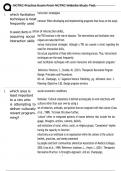
NCTRC Practice Exam From NCTRC Website Study Test.
instruction strategies
1. which faciliation
technique is most
rational: When developing and implementing programs that focus on the acqui-
frequently used
to assist clients in sition of interaction skills,
acquiring social the TRS functions in the role of educator. The interventions and facilitation tech-
interaction skills niques are selected from
various instructional strategies. Although a TRS can counsel a client regarding the
need for interaction skills,
the actual acquisition of those skills involves a learning process. Thus, instructional
techniques are the most frequently
used facilitation techniques with social interaction skill development programs."
Reference: Peterson, C., Stumbo, NJ. (2021). Therapeutic Recreation Program
Design: Principles and Procedures.
6th ed. Champaign, IL: Sagamore-Venture Publishing. pg. 44Content Area: 3.
Planning: Objective 3.02. Design program services
2. which area is social-economic conditions
least important
to a ctrs who Rationale: "Cultural competence is defined as being able to work ettectively with
is attempting to cultures other than your own by using a
deliver culturally set of behaviors, attitudes, and policies that are congruent with that culture (Cross
relvant program- et al., 1989). To break this down further,
ming? "culture" refers to integrated patterns of human behavior that include the lan-
guage, thoughts, actions, customs, beliefs,
and institutions of racial, ethnic, social, or religious groups. "Competence" implies
having the capacity to function
ettectively as an individual or an organization within the context of the cultural
beliefs, practices, and needs presented
by people and their communities (American Association of Medical Colleges,
2005; Cross et al., 1989)."Reference: Anderson, L., Heyne, L. (2021). Therapeutic
Recreation Practice: A Strengths Approach. 2nd ed. Champaign,
, NCTRC Practice Exam From NCTRC Website Study Test.
IL: Sagamore-Venture Publishing. pg. 6Content Area: 1. Professionalism: Objective
1.02. Maintain professional competency
3. which secondary family reports
source should
Rationale: "Secondary data sources are sources other than the participant; for
a CTRS use
example, family members and
for an assess-
documentation provided by other team members."
metn when un-
able to collect
Reference: Carter, MJ., Van Andel, GE. (2020). Therapeutic Recreation: A Practical
background in- Approach. 5th ed. Prospect Long Grove,
formation froma IL: Waveland Press. pg. 94
client who has
dementia and ex- Content Area: 2. Assessment: Objective 2.01. Conduct the assessment process
pressive aphasia
due to a re-
cent cerebrovas-
cular accident
(CVA)
4. cerebrovascular a loss of blood flow to part of the brain which damaged brain tissue.
accident
they are caused by blood clots and broken blood vessels int he brain.
symptom includes dizziness numbness, weakness on one side of the body, and
problem with talking, writing, or understanding language.
5. A CTRS who is reminiscence therapy
working in a
Rationale: "Reminiscence has been broadly defined as "the act of relating person-
long-term facili-
ally significant past experiences"
ty develops "life
(Kottman, 2000, p. 29). Today reminiscence therapy has become widely accepted
history albums"
and is among the most popular
for clients with
dementia of the
, NCTRC Practice Exam From NCTRC Website Study Test.
alzhimers type. psychosocial interventions applied with clients with dementia (B. Woods, Spector,
the ctrs shced- Jones, Orrell, & Davies, 2005). Azcurra
ules a weekly ses- (2012) similarly explained the distinction between reminiscence and life review:
sion with each simple reminiscence is a form of
cleitn and reviews unstructured autobiographical storytelling used to communicate with others, re-
the cleitns album. membering past events and enhancing
which interven- positive feelings, while life review is more structured, covering the complete life
tion technique is span and applying therapeutic approaches
the CTRS using? as a stand-alone proposal or as part of another therapeutic framework such as
cognitive therapy, problem solving or
narrative therapy. (p. 423)"Reference: Austin, DR. (2018). Therapeutic Recreation:
Processes and Techniques. 8th ed. Champaign, IL: sagamore-venture publsihing
pg. 169.
6. reminiscence 1. is a treatmetn that uses all the senses- sight, touch, taste, smell and sound= to
therapy help indviduals with demential remember events, people and places from their
past lives. (recall memories)
vs.
vs.
realilty orinetna-
tion 2. is a therapeutikc technqiue used with epople who have dementia or are other-
wise disordeitned. the approach is to weave detials of their surroundings into the
conversations, including where they are, who they are with and what day it is.
7. dementia a slowly progressive decline in mental abilities, including memory, thinking, and
judgment, that is often accompanied by personality changes
8. Alzheimer's dis- a progressive and irreversible brain disorder characterized by gradual deteriora-
ease tion of memory, reasoning, language, and, finally, physical functioning
9. Multple Sclerosis chronic and crippling disease of the CNS, destruction of the myelin sheath or nerve
, NCTRC Practice Exam From NCTRC Website Study Test.
cells. Loss of myelin slows transmission of nerve impulses,
instruction strategies
1. which faciliation
technique is most
rational: When developing and implementing programs that focus on the acqui-
frequently used
to assist clients in sition of interaction skills,
acquiring social the TRS functions in the role of educator. The interventions and facilitation tech-
interaction skills niques are selected from
various instructional strategies. Although a TRS can counsel a client regarding the
need for interaction skills,
the actual acquisition of those skills involves a learning process. Thus, instructional
techniques are the most frequently
used facilitation techniques with social interaction skill development programs."
Reference: Peterson, C., Stumbo, NJ. (2021). Therapeutic Recreation Program
Design: Principles and Procedures.
6th ed. Champaign, IL: Sagamore-Venture Publishing. pg. 44Content Area: 3.
Planning: Objective 3.02. Design program services
2. which area is social-economic conditions
least important
to a ctrs who Rationale: "Cultural competence is defined as being able to work ettectively with
is attempting to cultures other than your own by using a
deliver culturally set of behaviors, attitudes, and policies that are congruent with that culture (Cross
relvant program- et al., 1989). To break this down further,
ming? "culture" refers to integrated patterns of human behavior that include the lan-
guage, thoughts, actions, customs, beliefs,
and institutions of racial, ethnic, social, or religious groups. "Competence" implies
having the capacity to function
ettectively as an individual or an organization within the context of the cultural
beliefs, practices, and needs presented
by people and their communities (American Association of Medical Colleges,
2005; Cross et al., 1989)."Reference: Anderson, L., Heyne, L. (2021). Therapeutic
Recreation Practice: A Strengths Approach. 2nd ed. Champaign,
, NCTRC Practice Exam From NCTRC Website Study Test.
IL: Sagamore-Venture Publishing. pg. 6Content Area: 1. Professionalism: Objective
1.02. Maintain professional competency
3. which secondary family reports
source should
Rationale: "Secondary data sources are sources other than the participant; for
a CTRS use
example, family members and
for an assess-
documentation provided by other team members."
metn when un-
able to collect
Reference: Carter, MJ., Van Andel, GE. (2020). Therapeutic Recreation: A Practical
background in- Approach. 5th ed. Prospect Long Grove,
formation froma IL: Waveland Press. pg. 94
client who has
dementia and ex- Content Area: 2. Assessment: Objective 2.01. Conduct the assessment process
pressive aphasia
due to a re-
cent cerebrovas-
cular accident
(CVA)
4. cerebrovascular a loss of blood flow to part of the brain which damaged brain tissue.
accident
they are caused by blood clots and broken blood vessels int he brain.
symptom includes dizziness numbness, weakness on one side of the body, and
problem with talking, writing, or understanding language.
5. A CTRS who is reminiscence therapy
working in a
Rationale: "Reminiscence has been broadly defined as "the act of relating person-
long-term facili-
ally significant past experiences"
ty develops "life
(Kottman, 2000, p. 29). Today reminiscence therapy has become widely accepted
history albums"
and is among the most popular
for clients with
dementia of the
, NCTRC Practice Exam From NCTRC Website Study Test.
alzhimers type. psychosocial interventions applied with clients with dementia (B. Woods, Spector,
the ctrs shced- Jones, Orrell, & Davies, 2005). Azcurra
ules a weekly ses- (2012) similarly explained the distinction between reminiscence and life review:
sion with each simple reminiscence is a form of
cleitn and reviews unstructured autobiographical storytelling used to communicate with others, re-
the cleitns album. membering past events and enhancing
which interven- positive feelings, while life review is more structured, covering the complete life
tion technique is span and applying therapeutic approaches
the CTRS using? as a stand-alone proposal or as part of another therapeutic framework such as
cognitive therapy, problem solving or
narrative therapy. (p. 423)"Reference: Austin, DR. (2018). Therapeutic Recreation:
Processes and Techniques. 8th ed. Champaign, IL: sagamore-venture publsihing
pg. 169.
6. reminiscence 1. is a treatmetn that uses all the senses- sight, touch, taste, smell and sound= to
therapy help indviduals with demential remember events, people and places from their
past lives. (recall memories)
vs.
vs.
realilty orinetna-
tion 2. is a therapeutikc technqiue used with epople who have dementia or are other-
wise disordeitned. the approach is to weave detials of their surroundings into the
conversations, including where they are, who they are with and what day it is.
7. dementia a slowly progressive decline in mental abilities, including memory, thinking, and
judgment, that is often accompanied by personality changes
8. Alzheimer's dis- a progressive and irreversible brain disorder characterized by gradual deteriora-
ease tion of memory, reasoning, language, and, finally, physical functioning
9. Multple Sclerosis chronic and crippling disease of the CNS, destruction of the myelin sheath or nerve
, NCTRC Practice Exam From NCTRC Website Study Test.
cells. Loss of myelin slows transmission of nerve impulses,