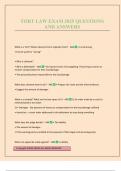
TORT LAW EXAM 2025 QUESTIONS
AND ANSWERS
What is a 'tort'? Where does the term originate from? - ANS • A civil wrong
• French word for "wrong"
• Who is claimant?
• Who is defendant? - ANS • An injured victim of wrongdoing. They bring an action to
recover compensation for their loss/damage
• The person/business responsible for the loss/damage
What does claimant have to do? - ANS • Prepare the claim and the initial evidence
• Suggest the amount of damages
What is a remedy? What are the two types of it? - ANS 1) An order made by a court to
enforce/satisfy a tort claim
2) • Damages - the payment of money as compensation for the loss/damage suffered
• Injunction - a court order addressed to the defendant to stop doing something
What does the judge decide? - ANS • The liability
• The amount of damages
• If the winning party is entitled to the payment of their legal costs by losing party
What can appeal be made against? - ANS • Liability
1 Copyright ©2025 SIRJOEL ALL RIGHTS RESERVED
,• Amount of damages awarded
What if claimant is underaged? - ANS Parent/litigation friend takes the action on their behalf
What is a standard of proof? Who is it on? - ANS • On the balance of probabilities
• On the claimant
What are defences available? - ANS • Dispute the case
• Suggest the claimant wholly or partly caused their own injury
What is the main point of tort law? - ANS "Person has certain interests which others have the
obligation to respect"
What are the protected interests? - ANS • Personal harm
• Physical
• Reputational harm (defamation: libel/slander)
• Personal freedom
• Harm to property
• Harm to financial interests
What are the main aims of tort law? - ANS • To provide compensation to injured victims
• To achieve and provide justice for an injured victim
• It is morally fair that an injury causer should be required to pay for the suffering caused,
penalising a defendant
• Loss distribution - greater liablity should be imposed on businesses/companies whose
activities cause physical injury and damage
• To achieve policy aims of improving standards
2 Copyright ©2025 SIRJOEL ALL RIGHTS RESERVED
, • What is the compensation culture?
• What has the Compensation Act 2006 changed? - ANS • Attitude to sue for even the most
trivial reasons/where only minor injury/damage has been caused
• It became an offence to run an unauthorised claims management company
What is the difference between tort law and contract law? - ANS • Contract law - previously
entered contract
• Tort law - no formal relationship before the incident
What is a negligence? What must be proved? - ANS • An act or a failure to act which causes
injury to another person/damage to their property
• Duty of care + breach of duty + damage caused
What was the Donoghue v Stevenson (1932)? What has it established? - ANS • Beer
manufacturers were found liable for causing injury (snail in a bottle)
• The neighbour principle - the person who is owed a duty of care by the defendant. It is
anyone who could be injured by your act/omission
What is incremental? - ANS Development of the law through cases
What is the Caparo v Dickman (1990) case? What has it established? - ANS Economic loss =
injury/damage
What is a three-part (Caparo test)? Give case examples. - ANS 1) An update of the neighbour
principle
2) • Harm is reasonably foreseeable (Kent v Griffiths 2000 - the ambulance could foresee that
the claimant could have been injured if they arrive late)
• Proximity of relationship (Bourhill v Young 1943 - the dead motorcyclist did not owe a duty of
care to the claimant who suffered trauma+stillborn because of seeing the motorcyclist dead in
the accident)
3 Copyright ©2025 SIRJOEL ALL RIGHTS RESERVED
AND ANSWERS
What is a 'tort'? Where does the term originate from? - ANS • A civil wrong
• French word for "wrong"
• Who is claimant?
• Who is defendant? - ANS • An injured victim of wrongdoing. They bring an action to
recover compensation for their loss/damage
• The person/business responsible for the loss/damage
What does claimant have to do? - ANS • Prepare the claim and the initial evidence
• Suggest the amount of damages
What is a remedy? What are the two types of it? - ANS 1) An order made by a court to
enforce/satisfy a tort claim
2) • Damages - the payment of money as compensation for the loss/damage suffered
• Injunction - a court order addressed to the defendant to stop doing something
What does the judge decide? - ANS • The liability
• The amount of damages
• If the winning party is entitled to the payment of their legal costs by losing party
What can appeal be made against? - ANS • Liability
1 Copyright ©2025 SIRJOEL ALL RIGHTS RESERVED
,• Amount of damages awarded
What if claimant is underaged? - ANS Parent/litigation friend takes the action on their behalf
What is a standard of proof? Who is it on? - ANS • On the balance of probabilities
• On the claimant
What are defences available? - ANS • Dispute the case
• Suggest the claimant wholly or partly caused their own injury
What is the main point of tort law? - ANS "Person has certain interests which others have the
obligation to respect"
What are the protected interests? - ANS • Personal harm
• Physical
• Reputational harm (defamation: libel/slander)
• Personal freedom
• Harm to property
• Harm to financial interests
What are the main aims of tort law? - ANS • To provide compensation to injured victims
• To achieve and provide justice for an injured victim
• It is morally fair that an injury causer should be required to pay for the suffering caused,
penalising a defendant
• Loss distribution - greater liablity should be imposed on businesses/companies whose
activities cause physical injury and damage
• To achieve policy aims of improving standards
2 Copyright ©2025 SIRJOEL ALL RIGHTS RESERVED
, • What is the compensation culture?
• What has the Compensation Act 2006 changed? - ANS • Attitude to sue for even the most
trivial reasons/where only minor injury/damage has been caused
• It became an offence to run an unauthorised claims management company
What is the difference between tort law and contract law? - ANS • Contract law - previously
entered contract
• Tort law - no formal relationship before the incident
What is a negligence? What must be proved? - ANS • An act or a failure to act which causes
injury to another person/damage to their property
• Duty of care + breach of duty + damage caused
What was the Donoghue v Stevenson (1932)? What has it established? - ANS • Beer
manufacturers were found liable for causing injury (snail in a bottle)
• The neighbour principle - the person who is owed a duty of care by the defendant. It is
anyone who could be injured by your act/omission
What is incremental? - ANS Development of the law through cases
What is the Caparo v Dickman (1990) case? What has it established? - ANS Economic loss =
injury/damage
What is a three-part (Caparo test)? Give case examples. - ANS 1) An update of the neighbour
principle
2) • Harm is reasonably foreseeable (Kent v Griffiths 2000 - the ambulance could foresee that
the claimant could have been injured if they arrive late)
• Proximity of relationship (Bourhill v Young 1943 - the dead motorcyclist did not owe a duty of
care to the claimant who suffered trauma+stillborn because of seeing the motorcyclist dead in
the accident)
3 Copyright ©2025 SIRJOEL ALL RIGHTS RESERVED