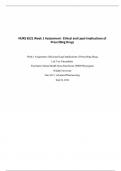
NURS 6521 Week 1 Assignment - Ethical and Legal Implications of Prescribing Drugs
Introduction Ethics is not a specific set of rules but a set of moral principles that govern a person's behavior (Epstein, B., Turner, M., 2015). Ethics is how we provide practical and patient care to our patients (Epstein, B., Turner, M., 2015). Nursing is one of the most challenging professions, and we should always provide quality patient care. Individuals often determine right or wrong based on emotions (Epstein, B., Turner, M., 2015). Ethics is not based on emotion but on your actions' effect on others; nurses have the American Nurses Association's Code of Ethics to turn to for reference (Epstein, B., Turner, M. 2015). Scenario MA is an 85-year-old female living in a long-term care facility. She has significant cognitive decline, and her physician has even said that death is near with her other health issues, including renal failure and CHF. She was on blood thinners for years due to a valve replacement 20 years ago. She cries in agony with each fingerpick and can barely tolerate the lab draws if needed to check her INR. In this scenario, the question is whether continual monitoring of the INR is required, given her terminal status. In this scenario, this patient has a significant cognitive decline; she cannot make her own decision regarding her issues, and it will affect her autonomy will be compromised. The physician must make sure this patient receives the proper treatment. The pharmacist must ensure this patient takes her medication as prescribed. The patient's family must update the primary provider if any condition changes in the patient. Disclosure and nondisclosure in the scenario In this scenario, I would say if MA wished to continue all her treatment and monitor her INR, it is necessary to ensure that she is not at risk for bleeding, despite her terminal status. If MA does not want to continue any of her treatment and no need to continue to monitor her INR level, we should respect her wishes. Two strategies may use in this scenario In this scenario. MA is an 85-year-old female with a significant cognitive decline, a past medical history of renal failure, and CHF. Her physician has said that death is near with her other health issues. With MA's age, overall health status, and cognitive decline, she is close to the end of her life. In a situation like this, it is unnecessary to continue monitoring her INR level because her health condition may not improve. On the other hand, if MA is alert and oriented to communicate with her primary provider and wants to continue monitoring her INR level as she wishes, then it should be continued. Suppose MA's cognitive issues get worse and she is unable to communicate, or she does not tolerate any pain with fingerpicks. In that case, it is unnecessary to continue monitoring her INR. As an advanced practice nurse, it is essential to communicate with the patient, the patient's primary care provider, and family members. To ensure every patient's care team member will be aware of their health condition change and can provide quality care to this patient. The process of writing prescriptions to prevent medication errors When it comes to strategies to minimize medication errors, first, healthcare professionals should take steps to reduce medication errors, including using clear, concise directions when writing prescriptions (Drug Enforcement Administration. 2006). It is also essential to verify that
Written for
- Institution
-
Walden University
- Course
-
NURS 6521
Document information
- Uploaded on
- July 21, 2025
- Number of pages
- 5
- Written in
- 2024/2025
- Type
- Exam (elaborations)
- Contains
- Questions & answers
Subjects
- nurs 6521
-
nurs 6521 week 1 assignment ethical and legal im
-
nurs 6521 week 1 assignment

Also available in package deal