

Written by students who passed Immediately available after payment Read online or as PDF Wrong document? Swap it for free 4.6 TrustPilot
logo-home
Document preview thumbnail
Preview 1 out of 2 pages
Exam (elaborations)

Basic Chemistry practice Test 2 Questions Fully Solved 2025 Updated.

Document preview thumbnail
Preview 1 out of 2 pages

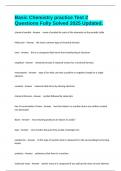
chemical symbol - Answer name of symbol for each of the elements on the periodic table Molecular - Answer the most common type of chemical formula ionic - Answer this is a compound that forms from transferring of electrons empitical - Answer chemical formula is reduced version for a chemical formula monoatomic - Answer type of ion that can have a positive or negative charge for a single element covalent - Answer molecule that forms by sharing electrons chemical formula - Answer symbol followed by subscripts law of conservation of mass - Answer law that states in a reaction atoms are neither created nor destroyed Bases - Answer most cleaning products are (bases or acids)? base - Answer very reactive because they accept a hydrogen ion exothermic - Answer in this type of reaction heat is released in to the surroundings by forming bonds products - Answer substances that form in a reaction molecular mass - Answer atomic mass of a compound if you add up the mass of each element acid - Answer compounds that are very reactive because they donate a hydrogen ion coefficiants - Answer large number that goes in front of the compound and represents the number of compounds you have

Content preview

Basic Chemistry practice Test 2
Questions Fully Solved 2025 Updated.
chemical symbol - Answer name of symbol for each of the elements on the periodic table


Molecular - Answer the most common type of chemical formula


ionic - Answer this is a compound that forms from transferring of electrons


empitical - Answer chemical formula is reduced version for a chemical formula


monoatomic - Answer type of ion that can have a positive or negative charge for a single
element


covalent - Answer molecule that forms by sharing electrons


chemical formula - Answer symbol followed by subscripts


law of conservation of mass - Answer law that states in a reaction atoms are neither created
nor destroyed


Bases - Answer most cleaning products are (bases or acids)?


base - Answer very reactive because they accept a hydrogen ion


exothermic - Answer in this type of reaction heat is released in to the surroundings by forming
bonds


products - Answer substances that form in a reaction


molecular mass - Answer atomic mass of a compound if you add up the mass of each element

Document information

Uploaded on
July 21, 2025
Number of pages
2
Written in
2024/2025
Type
Exam (elaborations)
Contains
Questions & answers
$12.49

Wrong document? Swap it for free Within 14 days of purchase and before downloading, you can choose a different document. You can simply spend the amount again.
Written by students who passed
Immediately available after payment
Read online or as PDF

Seller avatar
Reputation scores are based on the amount of documents a seller has sold for a fee and the reviews they have received for those documents. There are three levels: Bronze, Silver and Gold. The better the reputation, the more your can rely on the quality of the sellers work.
TestSolver9
3.5
(165)
Sold
958
Followers
128
Items
30764
Last sold
3 days ago


Why students choose Stuvia

Created by fellow students, verified by reviews

Quality you can trust: written by students who passed their tests and reviewed by others who've used these notes.

Didn't get what you expected? Choose another document

No worries! You can instantly pick a different document that better fits what you're looking for.

Pay as you like, start learning right away

No subscription, no commitments. Pay the way you're used to via credit card and download your PDF document instantly.

Student with book image

“Bought, downloaded, and aced it. It really can be that simple.”

Alisha Student

Working on your references?

Create accurate citations in APA, MLA and Harvard with our free citation generator.

Working on your references?

Frequently asked questions
