CNA Test 2 UPDATED ACTUAL Exam
Questions and CORRECT Answers
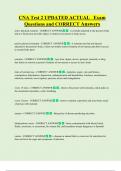
active physical restraint - CORRECT ANSWER - A restraint attached to the person's body
and to a fixed (non-movable object; it restricts movement or body access
passive physical restraint - CORRECT ANSWER - A restraint near but not directly
attached to the person's body; it does not totally restrict freedom of movement and allows access
to certain body parts
restraint - CORRECT ANSWER - Any item, object, device, garment, material, or drug
that limits or restricts a person's freedom of movement or access to one's body
risks of restraint use - CORRECT ANSWER - Agitation, anger, cuts and bruises,
constipation, dehydration, depression, embarrassment and humiliation, fractures, incontinence,
infection, mistrust, nerve injuries, pressure ulcers and strangulation
every 15 mins - CORRECT ANSWER - observe the person with restraints, check pulse in
the restrained extremities, color, breathing
every 2 hours - CORRECT ANSWER - remove restraint, reposition and meet basic needs
of person with restraint
asepsis - CORRECT ANSWER - Being free of disease-producing microbes
biohazardous waste - CORRECT ANSWER - Items contaminated with blood, blood
fluids, secretions, or excretions; bio means life, and hazardous means dangerous or harmful
carrier - CORRECT ANSWER - a human or animal that is a reservoir for microbes but
does not have the signs and symptoms of infection
, clean technique - CORRECT ANSWER - medical asepsis
communicable disease - CORRECT ANSWER - a disease caused by pathogens that spread
easily; a contagious disease
contagious disease - CORRECT ANSWER - communicable disease
contamination - CORRECT ANSWER - The process of becoming unclean
disinfection - CORRECT ANSWER - the process of destroying pathogens
infection - CORRECT ANSWER - A disease state resulting from the invasion and growth
of microbes in the body
medical asepsis - CORRECT ANSWER - practices used to remove or destroy pathogens
and to prevent their spread from one person or place to another person or place; clean technique
microbe - CORRECT ANSWER - a microorganism
microorganism - CORRECT ANSWER - A small (micro) living plant or animal
(organism) seen only with a microscope; a microbe
non-pathogen - CORRECT ANSWER - a microbe that does not usually cause an infection
pathogen - CORRECT ANSWER - A microbe that is harmful and can cause an infection
sterile - CORRECT ANSWER - the absence of all microbes
Questions and CORRECT Answers
active physical restraint - CORRECT ANSWER - A restraint attached to the person's body
and to a fixed (non-movable object; it restricts movement or body access
passive physical restraint - CORRECT ANSWER - A restraint near but not directly
attached to the person's body; it does not totally restrict freedom of movement and allows access
to certain body parts
restraint - CORRECT ANSWER - Any item, object, device, garment, material, or drug
that limits or restricts a person's freedom of movement or access to one's body
risks of restraint use - CORRECT ANSWER - Agitation, anger, cuts and bruises,
constipation, dehydration, depression, embarrassment and humiliation, fractures, incontinence,
infection, mistrust, nerve injuries, pressure ulcers and strangulation
every 15 mins - CORRECT ANSWER - observe the person with restraints, check pulse in
the restrained extremities, color, breathing
every 2 hours - CORRECT ANSWER - remove restraint, reposition and meet basic needs
of person with restraint
asepsis - CORRECT ANSWER - Being free of disease-producing microbes
biohazardous waste - CORRECT ANSWER - Items contaminated with blood, blood
fluids, secretions, or excretions; bio means life, and hazardous means dangerous or harmful
carrier - CORRECT ANSWER - a human or animal that is a reservoir for microbes but
does not have the signs and symptoms of infection
, clean technique - CORRECT ANSWER - medical asepsis
communicable disease - CORRECT ANSWER - a disease caused by pathogens that spread
easily; a contagious disease
contagious disease - CORRECT ANSWER - communicable disease
contamination - CORRECT ANSWER - The process of becoming unclean
disinfection - CORRECT ANSWER - the process of destroying pathogens
infection - CORRECT ANSWER - A disease state resulting from the invasion and growth
of microbes in the body
medical asepsis - CORRECT ANSWER - practices used to remove or destroy pathogens
and to prevent their spread from one person or place to another person or place; clean technique
microbe - CORRECT ANSWER - a microorganism
microorganism - CORRECT ANSWER - A small (micro) living plant or animal
(organism) seen only with a microscope; a microbe
non-pathogen - CORRECT ANSWER - a microbe that does not usually cause an infection
pathogen - CORRECT ANSWER - A microbe that is harmful and can cause an infection
sterile - CORRECT ANSWER - the absence of all microbes