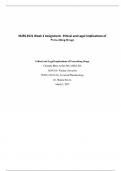
NURS 6521 Week 2 Assignment - Ethical and Legal Implications of Prescribing Drugs
JJ is a 7-year-old male who has had asthma his entire life. Multiple treatments have been tried, but nothing works completely. A study regarding a new asthma medication is being developed. This medication contains a bronchodilator/steroid/antihistamine as an inhalation. None of the drugs being studied have previously been approved for children under the age of 12. Advanced Practice Registered Nurses (APRNs) are vital in our healthcare system. APRNs treat and diagnose illness and manage chronic diseases as well as assess, order, and interpret diagnostic and laboratory tests. In addition, APRNs have prescriptive authority and manage medication. APRNs can work independently, autonomously, or in collaboration with other healthcare professionals depending on their state of licensure (Scope of Practice for Nurse Practitioners, n.d.). Ethical and Legal Implications Prescriber, Pharmacist, Patient, and Patient’s Family The primary responsibility for any medication falls on the prescriber. In our scenario, the new medication described has not been approved for children under 12, and the child in question is seven years old. It is the prescriber's ethical and legal duty to ensure all medications prescribed are for improving the patient’s care without compromising his safety. While state laws may vary in determining an APRN's prescriptive authority, it is the responsibility of the APRN first to do no harm (Zhang & Patel, 2022). A pharmacist has the same role as the prescriber in preventing the misuse of medication and its appropriateness (Sun, 2021). The pharmacist would be ethically and legally obligated to refuse to dispense the medication for our patient due to his age. The APRN, as the provider, has the obligation to inform the patient and his family of all information pertaining to his care. However, the child’s parents have the legal right to disagree with what may be deemed beneficial for the child by the APRN (Olejarczyk & Young, 2022). Strategies for Disclosure and Nondisclosure of Medication Errors Medication errors will occur within the medical profession. For this reason, there are laws, recommendations, and guidelines governing how it should be handled. APRNs and healthcare workers are ethically obligated to disclose medication errors to their patients (Sorrell (2017). Disclosure is defined by HIPAA as the "release, transfer, provision of access to, or divulging in any manner of information outside the entity holding the information" (Module 5: Response and Disclosure, n.d.). The American Nurses Association (ANA) recognizes the Code of Ethics for Nurses as a guide for nursing responsibilities and ethical obligations. An APRN's duty in disclosing a medication error would be adherence to doing no harm and preventing any further harm. Under the Code of Ethics, this would fall under Provision 3.5, which states the protection of patient health and safety by acting on questionable practices. An APRN choosing Non-disclosure would be in direct violation of Provisions 4.1 and 4.2, which state the APRN is accountable and responsible for nursing judgments, decisions, and actions (Login, n.d.). The APRN would also be in violation of Maryland State and the ANA, which recognizes and has adopted the language of the American Code of Ethics for Nurses (Maryland Department of Health Home, n.d.). If faced with the decision to choose disclosure or non-disclosure, the APRN should always choose disclosure, as medication safety and treatment in the case of error is vital for the patient’s well-being. Strategies for disclosure include following the policies set by any governing institution and to follow protocol immediately. A five-step process would include setting up the conversation with the patient/family, listening and inviting questions, apologizing with sincerity, discussing the next steps, and offering support (How to Disclose Medical Errors and Unanticipated Outcomes, n.d.).
Written for
- Institution
-
Walden University
- Course
-
NURS 6521
Document information
- Uploaded on
- July 17, 2025
- Number of pages
- 6
- Written in
- 2024/2025
- Type
- Exam (elaborations)
- Contains
- Questions & answers
Subjects
- nurs 6521
-
nurs 6521 week 2 assignment
-
ethical and legal implications of prescribing drug

Also available in package deal