

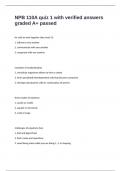
NPB 110A quiz 1 with verified answers
graded A+ passed
for cells to work together they must (3)
1. adhere to one another
2. communicate with one another
3. cooperate with one another
evolution of multicellularity
1. unicellular organisms adhere to form a colony
2. form specialized interdependent cells that became connected
3. develop reproductive cells for continuation of species
three modes of existence
1. sessile or motile
2. aquatic or terrestrial
3. small or large
challenges all organisms face
1. find and digest food
2. find a mate and reproduce
3. avoid being eaten while you are doing 1, 2, or sleeping
,4. maintain a balance between the fluids in the body and the salts dissolved in them
(osmotically stable environment)
5. circulate nutrients from one part of the body to the other
6. remove waste products generated by metabolism
SA of a sphere
4 pi r^2
volume of a sphere
4/3 pi r^3
size and diffusion issue
-animals need to be MADE OF SEVERAL SMALL UNITS and grow by adding units
- FOLDING the respiratory, digestive, and other surfaces to increase amount of SA in a limited
space
-VERY THIN or VERY FLAT (easy movement)
-developing VASCULAR SYSTEMS
-developing COELOMIC SYSTEMS
ultimate
long term / over many generations (big picture) (why a behavior exists)
, proximate
here and now (what is it and how does it work)
ultimate categories
-Function (Adaptation)
-Evolution (Phylogeny)
proximate categories
-Causation (Mechanism)
-Development (Ontogeny)
hypothesis tests
researcher states a hypothesis to be tested, formulates an analysis plan, analyzes sample data
according to the plan, and accepts or rejects the null hypothesis based on the results of the
analysis
null hypothesis
assumes whatever you are trying to prove didn't happen (states something equals zero)
alternative hypothesis
the hypothesis you are trying to prove
graded A+ passed
for cells to work together they must (3)
1. adhere to one another
2. communicate with one another
3. cooperate with one another
evolution of multicellularity
1. unicellular organisms adhere to form a colony
2. form specialized interdependent cells that became connected
3. develop reproductive cells for continuation of species
three modes of existence
1. sessile or motile
2. aquatic or terrestrial
3. small or large
challenges all organisms face
1. find and digest food
2. find a mate and reproduce
3. avoid being eaten while you are doing 1, 2, or sleeping
,4. maintain a balance between the fluids in the body and the salts dissolved in them
(osmotically stable environment)
5. circulate nutrients from one part of the body to the other
6. remove waste products generated by metabolism
SA of a sphere
4 pi r^2
volume of a sphere
4/3 pi r^3
size and diffusion issue
-animals need to be MADE OF SEVERAL SMALL UNITS and grow by adding units
- FOLDING the respiratory, digestive, and other surfaces to increase amount of SA in a limited
space
-VERY THIN or VERY FLAT (easy movement)
-developing VASCULAR SYSTEMS
-developing COELOMIC SYSTEMS
ultimate
long term / over many generations (big picture) (why a behavior exists)
, proximate
here and now (what is it and how does it work)
ultimate categories
-Function (Adaptation)
-Evolution (Phylogeny)
proximate categories
-Causation (Mechanism)
-Development (Ontogeny)
hypothesis tests
researcher states a hypothesis to be tested, formulates an analysis plan, analyzes sample data
according to the plan, and accepts or rejects the null hypothesis based on the results of the
analysis
null hypothesis
assumes whatever you are trying to prove didn't happen (states something equals zero)
alternative hypothesis
the hypothesis you are trying to prove


