

Written by students who passed Immediately available after payment Read online or as PDF Wrong document? Swap it for free 4.6 TrustPilot
logo-home
Exam (elaborations)

Kettering- Therapeutic Procedures B Questions And Answers With Complete Solutions 100% Correct Answers

Rating
-
Sold
-
Pages
4
Grade
A+
Uploaded on
13-07-2025
Written in
2024/2025

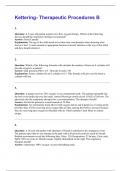
1. Question: A 5-year-old patient requires low-flow oxygen therapy. Which of the following devices should the respiratory therapist recommend? Answer: Nasal Cannula Explanation: The age of the child needs to be taken into consideration when choosing what device is best. A nasal cannula is appropriate because it doesn't interfere in the way of the child, and they should tolerate it. 2. Question: Which of the following formulas will calculate the number of hours an E cylinder will provide oxygen to a patient? Answer: tank pressure (PSI) x 0.3 / flowrate (L/min) / 60 Explanation: Factor cylinder for an E cylinder is 0.3. This formula will give you the hours a cylinder will last. 3. Question: A patient receives 28% oxygen via air entrainment mask. The patient repeatedly has the bed covers pulled up over the mask. Arterial blood gas results reveal a PaO2 of 168 torr. The physician asks the respiratory therapist for a recommendation. The therapist should? Answer: Switch the patient to a nasal cannula at 2L/Min Explanation: Air entrainment mask allows both oxygen and air and if patient is covering up the port then they will be receiving more oxygen than air thus causing the PaO2 to increase because they are receiving pure oxygen not blended with air. Nasal cannula is least likely to entrain air/gas. 4. Question: A 26-year-old patient with shortness of breath is admitted to the emergency room. The patient states that he was running in the park with a friend and could not catch his breath. Bedside assessment reveals the following data: Pulse: 120, Respirations: 25 br/min, Color: pale, SpO2: 89% on room air, Breath sounds: slightly diminished on the right. The respiratory therapist should? Answer: Administer 100% oxygen via non-rebreathing mask.Explanation: Since the patient is fairly stable and given to his SpO2 being 89% what he needs immediately is oxygen. Once given oxygen then you would proceed with other intervention. 5. Question: The respiratory therapist monitors a patient in the ICU following a cholecystectomy. The surgeon has written post-op orders for incentive spirometry Q1h while awake. The patient uses a volume-oriented incentive spirometer. The patient inhales to TLC and then exhales slowly to FRC. What recommendation should the therapist provide to improve the distribution of ventilation? Answer: Have the patient perform an inspiratory hold. Explanation: Since the patient has good breathing, an inspiratory hold while doing good breathing will improve distribution of ventilation. 6. Question: A patient with obstructive sleep apnea receives CPAP therapy via a mask during hours of sleep. The inspiratory pressure is fluctuating between +5 and -8 cm H2O. Which of the following should the respiratory therapist recommend? Answer: Increase the flow rate. Explanation: CPAP will always be positive pressure so in order to maintain a positive pressure you must have adequate flow in order to maintain that pressure. If the patient is inhaling faster than the equipment is delivering the gas then pressure will drop. 7. Question: An air/oxygen proportioner is used to provide an FIO2 of 0.55 by a non-rebreather mask. The blender alarm is sounding. Which of the following is the most likely cause? Answer: Low oxygen inlet pressure Explanation: A blender alarm normally sounds because you are either low on oxygen or air. The alarm will only go off when the pressure is low on the blender.

Show more Read less
Institution
Kettering- Therapeutic Procedures B
Course
Kettering- Therapeutic Procedures B

Content preview

Kettering- Therapeutic Procedures B

1.

Question: A 5-year-old patient requires low-flow oxygen therapy. Which of the following
devices should the respiratory therapist recommend?
Answer: Nasal Cannula
Explanation: The age of the child needs to be taken into consideration when choosing what
device is best. A nasal cannula is appropriate because it doesn't interfere in the way of the child,
and they should tolerate it.


2.

Question: Which of the following formulas will calculate the number of hours an E cylinder will
provide oxygen to a patient?
Answer: tank pressure (PSI) x 0.3 / flowrate (L/min) / 60
Explanation: Factor cylinder for an E cylinder is 0.3. This formula will give you the hours a
cylinder will last.


3.

Question: A patient receives 28% oxygen via air entrainment mask. The patient repeatedly has
the bed covers pulled up over the mask. Arterial blood gas results reveal a PaO2 of 168 torr. The
physician asks the respiratory therapist for a recommendation. The therapist should?
Answer: Switch the patient to a nasal cannula at 2L/Min
Explanation: Air entrainment mask allows both oxygen and air and if patient is covering up the
port then they will be receiving more oxygen than air thus causing the PaO2 to increase because
they are receiving pure oxygen not blended with air. Nasal cannula is least likely to entrain
air/gas.


4.

Question: A 26-year-old patient with shortness of breath is admitted to the emergency room.
The patient states that he was running in the park with a friend and could not catch his breath.
Bedside assessment reveals the following data: Pulse: 120, Respirations: 25 br/min, Color: pale,
SpO2: 89% on room air, Breath sounds: slightly diminished on the right. The respiratory
therapist should?
Answer: Administer 100% oxygen via non-rebreathing mask.

Written for

Institution
Kettering- Therapeutic Procedures B
Course
Kettering- Therapeutic Procedures B

Document information

Uploaded on
July 13, 2025
Number of pages
4
Written in
2024/2025
Type
Exam (elaborations)
Contains
Questions & answers

Subjects

$8.49
Get access to the full document:

Wrong document? Swap it for free Within 14 days of purchase and before downloading, you can choose a different document. You can simply spend the amount again.
Written by students who passed
Immediately available after payment
Read online or as PDF


Also available in package deal

Thumbnail
Package deal
Kettering Exam Bundle with complete solutions.
-
24 2025
$ 77.23 More info

Get to know the seller

Seller avatar
Reputation scores are based on the amount of documents a seller has sold for a fee and the reviews they have received for those documents. There are three levels: Bronze, Silver and Gold. The better the reputation, the more your can rely on the quality of the sellers work.
Brainarium Delaware State University
View profile
Follow You need to be logged in order to follow users or courses
Sold
1965
Member since
3 year
Number of followers
1045
Documents
23616
Last sold
9 hours ago

3.8

333 reviews

5
155
4
63
3
57
2
16
1
42

Why students choose Stuvia

Created by fellow students, verified by reviews

Quality you can trust: written by students who passed their tests and reviewed by others who've used these notes.

Didn't get what you expected? Choose another document

No worries! You can instantly pick a different document that better fits what you're looking for.

Pay as you like, start learning right away

No subscription, no commitments. Pay the way you're used to via credit card and download your PDF document instantly.

Student with book image

“Bought, downloaded, and aced it. It really can be that simple.”

Alisha Student

Working on your references?

Create accurate citations in APA, MLA and Harvard with our free citation generator.

Working on your references?

Frequently asked questions

