

Written by students who passed Immediately available after payment Read online or as PDF Wrong document? Swap it for free 4.6 TrustPilot
logo-home
Document preview thumbnail
Preview 4 out of 841 pages
Exam (elaborations)

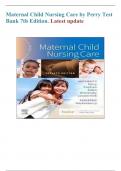
Maternal Child Nursing Care by Perry Test Bank 7th Edition. Latest update

Document preview thumbnail
Preview 4 out of 841 pages

Maternal Child Nursing Care by Perry Test Bank 7th Edition. Latest update Table of Contents Table of Contents 1 Chapter 01: 21st Century Maternity Nursing Chapter 02: Community Care: The Family and Culture Chapter 03: Assessment and Health Promotion Chapter 04: Reproductive System Concerns Chapter 05: Infertility, Contraception, and Abortion Chapter 06: Genetics, Conception, and Fetal Development Chapter 07: Anatomy and Physiology of Pregnancy Chapter 08: Nursing Care of the Family During Pregnancy Chapter 09: Maternal and Fetal Nutrition Chapter 10: Assessment of High Risk Pregnancy Chapter 11: High Risk Perinatal Care: Preexisting Conditions Chapter 12: High Risk Perinatal Care: Gestational Conditions Chapter 13: Labor and Birth Processes Chapter 14: Pain Management Chapter 15: Fetal Assessment During Labor Chapter 16: Nursing Care of the Family During Labor and Birth Chapter 17: Labor and Birth Complications Chapter 18: Maternal Physiologic Changes Chapter 19: Nursing Care of the Family During the Postpartum Period Chapter 20: Transition to Parenthood Chapter 21: Postpartum Complications Chapter 22: Physiologic and Behavioral Adaptations of the Newborn Chapter 23: Nursing Care of the Newborn and Family Chapter 24: Newborn Nutrition and Feeding Chapter 25: The High Risk Newborn Chapter 26: 21st Century Pediatric Nursing 3 17 27 44 65 83 99 114 131 148 162 182 204 217 234 252 276 293 307 321 336 354 373 385 402 426 Chapter 27: Family, Social, Cultural, and Religious Influences on Child Health Promotion 433 Chapter 28: Developmental and Genetic Influences on Child Health Promotion Chapter 29: Communication, History, and Physical Assessment Chapter 30: Pain Assessment and Management in Children Chapter 31: The Infant and Family Chapter 32: The Toddler and Family Chapter 33: The Preschooler and Family Chapter 34: The School-Age Child and Family Chapter 35: The Adolescent and Family Chapter 36: Impact of Chronic Illness, Disability, and End-of-Life Care for the Child and Family Chapter 37: Impact of Cognitive or Sensory Impairment on the Child and Family Chapter 38: Family-Centered Care of the Child During Illness and Hospitalization Chapter 39: Pediatric Variations of Nursing Interventions Chapter 40: Respiratory Dysfunction Chapter 41: Gastrointestinal Dysfunction Chapter 42: Cardiovascular Dysfunction Chapter 43: Hematologic and Immunologic Dysfunction Chapter 44: Cancer Chapter 45: Genitourinary Dysfunction Chapter 46: Cerebral Dysfunction Chapter 47: Endocrine Dysfunction Chapter 48: Musculoskeletal or Articular Dysfunction 441 456 476 487 509 527 541 557 578 595 614 626 648 666 688 713 736 758 774 795 811 Chapter 49: Neuromuscular or Muscular Dysfunction 827 Chapter 01: 21st Century Maternity Nursing MULTIPLE CHOICE 1. When providing care for a pregnant woman, the nurse should be aware that one of the most frequently reported maternal medical risk factors is: a. Diabetes mellitus. c. Chronic hypertension. b. Mitral valve prolapse (MVP). d. Anemia. - CORRECT ANS A The most frequently reported maternal medical risk factors are diabetes and hypertension associated with pregnancy. Both of these conditions are associated with maternal obesity. There are no studies that indicate MVP is among the most frequently reported maternal risk factors. Hypertension associated with pregnancy, not chronic hypertension, is one of the most frequently reported maternal medical risk factors. Although anemia is a concern in pregnancy, it is not one of the most frequently reported maternal medical risk factors in pregnancy. 2. To ensure optimal outcomes for the patient, the contemporary maternity nurse must incorporate both teamwork and communication with clinicians into her care delivery, The SBAR technique of communication is an easy-to-remember mechanism for communication. Which of the following correctly defines this acronym? a. Situation, baseline assessment, response b. Situation, background, assessment, recommendation c. Subjective background, assessment, recommendation d. Situation, background, anticipated recommendation - CORRECT ANS B The situation, background, assessment, recommendation (SBAR) technique provides a specific framework for communication among health care providers. Failure to communicate is one of the major reasons for errors in health care. The SBAR technique has the potential to serve as a means to reduce errors. 3. The role of the professional nurse caring for childbearing families has evolved to emphasize: a. Providing care to patients directly at the bedside. b. Primarily hospital care of maternity patients. c. Practice using an evidence-based approach. d. Planning patient care to cover longer hospital stays. - CORRECT ANS C Professional nurses are part of the team of health care providers who collaboratively care for patients throughout the childbearing cycle. Providing care to patients directly at the bedside is one of the nurses tasks; however, it does not encompass the concept of the evolved professional nurse. Throughout the prenatal period, nurses care for women in clinics and physicians offices and teach classes to help families prepare for childbirth. Nurses also care for childbearing families in birthing centers and in the home. Nurses have been critically important in developing strategies to improve the well-being of women and their infants and have led the efforts to implement clinical practice guidelines using an evidence-based approach. Maternity patients have experienced a decreased, rather than an increased, length of stay over the past 2 decades. 4. A 23-year-old African-American woman is pregnant with her first child. Based on the statistics for infant mortality, which plan is most important for the nurse to implement? a. Perform a nutrition assessment. b. Refer the woman to a social worker. c. Advise the woman to see an obstetrician, not a midwife. d. Explain to the woman the importance of keeping her prenatal care appointments. - CORRECT ANS D Consistent prenatal care is the best method of preventing or controlling risk factors associated with infant mortality. Nutritional status is an important modifiable risk factor, but a nutrition assessment is not the most important action a nurse should take in this situation. The patient may need assistance from a social worker at some time during her pregnancy, but a referral to a social worker is not the most important aspect the nurse should address at this time. If the woman has identifiable high-risk problems, her health care may need to be provided by a physician. However, it cannot be assumed that all African-American women have high-risk issues. In addition, advising the woman to see an obstetrician is not the most important aspect on which the nurse should focus at this time, and it is not appropriate for a nurse to advise or manage the type of care a patient is to receive. 5. During a prenatal intake interview, the nurse is in the process of obtaining an initial assessment of a 21-yearold Hispanic patient with limited English proficiency. It is important for the nurse to: a. Use maternity jargon in order for the patient to become familiar with these terms. b. Speak quickly and efficiently to expedite the visit. c. Provide the patient with handouts. d. Assess whether the patient understands the discussion. - CORRECT ANS D Nurses contribute to health literacy by using simple, common words; avoiding jargon; and evaluating whether the patient understands the discussion. Speaking slowly and clearly and focusing on what is important increase understanding. Most patient education materials are written at too high a level for the average adult and may not be useful for a client with limited English proficiency. 6. When managing health care for pregnant women at a prenatal clinic, the nurse should recognize that the most significant barrier to access to care is the pregnant wom- CORRECT ANS a. Age. c. Educational level. b. Minority status. d. Inability to pay. - CORRECT ANS D The most significant barrier to health care access is the inability to pay for services; this is compounded by the fact that many physicians refuse to care for women who cannot pay. Although adolescent pregnant clients statistically receive less prenatal care, age is not the most significant barrier. Significant disparities in morbidity and mortality rates exist for minority women; however, minority status is not the most significant barrier to access of care. Disparities in educational level are associated with morbidity and mortality rates; however, educational level is not the most significant barrier to access of care. 7. What is the primary role of practicing nurses in the research process? a. Designing research studies b. Collecting data for other researchers c. Identifying researchable problems d. Seeking funding to support research studies - CORRECT ANS C When problems are identified, research can be conducted properly. Research of health care issues leads to evidence-based practice guidelines. Designing research studies is only one factor of the research process. Data collection is one factor of research. Financial support is necessary to conduct research, but it is not the primary role of the nurse in the research process. 8. When the nurse is unsure about how to perform a patient care procedure, the best action would be to: a. Ask another nurse. b. Discuss the procedure with the patients physician. c. Look up the procedure in a nursing textbook. d. Consult the agency procedure manual and follow the guidelines for the procedure. - CORRECT ANS D It is always best to follow the agencys policies and procedures manual when seeking information on correct patient procedures. These policies should reflect the current standards of care and state guidelines. Each nurse is responsible for her own practice. Relying on another nurse may not always be safe practice. Each nurse is obligated to follow the standards of care for safe client care delivery. Physicians are responsible for their own client care activity. Nurses may follow safe orders from physicians, but they are also responsible for the activities that they as nurses are to carry out. Information provided in a nursing textbook is basic information for general knowledge. Furthermore, the information in a textbook may not reflect the current standard of care or individual state or hospital policies. REF: 11 9. From the nurses perspective, what measure should be the focus of the health care system to reduce the rate of infant mortality further? a. Implementing programs to ensure womens early participation in ongoing prenatal care b. Increasing the length of stay in a hospital after vaginal birth from 2 to 3 days c. Expanding the number of neonatal intensive care units (NICUs) d. Mandating that all pregnant women receive care from an obstetrician - CORRECT ANS A Early prenatal care allows for early diagnosis and appropriate interventions to reduce the rate of infant mortality. An increased length of stay has been shown to foster improved self-care and parental education. However, it does not prevent the incidence of leading causes of infant mortality rates, such as low birth weight. Early prevention and diagnosis reduce the rate of infant mortality. NICUs offer care to high-risk infants after they are born. Expanding the number of NICUs would offer better access for high-risk care, but this factor is not the primary focus for further reduction of infant mortality rates. A mandate that all pregnant women receive obstetric care would be nearly impossible to enforce. Furthermore, certified nurse-midwives (CNMs) have demonstrated reliable, safe care for pregnant women. REF: 10 10. Alternative and complementary therapies: a. Replace conventional Western modalities of treatment. b. Are used by only a small number of American adults. c. Recognize the value of clients input into their health care. d. Focus primarily on the disease an individual is experiencing. - CORRECT ANS C Many popular alternative healing modalities offer human-centered care based on philosophies that recognize the value of the patients input and honor the individuals beliefs, values, and desires. Alternative and complementary therapies are part of an integrative approach to health care. An increasing number of American adults are seeking alternative and complementary health care options. Alternative healing modalities offer an holistic approach to health, focusing on the whole person, not just the disease. REF: 4 11. A 38-year-old Hispanic woman delivered a 9-pound, 6-ounce girl vaginally after being in labor for 43 hours. The baby died 3 days later from sepsis. On what grounds would the woman potentially have a legitimate legal case for negligence? a. She is Hispanic. c. The standards of care were not met. b. She delivered a girl. d. She refused fetal monitoring. - CORRECT ANS C Not meeting the standards of care is a legitimate factor for a case of negligence. The clients race is not a factor for a case of negligence. The infants gender is not a factor for a case of negligence. Although fetal monitoring is the standard of care, the client has the right to refuse treatment. This refusal is not a case for negligence; however, informed consent should be properly obtained, and the client should sign an against medical advice form for refusal of any treatment that is within the standard of car

Content preview

Maternal Child Nursing Care by Perry Test
Bank 7th Edition. Latest update

, Table of Contents
Table of Contents 1
Chapter 01: 21st Century Maternity Nursing 3
Chapter 02: Community Care: The Family and Culture 17
Chapter 03: Assessment and Health Promotion 27
Chapter 04: Reproductive System Concerns 44
Chapter 05: Infertility, Contraception, and Abortion 65
Chapter 06: Genetics, Conception, and Fetal Development 83
Chapter 07: Anatomy and Physiology of Pregnancy 99
Chapter 08: Nursing Care of the Family During Pregnancy 114
Chapter 09: Maternal and Fetal Nutrition 131
Chapter 10: Assessment of High Risk Pregnancy 148
Chapter 11: High Risk Perinatal Care: Preexisting Conditions 162
Chapter 12: High Risk Perinatal Care: Gestational Conditions 182
Chapter 13: Labor and Birth Processes 204
Chapter 14: Pain Management 217
Chapter 15: Fetal Assessment During Labor 234
Chapter 16: Nursing Care of the Family During Labor and Birth 252
Chapter 17: Labor and Birth Complications 276
Chapter 18: Maternal Physiologic Changes 293
Chapter 19: Nursing Care of the Family During the Postpartum Period 307
Chapter 20: Transition to Parenthood 321
Chapter 21: Postpartum Complications 336
Chapter 22: Physiologic and Behavioral Adaptations of the Newborn 354
Chapter 23: Nursing Care of the Newborn and Family 373
Chapter 24: Newborn Nutrition and Feeding 385
Chapter 25: The High Risk Newborn 402
Chapter 26: 21st Century Pediatric Nursing 426
Chapter 27: Family, Social, Cultural, and Religious Influences on Child Health Promotion
433
Chapter 28: Developmental and Genetic Influences on Child Health Promotion 441
Chapter 29: Communication, History, and Physical Assessment 456
Chapter 30: Pain Assessment and Management in Children 476
Chapter 31: The Infant and Family 487
Chapter 32: The Toddler and Family 509
Chapter 33: The Preschooler and Family 527
Chapter 34: The School-Age Child and Family 541
Chapter 35: The Adolescent and Family 557
Chapter 36: Impact of Chronic Illness, Disability, and End-of-Life Care for the Child and
Family 578
Chapter 37: Impact of Cognitive or Sensory Impairment on the Child and Family 595
Chapter 38: Family-Centered Care of the Child During Illness and Hospitalization 614
Chapter 39: Pediatric Variations of Nursing Interventions 626
Chapter 40: Respiratory Dysfunction 648
Chapter 41: Gastrointestinal Dysfunction 666
Chapter 42: Cardiovascular Dysfunction 688
Chapter 43: Hematologic and Immunologic Dysfunction 713
Chapter 44: Cancer 736
Chapter 45: Genitourinary Dysfunction 758
Chapter 46: Cerebral Dysfunction 774
Chapter 47: Endocrine Dysfunction 795
Chapter 48: Musculoskeletal or Articular Dysfunction 811

,Chapter 49: Neuromuscular or Muscular Dysfunction 827

, Chapter 01: 21st Century Maternity Nursing
MULTIPLE CHOICE

1. When providing care for a pregnant woman, the nurse should be aware that one of the most frequently
reported maternal medical risk factors is:


a. Diabetes mellitus. c. Chronic hypertension.


b. Mitral valve prolapse (MVP). d. Anemia.


- CORRECT ANS>> A

The most frequently reported maternal medical risk factors are diabetes and hypertension associated with
pregnancy. Both of these conditions are associated with maternal obesity. There are no studies that indicate
MVP is among the most frequently reported maternal risk factors. Hypertension associated with pregnancy,
not chronic hypertension, is one of the most frequently reported maternal medical risk factors. Although
anemia is a concern in pregnancy, it is not one of the most frequently reported maternal medical risk factors in
pregnancy.


2. To ensure optimal outcomes for the patient, the contemporary maternity nurse must incorporate both
teamwork and communication with clinicians into her care delivery, The SBAR technique of communication is
an easy-to-remember mechanism for communication. Which of the following correctly defines this acronym?


a. Situation, baseline assessment, response


b. Situation, background, assessment, recommendation


c. Subjective background, assessment, recommendation


d. Situation, background, anticipated recommendation


- CORRECT ANS>> B

The situation, background, assessment, recommendation (SBAR) technique provides a specific framework for
communication among health care providers. Failure to communicate is one of the major reasons for errors in
health care. The SBAR technique has the potential to serve as a means to reduce errors.


3. The role of the professional nurse caring for childbearing families has evolved to emphasize:


a. Providing care to patients directly at the bedside.

Document information

Uploaded on
July 10, 2025
Number of pages
841
Written in
2024/2025
Type
Exam (elaborations)
Contains
Questions & answers
$27.49

Wrong document? Swap it for free Within 14 days of purchase and before downloading, you can choose a different document. You can simply spend the amount again.
Written by students who passed
Immediately available after payment
Read online or as PDF

Seller avatar
Reputation scores are based on the amount of documents a seller has sold for a fee and the reviews they have received for those documents. There are three levels: Bronze, Silver and Gold. The better the reputation, the more your can rely on the quality of the sellers work.
Nurslink
3.5
(27)
Sold
237
Followers
72
Items
1693
Last sold
2 weeks ago


Why students choose Stuvia

Created by fellow students, verified by reviews

Quality you can trust: written by students who passed their tests and reviewed by others who've used these notes.

Didn't get what you expected? Choose another document

No worries! You can instantly pick a different document that better fits what you're looking for.

Pay as you like, start learning right away

No subscription, no commitments. Pay the way you're used to via credit card and download your PDF document instantly.

Student with book image

“Bought, downloaded, and aced it. It really can be that simple.”

Alisha Student

Working on your references?

Create accurate citations in APA, MLA and Harvard with our free citation generator.

Working on your references?

Frequently asked questions
