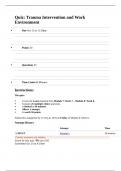
Quiz: Trauma Intervention and Work
Environment
Due Oct 13 at 11:59pm
Points 50
Questions 25
Time Limit 60 Minutes
Instructions
The quiz:
Covers the Learn material from Module 7: Week 7 – Module 8: Week 8.
Contains 25 multiple-choice questions.
Is limited to 60 minutes.
Allows 1 attempt.
Is worth 50 points.
Submit this assignment by 11:59 p.m. (ET) on Friday of Module 8: Week 8.
Attempt History
Attempt Time
LATEST Attempt 1 26 minutes
Correct answers are hidden.
Score for this quiz: 46 out of 50
Submitted Oct 10 at 9:19am
, This attempt took 26 minutes.
Question 1
pts
Which type of medication can be addictive, according to Dr. Lyles?
Antidepressants
Adrenaline Blockers
Mood Stabilizers
Anti-anxiety Medication
Question 2
pts
Which of the following is not true of Secondary Traumatic Stress?
an inevitable consequence of working with traumatized individuals.
stress experienced when wanting to help a traumatized person.
a result of empathic engagement with trauma victims and exposure to their experiences.
found to produce symptoms that are categorically different from the victim’s symptoms.
Question 3
pts
The assumption that even a trauma victim is competent to make his or her own decisions and
give informed consent to treatment is covered under which ethical principle?
Autonomy
Justice
Environment
Due Oct 13 at 11:59pm
Points 50
Questions 25
Time Limit 60 Minutes
Instructions
The quiz:
Covers the Learn material from Module 7: Week 7 – Module 8: Week 8.
Contains 25 multiple-choice questions.
Is limited to 60 minutes.
Allows 1 attempt.
Is worth 50 points.
Submit this assignment by 11:59 p.m. (ET) on Friday of Module 8: Week 8.
Attempt History
Attempt Time
LATEST Attempt 1 26 minutes
Correct answers are hidden.
Score for this quiz: 46 out of 50
Submitted Oct 10 at 9:19am
, This attempt took 26 minutes.
Question 1
pts
Which type of medication can be addictive, according to Dr. Lyles?
Antidepressants
Adrenaline Blockers
Mood Stabilizers
Anti-anxiety Medication
Question 2
pts
Which of the following is not true of Secondary Traumatic Stress?
an inevitable consequence of working with traumatized individuals.
stress experienced when wanting to help a traumatized person.
a result of empathic engagement with trauma victims and exposure to their experiences.
found to produce symptoms that are categorically different from the victim’s symptoms.
Question 3
pts
The assumption that even a trauma victim is competent to make his or her own decisions and
give informed consent to treatment is covered under which ethical principle?
Autonomy
Justice