

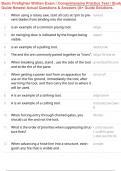
Basic Firefighter Written Exam / Comprehensive Practice Test / Study
Basic Firefighter Written Exam
Guide Newest Actual Questions & Answers (A+ Guide Solutions.
Study online at https://quizlet.com/_43sd7p
1. When using a rotary saw, start all cuts at rpm to pre- maximum
vent blades from binding into the material.
2. is an example of a common prying tool. halligan
3. An swinging door is indicated by the hinges being outward
visible.
4. is an example of a pulling tool. sheetrock rake
5. The and the are commonly paired together as "irons". halligan Flat head axe
6. When breaking glass, stand , use the side of the tool up-wind blunt/flat corner
and strike the of the pane.
7. When getting a power tool from an apparatus for start turn off
use on the fire ground, immediately the tool, after
warming the tool, and then carry the tool to where it
will be used.
8. A is an example of a striking tool. sledge hammer
9. A is an example of a cutting tool. reciprocating saw (Sawza-
ll)
10. When forcing entry through chained gates, you link/chain
should cut the and not the lock.
11. What is the order of priorities when suppressing struc- 1. protect exposures
ture fires? 2. cut off fire spread
3. attack seat of the fire
12. When advancing a hose-line into a structure, extin- accessible
guish any fire that is visible and .
, Basic Firefighter Written Exam
Study online at https://quizlet.com/_43sd7p
13. A vehicle fire should be fought from a degree angle. 45
14. If you are advancing an attack line into a structure and crawl
CANNOT see your feet, you should .
15. and are the appropriate hose sizes for attacking a 2 1/2 1 3/4
structure fire.
16. Directing fire streams toward the ceiling or wall of a indirect
room or building in order to generate large amount
of steam is an attack.
17. At a structure fire, the highest priority are close prior- exposures
ity fuel tanks and propane cylinders.
18. A attack is discharging water or foam directly onto a direct
burning material.
19. When extinguishing a container fire you should never downwind
approach from downhill or .
20. You should first direct your fire stream at the during a ceiling
combination fire attack.
21. The process of hauling water from a fill site to a dump water shuttle
site is the definition of a .
22. hydrants are installed in areas where prolonged peri- dry barrel
ods of subfreezing weather are common.
23. The process of drawing water from a static source to drafting
supply a pumper is known as .
24. Wet-barrel hydrants are always filled with . water
Basic Firefighter Written Exam
Guide Newest Actual Questions & Answers (A+ Guide Solutions.
Study online at https://quizlet.com/_43sd7p
1. When using a rotary saw, start all cuts at rpm to pre- maximum
vent blades from binding into the material.
2. is an example of a common prying tool. halligan
3. An swinging door is indicated by the hinges being outward
visible.
4. is an example of a pulling tool. sheetrock rake
5. The and the are commonly paired together as "irons". halligan Flat head axe
6. When breaking glass, stand , use the side of the tool up-wind blunt/flat corner
and strike the of the pane.
7. When getting a power tool from an apparatus for start turn off
use on the fire ground, immediately the tool, after
warming the tool, and then carry the tool to where it
will be used.
8. A is an example of a striking tool. sledge hammer
9. A is an example of a cutting tool. reciprocating saw (Sawza-
ll)
10. When forcing entry through chained gates, you link/chain
should cut the and not the lock.
11. What is the order of priorities when suppressing struc- 1. protect exposures
ture fires? 2. cut off fire spread
3. attack seat of the fire
12. When advancing a hose-line into a structure, extin- accessible
guish any fire that is visible and .
, Basic Firefighter Written Exam
Study online at https://quizlet.com/_43sd7p
13. A vehicle fire should be fought from a degree angle. 45
14. If you are advancing an attack line into a structure and crawl
CANNOT see your feet, you should .
15. and are the appropriate hose sizes for attacking a 2 1/2 1 3/4
structure fire.
16. Directing fire streams toward the ceiling or wall of a indirect
room or building in order to generate large amount
of steam is an attack.
17. At a structure fire, the highest priority are close prior- exposures
ity fuel tanks and propane cylinders.
18. A attack is discharging water or foam directly onto a direct
burning material.
19. When extinguishing a container fire you should never downwind
approach from downhill or .
20. You should first direct your fire stream at the during a ceiling
combination fire attack.
21. The process of hauling water from a fill site to a dump water shuttle
site is the definition of a .
22. hydrants are installed in areas where prolonged peri- dry barrel
ods of subfreezing weather are common.
23. The process of drawing water from a static source to drafting
supply a pumper is known as .
24. Wet-barrel hydrants are always filled with . water


