7/6/25, 2:03 PM
NMS STUDY GUIDE TEST BANK\\LATEST VERSION
WITH COMPLETE QUESTIONS AND CORRECT
DETAILED ANSWERS \ASSURED PASS ALREADY
GRADED A+\LATEST EXAM 2025-2026
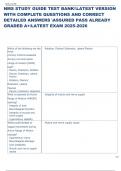
Which of the following are the Rotation, Flexion/ Extension, Lateral Flexion
three
primary motions assessed
during a cervical spine
range of motion (ROM)
test?
a. Flexion, Extension, Rotation
b. Flexion, Extension, Lateral
Flexion
c. Rotation, Flexion/
Extension, Lateral
Flexion
d. Flexion, Extension, Abduction
What is assessed by Active Integrity of muscle and nerve supply
Range of Motion (AROM)
testing?
a. Integrity of joint
b. Neurological function
c. Integrity of muscle and
nerve supply
d. Ligamentous stability
What could limited or Muscle and nerve supply issues
vague movement during
Active Range of Motion
indicate?
a. Ligamentous injury
b. Neurological damage
c. Joint instability
d. Muscle and nerve supply
issues
1/54
,7/6/25, 2:03 PM RPB102 Study Set
Passive Range of Motion Joint integrity
(PROM) is primarily used
to assess what?
a. Integrity of muscle and
nerve supply
b. Joint integrity
c. Neurological function
d. Bone fractures
Which of the following is a Neurological damage (Rust sign)
potential consequence of
performing Range of
Motion (ROM) on an
unstable
spine?
a. Muscle strain
b. Neurological damage (Rust
sign)
c. Ligament sprain
d. Joint
capsular tightness
Resisted Range of Motion Neurological function (Nerve root lesion)
(RROM) is most useful in
assessing what?
a. Joint integrity
b. Neurological function
(Nerve root lesion)
c. Ligamentous stability
d. Muscle strength
Which muscle is the primary Sternocleidomastoid (SCM)
mover for cervical flexion
and rotation?
a. Scalenes
b. Sternocleidomastoid (SCM)
c. Trapezius
d. Paraspinals
What muscle is primarily Scalenes
responsible for lateral
flexion of the cervical
spine?
2/54
,7/6/25, 2:03 PM RPB102 Study Set
a. Trapezius
b. Sternocleidomastoid (SCM)
c. Paraspinals
d. Scalenes
Which muscles are primarily Trapezius and Paraspinals
responsible for cervical
extension?
a. Paraspinals and SCM
b. Trapezius and Paraspinals
c. SCM and Scalenes
d. Scalenes and Trapezius
What is the normal range of 50 degrees or greater
motion (ROM) value for
cervical flexion from
neutral?
a. 60 degrees or greater
b. 80 degrees or greater
c. 45 degrees or greater
d. 50 degrees or greater
What is the normal range of 60 degrees or greater
motion (ROM) value for
cervical extension from
neutral?
a. 45 degrees or greater
b. 80 degrees or greater
c. 60 degrees or greater
d. 50 degrees or greater
What is the normal range of 45 degrees or greater
motion (ROM) value for
lateral flexion from
neutral?
a. 60 degrees or greater
b. 80 degrees or greater
c. 45 degrees or greater
d. 50 degrees or greater
What is the normal range of 80 degrees or greater
motion (ROM) value for
cervical rotation from
neutral?
a. 45 degrees or greater
3/54
, 7/6/25, 2:03 PM RPB102 Study Set
b. 80 degrees or greater
c. 60 degrees or greater
d. 50 degrees or greater
In the O'Donoghue's Seated
Maneuver Test, the patient
is positioned in which
way?
a. Seated b. Supine c. Standing
d. Prone
What does the examiner do Moves cervical spine through isometric resisted rotation then
during the O'Donoghue's passive rotation
Maneuver Test?
a. Moves cervical spine
through isometric resisted
rotation then passive
rotation
b. Rotates the head from side
to side
c. Asks the patient to take a
deep breath and hold it
d. Applies pressure to the
lumbar spine
During O'Donoghue's Muscle strain
Maneuver, pain during
resisted rotation is indicative
of what?
a. Ligament strain
b. Muscle strain
c. Joint instability
d. Nerve root lesion
During O'Donoghue's Ligament strain
Maneuver, pain during
passive rotation suggests
what?
a. Muscle strain
b. Ligament strain
c. Joint capsular injury
d. Nerve root lesion
4/54
NMS STUDY GUIDE TEST BANK\\LATEST VERSION
WITH COMPLETE QUESTIONS AND CORRECT
DETAILED ANSWERS \ASSURED PASS ALREADY
GRADED A+\LATEST EXAM 2025-2026
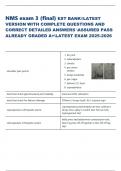
Which of the following are the Rotation, Flexion/ Extension, Lateral Flexion
three
primary motions assessed
during a cervical spine
range of motion (ROM)
test?
a. Flexion, Extension, Rotation
b. Flexion, Extension, Lateral
Flexion
c. Rotation, Flexion/
Extension, Lateral
Flexion
d. Flexion, Extension, Abduction
What is assessed by Active Integrity of muscle and nerve supply
Range of Motion (AROM)
testing?
a. Integrity of joint
b. Neurological function
c. Integrity of muscle and
nerve supply
d. Ligamentous stability
What could limited or Muscle and nerve supply issues
vague movement during
Active Range of Motion
indicate?
a. Ligamentous injury
b. Neurological damage
c. Joint instability
d. Muscle and nerve supply
issues
1/54
,7/6/25, 2:03 PM RPB102 Study Set
Passive Range of Motion Joint integrity
(PROM) is primarily used
to assess what?
a. Integrity of muscle and
nerve supply
b. Joint integrity
c. Neurological function
d. Bone fractures
Which of the following is a Neurological damage (Rust sign)
potential consequence of
performing Range of
Motion (ROM) on an
unstable
spine?
a. Muscle strain
b. Neurological damage (Rust
sign)
c. Ligament sprain
d. Joint
capsular tightness
Resisted Range of Motion Neurological function (Nerve root lesion)
(RROM) is most useful in
assessing what?
a. Joint integrity
b. Neurological function
(Nerve root lesion)
c. Ligamentous stability
d. Muscle strength
Which muscle is the primary Sternocleidomastoid (SCM)
mover for cervical flexion
and rotation?
a. Scalenes
b. Sternocleidomastoid (SCM)
c. Trapezius
d. Paraspinals
What muscle is primarily Scalenes
responsible for lateral
flexion of the cervical
spine?
2/54
,7/6/25, 2:03 PM RPB102 Study Set
a. Trapezius
b. Sternocleidomastoid (SCM)
c. Paraspinals
d. Scalenes
Which muscles are primarily Trapezius and Paraspinals
responsible for cervical
extension?
a. Paraspinals and SCM
b. Trapezius and Paraspinals
c. SCM and Scalenes
d. Scalenes and Trapezius
What is the normal range of 50 degrees or greater
motion (ROM) value for
cervical flexion from
neutral?
a. 60 degrees or greater
b. 80 degrees or greater
c. 45 degrees or greater
d. 50 degrees or greater
What is the normal range of 60 degrees or greater
motion (ROM) value for
cervical extension from
neutral?
a. 45 degrees or greater
b. 80 degrees or greater
c. 60 degrees or greater
d. 50 degrees or greater
What is the normal range of 45 degrees or greater
motion (ROM) value for
lateral flexion from
neutral?
a. 60 degrees or greater
b. 80 degrees or greater
c. 45 degrees or greater
d. 50 degrees or greater
What is the normal range of 80 degrees or greater
motion (ROM) value for
cervical rotation from
neutral?
a. 45 degrees or greater
3/54
, 7/6/25, 2:03 PM RPB102 Study Set
b. 80 degrees or greater
c. 60 degrees or greater
d. 50 degrees or greater
In the O'Donoghue's Seated
Maneuver Test, the patient
is positioned in which
way?
a. Seated b. Supine c. Standing
d. Prone
What does the examiner do Moves cervical spine through isometric resisted rotation then
during the O'Donoghue's passive rotation
Maneuver Test?
a. Moves cervical spine
through isometric resisted
rotation then passive
rotation
b. Rotates the head from side
to side
c. Asks the patient to take a
deep breath and hold it
d. Applies pressure to the
lumbar spine
During O'Donoghue's Muscle strain
Maneuver, pain during
resisted rotation is indicative
of what?
a. Ligament strain
b. Muscle strain
c. Joint instability
d. Nerve root lesion
During O'Donoghue's Ligament strain
Maneuver, pain during
passive rotation suggests
what?
a. Muscle strain
b. Ligament strain
c. Joint capsular injury
d. Nerve root lesion
4/54