Safe Crisis Management || All Solved.
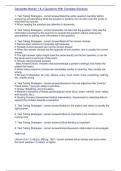
3 Components of Self-Talk (pg 79) correct answers 1. Perception
2. Interpretation
3. Behavior
3 Phases of Behavior Curve (pg 63) correct answers 1. Period of Escalation
2. Out-of-Control Period
3. Period of De-escalation
3 Common Sources of Behavior (pg 58) correct answers 1. Carry In Behavior
2. Carry Over Behavior
3. Tune In Behavior
T/F: Staff can be held liable for what they do and don't do when responding to dangerous
behavior. correct answers True
T/F: Positive normative cultures are established when policies and performance mirror each
other. correct answers True
T/F: Individuals who acquire poor social skills from a dysfunctional environment are more likely
to engage in behaviors of concern. correct answers True
T/F: According to JKM Training, staff can maintain an individual in the same ESPI for as long as
they deem necessary. correct answers False
T/F: Proximity & touch prompts are acceptable to use to provoke an individual into aggression.
correct answers False
, T/F: Professional responses are intended to replace instinctual, survival responses. Examples
include scripting responses and focusing on the individual's behavior. correct answers True
T/F: The three phases of the behavior curve are escalation, out-of-control, and relaxation. correct
answers False
T/F: Aggression, often fueled by emotion, can be described as cumulative and transferable.
correct answers True
T/F: The prolonged duration of an ESPI does not increase the potential for adverse outcomes.
correct answers False
T/F: Debriefing with an individual after an incident is critical to minimize trauma and reduce
carry over behaviors. correct answers True
Use of excitement & affect to show approval/support correct answers Effusive Praise
Pleasantly acknowledge each individual at start of class/shift correct answers Meet & Greet
Providing direction & empowering performance correct answers Positively Support & Correct
Behavior
Identify things & activities you have in common correct answers Interest Relating
Being present/interactive with individuals during the day correct answers Active Engagement
Competent staff are this type of communicator:
a. Assertive
b. Passive
3 Components of Self-Talk (pg 79) correct answers 1. Perception
2. Interpretation
3. Behavior
3 Phases of Behavior Curve (pg 63) correct answers 1. Period of Escalation
2. Out-of-Control Period
3. Period of De-escalation
3 Common Sources of Behavior (pg 58) correct answers 1. Carry In Behavior
2. Carry Over Behavior
3. Tune In Behavior
T/F: Staff can be held liable for what they do and don't do when responding to dangerous
behavior. correct answers True
T/F: Positive normative cultures are established when policies and performance mirror each
other. correct answers True
T/F: Individuals who acquire poor social skills from a dysfunctional environment are more likely
to engage in behaviors of concern. correct answers True
T/F: According to JKM Training, staff can maintain an individual in the same ESPI for as long as
they deem necessary. correct answers False
T/F: Proximity & touch prompts are acceptable to use to provoke an individual into aggression.
correct answers False
, T/F: Professional responses are intended to replace instinctual, survival responses. Examples
include scripting responses and focusing on the individual's behavior. correct answers True
T/F: The three phases of the behavior curve are escalation, out-of-control, and relaxation. correct
answers False
T/F: Aggression, often fueled by emotion, can be described as cumulative and transferable.
correct answers True
T/F: The prolonged duration of an ESPI does not increase the potential for adverse outcomes.
correct answers False
T/F: Debriefing with an individual after an incident is critical to minimize trauma and reduce
carry over behaviors. correct answers True
Use of excitement & affect to show approval/support correct answers Effusive Praise
Pleasantly acknowledge each individual at start of class/shift correct answers Meet & Greet
Providing direction & empowering performance correct answers Positively Support & Correct
Behavior
Identify things & activities you have in common correct answers Interest Relating
Being present/interactive with individuals during the day correct answers Active Engagement
Competent staff are this type of communicator:
a. Assertive
b. Passive