

Translation and Proteins
0609842861 Monique von Molendorff – Genetics Notes (2020)
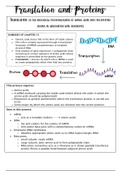
Translation: is the biological polymerization of amino acids into polypeptide
chains in association with ribosomes
SUMMARY OF CHAPTER 13:
• Genetic code stores info in the form of triplet codons
• This info is initially expressed through transcription-
formation of MRNA complementary to template
strand of DNA
DNA
• Final product of gene expression = polypeptide chain
consisting of a linear sequence of amino acids whose
sequence is prescribed by the genetic code. Transcription
• Translation = process by which info in MRNA is used
to create polypeptides which then fold into proteins.
Protein Translation
mRNA
This process requires:
→ Amino acids
→ A mRNA molecule carrying the triplet code (which directs the order in which the
amino acids should be polymerized)
→ Ribosomes as general workbenches (which the translation process is carried out
in/on
→ Some means by which the amino acids are directed into the correct position.
Seen in this process
• mRNA
o acts as a template (codons ------→ amino acids)
• tRNA
o has anti-codons for the codons of mRNA
o Anti-codon base pairs with a complementary codon on mRNA.
• Aminoacyl tRNA synthetase
o Attaches appropriate amino acids to its tRNA loads/charges tRNA
• Ribosomes:
o small subunit: reads mRNA.
o Large subunit: Joins amino acid to form polypeptide chain.
o Ribosomes sometimes acts as a ribozyme as it shows peptidyl transferase
activity (forms a peptide bond between adjacent amino acid)
, 0609842861 Monique von Molendorff – Genetics Notes (2020)
How do codons of mRNA direct specific amino acids into their correct position
on the polypeptide?
• Francis Crick proposed the need for some sort of adapter in the translation
process.
o He reasoned that any affinity between the nucleotide strand and amino
acid would require hydrogen bonding, but chemically such affinities are
highly unlikely.
o Instead, Crick proposed that there would be an adapter molecule, that
could covalently bond to the amino acid whilst also being capable of
hydrogen bonding to the nucleic acid.
• We now know that these adapters are the tRNA molecules
o Which can bind both to amino acids at one end and to the nucleotide
codon to the other end. (tRNA adapts genetic info present in a specific
codon to corresponding amino acid)
o The anticodon present in the tRNA is able to bind to the complimentary
codon the mRNA, bringing the amino acid that is covalently bond to that
tRNA and holding it in close proximity to the adjacent amino acid in the
sequence, allowing for the formation of a peptide bond between them.
o This process occurs over and over on the ribosome, as the messenger
RNA runs through it, allowing for the polymerization of the amino acids
into a polypeptide.
, 0609842861 Monique von Molendorff – Genetics Notes (2020)
• 𝑡𝑅𝑁𝐴 𝑓𝑚𝑒𝑡
o Bring amino acids to the ribosome
• N-Formyl methionine (fmet)
o Modified methionine in which a formyl group has been added to amino
group
• Methionyl-tRNA Formyl transferase
o Catalyzes the addition of formyl group to methionine
Initiation factors:
• IF 1
o Prevent premature entry of tRNA into A-site of ribosome
• IF 2
o Regulates and directs the initiator tRNA to its correct position in the
initiation complex
• IF 3
o Prevent premature association of ribosome units
o Fidelity of AUG codon recognition
Elongation factors
• EF-TU
o Elongation Factor Thermounstable : mediates the entry of aminoacyl
tRNA into a free site if ribosome
• EF-TS
o Serves as the guanine nucleotide exchange factor for EF-TU
• EF-G
o Catalyzes the translocation of tRNA and mRNA down the ribosome
• EF-P
o Factor required for efficient peptide bond formation
Release factors
• Class 1
o RF 1 : (recognizes UAA UAG )
o RF 2 : ( recognizes UAA UGA )
• Class 2
o RF 3 : (GTPase Protein – enhances activity of Class 1 factors)
• Ribosome recycling factor (RRF)
o Functions to recycle ribosomes after translation
o Mediated dissociation of ribosome subunits after translation has
terminated
0609842861 Monique von Molendorff – Genetics Notes (2020)
Translation: is the biological polymerization of amino acids into polypeptide
chains in association with ribosomes
SUMMARY OF CHAPTER 13:
• Genetic code stores info in the form of triplet codons
• This info is initially expressed through transcription-
formation of MRNA complementary to template
strand of DNA
DNA
• Final product of gene expression = polypeptide chain
consisting of a linear sequence of amino acids whose
sequence is prescribed by the genetic code. Transcription
• Translation = process by which info in MRNA is used
to create polypeptides which then fold into proteins.
Protein Translation
mRNA
This process requires:
→ Amino acids
→ A mRNA molecule carrying the triplet code (which directs the order in which the
amino acids should be polymerized)
→ Ribosomes as general workbenches (which the translation process is carried out
in/on
→ Some means by which the amino acids are directed into the correct position.
Seen in this process
• mRNA
o acts as a template (codons ------→ amino acids)
• tRNA
o has anti-codons for the codons of mRNA
o Anti-codon base pairs with a complementary codon on mRNA.
• Aminoacyl tRNA synthetase
o Attaches appropriate amino acids to its tRNA loads/charges tRNA
• Ribosomes:
o small subunit: reads mRNA.
o Large subunit: Joins amino acid to form polypeptide chain.
o Ribosomes sometimes acts as a ribozyme as it shows peptidyl transferase
activity (forms a peptide bond between adjacent amino acid)
, 0609842861 Monique von Molendorff – Genetics Notes (2020)
How do codons of mRNA direct specific amino acids into their correct position
on the polypeptide?
• Francis Crick proposed the need for some sort of adapter in the translation
process.
o He reasoned that any affinity between the nucleotide strand and amino
acid would require hydrogen bonding, but chemically such affinities are
highly unlikely.
o Instead, Crick proposed that there would be an adapter molecule, that
could covalently bond to the amino acid whilst also being capable of
hydrogen bonding to the nucleic acid.
• We now know that these adapters are the tRNA molecules
o Which can bind both to amino acids at one end and to the nucleotide
codon to the other end. (tRNA adapts genetic info present in a specific
codon to corresponding amino acid)
o The anticodon present in the tRNA is able to bind to the complimentary
codon the mRNA, bringing the amino acid that is covalently bond to that
tRNA and holding it in close proximity to the adjacent amino acid in the
sequence, allowing for the formation of a peptide bond between them.
o This process occurs over and over on the ribosome, as the messenger
RNA runs through it, allowing for the polymerization of the amino acids
into a polypeptide.
, 0609842861 Monique von Molendorff – Genetics Notes (2020)
• 𝑡𝑅𝑁𝐴 𝑓𝑚𝑒𝑡
o Bring amino acids to the ribosome
• N-Formyl methionine (fmet)
o Modified methionine in which a formyl group has been added to amino
group
• Methionyl-tRNA Formyl transferase
o Catalyzes the addition of formyl group to methionine
Initiation factors:
• IF 1
o Prevent premature entry of tRNA into A-site of ribosome
• IF 2
o Regulates and directs the initiator tRNA to its correct position in the
initiation complex
• IF 3
o Prevent premature association of ribosome units
o Fidelity of AUG codon recognition
Elongation factors
• EF-TU
o Elongation Factor Thermounstable : mediates the entry of aminoacyl
tRNA into a free site if ribosome
• EF-TS
o Serves as the guanine nucleotide exchange factor for EF-TU
• EF-G
o Catalyzes the translocation of tRNA and mRNA down the ribosome
• EF-P
o Factor required for efficient peptide bond formation
Release factors
• Class 1
o RF 1 : (recognizes UAA UAG )
o RF 2 : ( recognizes UAA UGA )
• Class 2
o RF 3 : (GTPase Protein – enhances activity of Class 1 factors)
• Ribosome recycling factor (RRF)
o Functions to recycle ribosomes after translation
o Mediated dissociation of ribosome subunits after translation has
terminated


