100% satisfaction guarantee Immediately available after payment Both online and in PDF No strings attached 4.2 TrustPilot
logo-home
Exam (elaborations)

GA Real Estate Final Exam Questions & AnswersEXAM NEW VERSION LATEST UPDATE WITH ACCURATE ANSWERS GUARANTEED PASS BEST STUDYING MATERIAL

Rating
-
Sold
-
Pages
28
Grade
A+
Uploaded on
26-06-2025
Written in
2024/2025

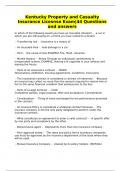
1. Which of the following is considered a general lien? A. Property tax lien B. Mechanic’s lien C. Mortgage lien D. Judgment lien Rationale: A judgment lien is a general lien that applies to all of a debtor's property, not just a specific asset. 2. What is the most common type of tax sale? A. Judicial tax sale B. Non-judicial tax sale C. Redemption tax sale D. Foreclosure auction Rationale: Most tax sales occur without court involvement, making non-judicial tax sales the most common. 3. Once a property is sold, the past owner has another opportunity to get the property back through: A. Estoppel B. Reversion C. Reinstatement D. Redemption Rationale: Redemption allows the former owner to reclaim their property by paying owed taxes and costs after a sale. 4. When a _____ occurs in Georgia, a tax sale is held and a one-year redemption period follows the sale. A. Property dispute B. Lien settlement C. Tax delinquency D. Title defect Rationale: In Georgia, tax delinquency triggers a tax sale followed by a one-year redemption period for the former owner. 5. A contract is unenforceable when: A. It is oral B. Neither party can sue the other to force performance C. It lacks consideration D. One party is a minor Rationale: An unenforceable contract is valid in theory but not legally enforceable in court. 6. What is a new offer substituted for the original offer? A. Counteroffer B. Addendum C. Assignment D. Novation Rationale: A counteroffer nullifies the original offer and puts a new one in its place. 7. Which of the following is FALSE about an expressed contract? A. May be a contract for forbearance B. Can be written or oral C. Is created by the acts of the parties D. Arises from the stated intent of the parties Rationale: Expressed contracts are based on clearly stated terms, not implied actions. 8. Option contract means: A. A unilateral contract binding on the seller with an obligation to sell for a set price if the buyer decides to buy B. A bilateral lease agreement C. A novation of a sales contract D. An earnest money agreement Rationale: In an option contract, the seller must sell if the buyer chooses to exercise the option, but the buyer is not obligated. 9. When is a real estate sales contract no longer executory? A. When it’s signed B. When earnest money is paid C. When all obligations are fulfilled and the transaction closes D. When a deed is drafted Rationale: An executory contract becomes executed once all terms are completed and the deal closes. 10. The buyer can rescind a contract or ____ if defects are not disclosed and the property is misrepresented. A. File criminal charges B. Refinance C. Demand money to repair the defect D. Sue the lender Rationale: The buyer has the right to rescind the contract or claim monetary compensation for undisclosed defects. 11. How do unilateral and bilateral contracts differ? A. Only one party must perform in a unilateral contract; both must in a bilateral contract B. Only bilateral contracts are valid C. Unilateral contracts are written, bilateral are oral D. Unilateral contracts never apply in real estate Rationale: A unilateral contract obligates only one party; a bilateral contract involves mutual obligations. 12. What category do nonresidential properties fall into? A. Multi-family and mixed-use B. Condominiums and co-ops C. Agricultural, Industrial, Special Use buildings D. Detached single-family homes Rationale: Nonresidential real estate includes commercial, agricultural, industrial, and specialpurpose buildings. 13. What is real property? A. Land only B. Interests, rights, and benefits in ownership of real estate C. Movable property D. Taxed personal property Rationale: Real property includes not just the land and buildings but also legal rights and interests. 14. What are the four characteristics of value in real estate? A. Demand, Utility, Scarcity, Transferability B. Location, Zoning, Taxes, Demand C. Income, Rent, Price, Cost D. Supply, Ownership, Title, Lease Rationale: These are the economic qualities that create value in real estate. 15. In which system is a recorded subdivision plat used? A. Metes and Bounds B. Lot and Block System C. Government Survey D. Title Plan Rationale: The lot and block system uses recorded plats to describe property legally. 16. What is an appurtenance in real property? A. Furniture B. Paint color C. Trees, buildings, or ownership rights D. Temporary signage Rationale: Appurtenances are rights or items attached to the land and considered part of the property. 17. "The location of land cannot be changed" describes: A. Immobility B. Indestructibility C. Uniqueness D. Inaccessibility Rationale: Land cannot be moved, which is known as immobility. 18. Which is a property improvement? A. Shrubs B. Artificial Attachments C. Personal items D. Tools Rationale: Improvements are man-made additions like buildings or fences (artificial attachments). 19. ________ is the period during which ROI will be realized. A. Amortization B. Depreciation term C. Economic life D. Loan term Rationale: Economic life is the duration a property is expected to generate a return. 20. A fixture becomes real estate by: A. Method, Adaptability, and Agreement B. Rent, Contract, Lease C. Ownership, Value, Title D. Permit, Deed, Price Rationale: These three tests determine if personal property is now considered real property. 21. What is NOT covered by hazard insurance? A. Fire damage B. Vandalism C. Windstorm D. Damage from wildlife Rationale: Wildlife damage is generally excluded from standard hazard insurance policies. 22. What is a material fact? A. A fact important enough to influence a decision in a transaction B. A rumor C. An opinion D. A listing price Rationale: Material facts must be disclosed as they affect the decision-making of a reasonable person. 23. What is a ministerial act? A. Something only a licensed agent can do B. Basic task not requiring professional judgment C. Disclosing a conflict of interest D. Drafting contracts Rationale: Ministerial acts are routine actions not requiring the agent’s discretion or judgment. 24. What is a transaction broker? A. Represents both buyer and seller equally B. Facilitates a transaction without acting as an agent C. Manages property for landlords D. Has fiduciary duties to both parties Rationale: A transaction broker helps facilitate the deal but does not have an agency relationship or fiduciary duties to either party. 25. What is an express agency? A. Created by mutual actions B. Exists only if compensation is paid C. Created by oral or written agreement between principal and agent D. Based on assumption Rationale: Express agency is clearly defined through spoken or written agreement, outlining agent and client responsibilities. 26. A listing agreement is: A. An option to buy a property B. An expressed agency agreement between a seller and a broker C. A unilateral contract D. A lease agreement Rationale: A listing agreement creates an agency relationship where a seller hires an agent to sell their property. 27. What is implied agency? A. Created through documents B. Created through the behavior of the parties without a formal agreement C. Illegal in all states D. A listing contract Rationale: Implied agency arises when the actions of the parties suggest an agency relationship exists, even without a formal agreement. 28. What are the 6 fiduciary duties owed by an agent? A. Care, Control, Loyalty, Diligence, Ethics, Respect B. Care, Obedience, Loyalty, Disclosure, Accounting, Confidentiality C. Confidence, Oversight, Loyalty, Diligence, Execution, Sharing D. Communication, Oversight, Lawfulness, Discipline, Agreement, Compensation Rationale: The acronym COLD-AC represents the six fiduciary duties that an agent owes a client. 29. What is a general agent? A. Authorized to act on behalf of the principal in a broad range of business matters B. Represents clients in a single transaction C. Is usually the buyer in a contract D. Acts as a dual agent Rationale: A general agent (e.g., a property manager) has broader authority than a special or limited agent. 30. What is a special (limited) agent? A. Has power of attorney B. Represents the principal in a single transaction C. Can bind the principal in all matters D. Manages multiple properties Rationale: Special agents have limited authority and usually represent a client for a one-time transaction like buying or selling a home.

Show more Read less
Institution
Real Estate Georgia
Course
Real Estate Georgia


Whoops! We can’t load your doc right now. Try again or contact support.

Written for

Institution
Real Estate Georgia
Course
Real Estate Georgia

Document information

Uploaded on
June 26, 2025
Number of pages
28
Written in
2024/2025
Type
Exam (elaborations)
Contains
Questions & answers

Subjects

  • ga real estate final exam
  • ga re

Content preview

GA Real Estate Final Exam Questions &
AnswersEXAM NEW VERSION LATEST UPDATE
2025-2026 WITH ACCURATE ANSWERS
GUARANTEED PASS BEST STUDYING MATERIAL
1. Which of the following is considered a general lien?
A. Property tax lien
B. Mechanic’s lien
C. Mortgage lien
D. Judgment lien ✅
Rationale: A judgment lien is a general lien that applies to all of a debtor's property, not just a
specific asset.


2. What is the most common type of tax sale?
A. Judicial tax sale
B. Non-judicial tax sale ✅
C. Redemption tax sale
D. Foreclosure auction
Rationale: Most tax sales occur without court involvement, making non-judicial tax sales the
most common.


3. Once a property is sold, the past owner has another opportunity to get the property back
through:
A. Estoppel
B. Reversion
C. Reinstatement
D. Redemption ✅
Rationale: Redemption allows the former owner to reclaim their property by paying owed taxes
and costs after a sale.

,4. When a _____ occurs in Georgia, a tax sale is held and a one-year redemption period
follows the sale.
A. Property dispute
B. Lien settlement
C. Tax delinquency ✅
D. Title defect
Rationale: In Georgia, tax delinquency triggers a tax sale followed by a one-year redemption
period for the former owner.


5. A contract is unenforceable when:
A. It is oral
B. Neither party can sue the other to force performance ✅
C. It lacks consideration
D. One party is a minor
Rationale: An unenforceable contract is valid in theory but not legally enforceable in court.


6. What is a new offer substituted for the original offer?

A. Counteroffer ✅
B. Addendum
C. Assignment
D. Novation
Rationale: A counteroffer nullifies the original offer and puts a new one in its place.


7. Which of the following is FALSE about an expressed contract?
A. May be a contract for forbearance
B. Can be written or oral
C. Is created by the acts of the parties ✅
D. Arises from the stated intent of the parties
Rationale: Expressed contracts are based on clearly stated terms, not implied actions.


8. Option contract means:

, A. A unilateral contract binding on the seller with an obligation to sell for a set price if the
buyer decides to buy ✅
B. A bilateral lease agreement
C. A novation of a sales contract
D. An earnest money agreement
Rationale: In an option contract, the seller must sell if the buyer chooses to exercise the option,
but the buyer is not obligated.


9. When is a real estate sales contract no longer executory?
A. When it’s signed
B. When earnest money is paid
C. When all obligations are fulfilled and the transaction closes ✅
D. When a deed is drafted
Rationale: An executory contract becomes executed once all terms are completed and the deal
closes.


10. The buyer can rescind a contract or ____ if defects are not disclosed and the property is
misrepresented.
A. File criminal charges
B. Refinance
C. Demand money to repair the defect ✅
D. Sue the lender
Rationale: The buyer has the right to rescind the contract or claim monetary compensation for
undisclosed defects.


11. How do unilateral and bilateral contracts differ?

A. Only one party must perform in a unilateral contract; both must in a bilateral contract ✅
B. Only bilateral contracts are valid
C. Unilateral contracts are written, bilateral are oral
D. Unilateral contracts never apply in real estate
Rationale: A unilateral contract obligates only one party; a bilateral contract involves mutual
obligations.


Get to know the seller

Seller avatar
Reputation scores are based on the amount of documents a seller has sold for a fee and the reviews they have received for those documents. There are three levels: Bronze, Silver and Gold. The better the reputation, the more your can rely on the quality of the sellers work.
lisarhodes411 HARVARD
View profile
Follow You need to be logged in order to follow users or courses
Sold
17
Member since
1 year
Number of followers
1
Documents
1596
Last sold
1 month ago

3.0

1 reviews

5
0
4
0
3
1
2
0
1
0

Recently viewed by you

Why students choose Stuvia

Created by fellow students, verified by reviews

Quality you can trust: written by students who passed their tests and reviewed by others who've used these notes.

Didn't get what you expected? Choose another document

No worries! You can instantly pick a different document that better fits what you're looking for.

Pay as you like, start learning right away

No subscription, no commitments. Pay the way you're used to via credit card and download your PDF document instantly.

Student with book image

“Bought, downloaded, and aced it. It really can be that simple.”

Alisha Student

Frequently asked questions