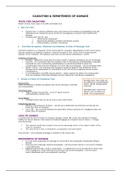
CAUSATION & REMOTENESS OF DAMAGE
TESTS FOR CAUSATION
Breach of duty must cause V to suffer actionable loss
1. But For Test
General rule = a person suffering injury must show on the balance of probabilities that the
defendants tort caused the injury: but for D’s wrongdoing, V wouldn’t have suffered the
damage
Problems with ‘But for’ test
i. “Notoriously inadequate”
ii. Apportioning between multiple contributory causes
iii. Proof problems: scientific uncertainty
2. Fairchild Exception: Material Contribution to Risk of Damage Test
Fairchild exception is a relaxation of the normal test for causation. Mesothelioma victim has to prove
that the exposure of asbestos created a “material increase in risk” of the victim contracting the
disease. To be “material”, the exposure just has to be de minimis Sienkiewicz v. Grief)
Evolution of Case Law
McGhee – sufficient to show that D’s breach made a material contribution to risk of damage
Fairchild – if C could show that one employer had, on the balance of probabilities, materially
increased his risk of contracting mesothelioma, he would be entitled to claim full
compensation from that one employer. For more than one employer – joint & severally liable
Barker v Corus – HoL said that each employer would be liable for that proportion of the
damage which represented his contribution to the risk that the employee would contract
mesothelioma
S.3 Compensation Act 2006 reverses Barker – allows claimant to obtain full compensation
from any employer (although damages may be reduced for contributory negligence)
3. Break in Chain of Causation Test
Divisble harm: harm that can
General Rule be suffered to a greater/lesser
Chain of causation is broken by positive acts tat are voluntary, informed extent. Partial compensation
and unreasonable expected
Third Party Acts: Indivisble harm: harm that
Topp v London Country Bus – act of 3rd party must be doesn’t vary in extent e.g.
unforeseeable to break chain death. Full compensation
Act of Nature
Carslogie steam ship can act as novus actus interveniens
Intervening own acts
Reeves v Commissioner of Police – suicide was a deliberate and informed act that did not
break the chain of causation
Corr v IBC – act of suicide flowing from psychiatric illness caused by D’s negligence does not
break chain of causation
LOSS OF CHANCE
V cannot claim for loss of chance of recovery (Gregg v Scott). NB: courts are reluctant to impose
liability for loss of chance in the context of medical negligence. Economic loss of chance – 2 things
must be proved:
i. The claimant would have sought to secure the advantage which is the subject matter of the
claim for valuation.
ii. The chance lost is real or substantial, as opposed to just speculative.
Once proved – court assesses damages in relation to the chance lost
REMOTENESS OF DAMAGE
D is only held responsible for damage of a kind which was reasonably foreseeable (Wagon
Mound)
Only the kind of damage need be foreseeable – not the precise manner it occurred in (Hughes
v Lord Advocate)
Eggshell skull principle. Smith v Leech Brain – C suffered burn on his lip that led to cancer due
to D’s negligence. It was held that only the burn had to be foreseeable – not the cancer
(which developed due to pre-malignant condition)
TESTS FOR CAUSATION
Breach of duty must cause V to suffer actionable loss
1. But For Test
General rule = a person suffering injury must show on the balance of probabilities that the
defendants tort caused the injury: but for D’s wrongdoing, V wouldn’t have suffered the
damage
Problems with ‘But for’ test
i. “Notoriously inadequate”
ii. Apportioning between multiple contributory causes
iii. Proof problems: scientific uncertainty
2. Fairchild Exception: Material Contribution to Risk of Damage Test
Fairchild exception is a relaxation of the normal test for causation. Mesothelioma victim has to prove
that the exposure of asbestos created a “material increase in risk” of the victim contracting the
disease. To be “material”, the exposure just has to be de minimis Sienkiewicz v. Grief)
Evolution of Case Law
McGhee – sufficient to show that D’s breach made a material contribution to risk of damage
Fairchild – if C could show that one employer had, on the balance of probabilities, materially
increased his risk of contracting mesothelioma, he would be entitled to claim full
compensation from that one employer. For more than one employer – joint & severally liable
Barker v Corus – HoL said that each employer would be liable for that proportion of the
damage which represented his contribution to the risk that the employee would contract
mesothelioma
S.3 Compensation Act 2006 reverses Barker – allows claimant to obtain full compensation
from any employer (although damages may be reduced for contributory negligence)
3. Break in Chain of Causation Test
Divisble harm: harm that can
General Rule be suffered to a greater/lesser
Chain of causation is broken by positive acts tat are voluntary, informed extent. Partial compensation
and unreasonable expected
Third Party Acts: Indivisble harm: harm that
Topp v London Country Bus – act of 3rd party must be doesn’t vary in extent e.g.
unforeseeable to break chain death. Full compensation
Act of Nature
Carslogie steam ship can act as novus actus interveniens
Intervening own acts
Reeves v Commissioner of Police – suicide was a deliberate and informed act that did not
break the chain of causation
Corr v IBC – act of suicide flowing from psychiatric illness caused by D’s negligence does not
break chain of causation
LOSS OF CHANCE
V cannot claim for loss of chance of recovery (Gregg v Scott). NB: courts are reluctant to impose
liability for loss of chance in the context of medical negligence. Economic loss of chance – 2 things
must be proved:
i. The claimant would have sought to secure the advantage which is the subject matter of the
claim for valuation.
ii. The chance lost is real or substantial, as opposed to just speculative.
Once proved – court assesses damages in relation to the chance lost
REMOTENESS OF DAMAGE
D is only held responsible for damage of a kind which was reasonably foreseeable (Wagon
Mound)
Only the kind of damage need be foreseeable – not the precise manner it occurred in (Hughes
v Lord Advocate)
Eggshell skull principle. Smith v Leech Brain – C suffered burn on his lip that led to cancer due
to D’s negligence. It was held that only the burn had to be foreseeable – not the cancer
(which developed due to pre-malignant condition)